Language


Views: 247 Author: Yuhang Power Publish Time: 2026-07-09 Origin: Site
Content Menu
● Brushless vs. Brushed: The Core Difference
● A Brief History of Brushed and Brushless Motors
>> Brushed Motors: 19th Century Workhorse
>> Brushless Motors: Powered by Electronics
● How Brushless Motors Work in Practice
● Key Performance Differences: Brushless vs. Brushed
● Where Brushed Motors Still Make Sense
● Why Brushless Motors Dominate Modern Applications
>> Violent Fans and Centrifugal Blowers
>> RC Cars and Hobby Platforms
>> Gimbal Cameras and Precision Mechanisms
>> Floor-Cleaning and Service Robots
● Real-World BLDC Power Systems: From Factory to Flight
● OEM/ODM Considerations When Choosing a BLDC Partner
>> Engineering Support and Customization
● Practical Selection Guide: When to Choose Brushless vs. Brushed
>> Choose Brushless Motors If You Need:
>> Choose Brushed Motors If You Need:
● Example Specification Table: Brushless vs. Brushed
● Call to Action: Plan Your Next Brushless Power System
● FAQ
Brushless motors have become the default choice for modern drones, RC vehicles, industrial fans, and robotics because they deliver more power, higher efficiency, and longer service life than traditional brushed motors—especially in demanding applications like ducted fan motors, UAVs, and cleaning robots. This article explains brushless vs. brushed motors in plain language, adds real-world manufacturer and user insights, and helps you choose the right motor technology for your next project or procurement decision. [wevolver]
In this guide you will learn:
- How brushed and brushless DC motors work in practical engineering terms. [monolithicpower]
- Key performance differences (efficiency, lifespan, noise, control, cost). [a-m-c]
- Application-specific insights for drones, ducted fans, gimbals, RC cars, and service robots. [wevolver]
- What OEM/ODM buyers should look for when selecting a brushless motor supplier in 2026. [overfuel]
- How a Chinese BLDC manufacturer's experience translates into better real-world performance and reliability.
For context, I write this from the perspective of an SEO-focused content strategist working closely with BLDC motor manufacturers serving global OEM/ODM projects, including applications like UAVs, FPV drones, RC cars, violent fans (high-performance centrifugal fans), camera gimbals, fixed-wing aircraft, floor-cleaning robots, and underwater ROVs. [marketveep]
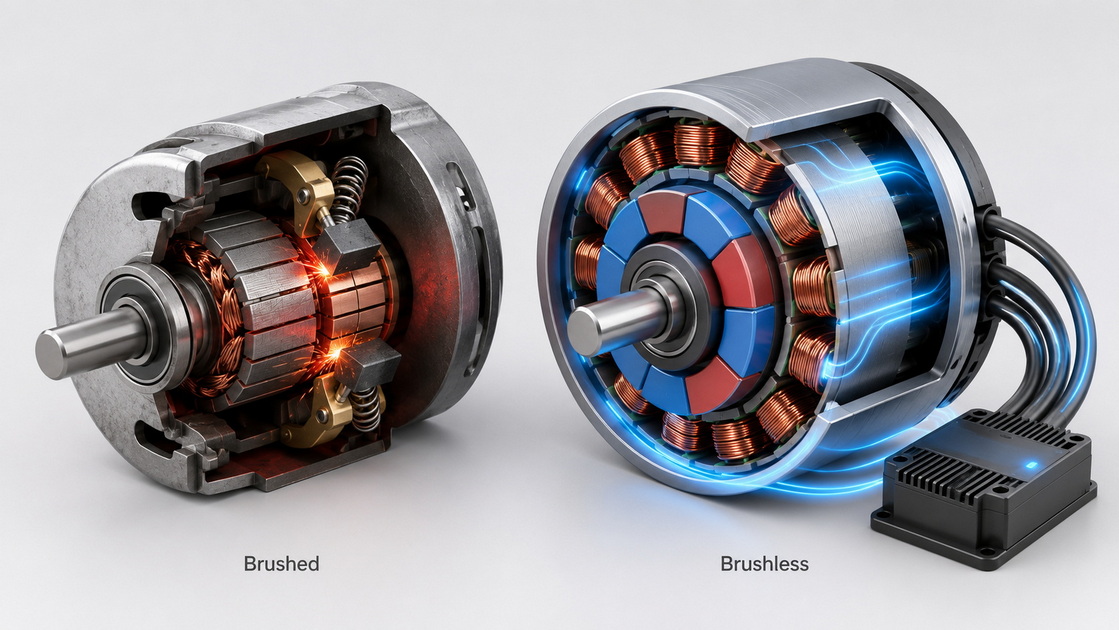
At a high level, brushed motors use mechanical brushes and a commutator to switch current, while brushless motors use electronic control and permanent magnets on the rotor, eliminating physical contact surfaces. In both cases, energized windings create a temporary magnetic field that interacts with permanent magnets to generate torque and produce rotation. [a-m-c]
Brushed motors rely on carbon brushes pressing against a copper commutator, mechanically routing current to different rotor windings as the shaft turns. This constant sliding contact introduces friction, heat, electrical noise (ESD), and wear, which limits efficiency and service life. [monolithicpower]
Brushless DC (BLDC) motors remove the brushes entirely and instead use an electronic speed controller (ESC) to commutate the motor by switching current in stator windings based on rotor position feedback. With no brush contact, BLDC motors offer higher efficiency, lower noise, and drastically longer maintenance intervals, especially under continuous or high-load operation. [wevolver]
Understanding the timeline helps explain why so many industries are now standardizing on BLDC.
Brushed DC motors have been in use since around 1856, powering applications such as electric propulsion, cranes, paper machines, and steel rolling mills. Their simple construction and low control complexity made them attractive in early industrial systems. [wevolver]
However, over time, the limitations of brushes became clear: frequent brush replacement, high electrical discharge noise (ESD), and limited speed and efficiency under demanding duty cycles (notably in aerospace and industrial applications). [a-m-c]
Brushless DC motors emerged with advances in solid-state electronics. In 1962, T.G. Wilson and P.H. Trickey described a "DC machine with solid state commutation," which is now recognized as one of the first BLDC motors. Early BLDC designs were constrained by magnet technology, so they could not initially match the power output of large brushed machines. [monolithicpower]
From the 1980s onward, improved permanent magnet materials enabled brushless motors to match or exceed the power density of brushed motors, and large-scale brushless systems followed. Today, BLDC motors dominate in computer disk drives, robotics, UAVs, and modern aircraft subsystems, thanks to their efficiency and low maintenance demands. [monolithicpower]
In a BLDC motor, the rotor carries permanent magnets and the stator houses multiple phase windings, usually arranged in three phases. An ESC monitors rotor position (via Hall sensors or sensorless back-EMF detection) and switches current between phases so that the magnetic field always leads the rotor just enough to keep it spinning. [wevolver]
Key characteristics of brushless operation include:
- Electronic commutation instead of mechanical brushes, eliminating friction and sparking. [monolithicpower]
- Higher torque per weight and torque per watt, due to optimized magnetic design and reduced losses. [wevolver]
- Fine-grained speed and torque control via ESC firmware, enabling custom acceleration curves, dynamic braking, and protection features. [a-m-c]
For ducted fan motors and centrifugal blowers, this means smooth, high-RPM operation with less vibration and better thermal behavior, directly translating into more stable airflow and longer bearing life. [monolithicpower]
To make this practical, here is a concise comparison across the factors most engineers and purchasing teams care about.
Modern analyses show that brushed motors typically operate at around 75–80% efficiency, while high-quality BLDC motors can reach 85–93% efficiency, especially in optimized designs. That efficiency gap becomes critical in battery-powered applications like UAVs and floor-cleaning robots, where every watt translates into flight time or runtime. [wevolver]
In centrifugal fans and blowers, higher efficiency means lower energy consumption and reduced heat generation, which is essential for long-term stability in enclosed housings and high-temperature environments. [monolithicpower]
Because brushed motors rely on mechanical contacts, they suffer from brush and commutator erosion, requiring periodic replacement and introducing downtime. BLDC motors, by design, have no brushes and no commutator, so there are no sliding electrical contacts to wear. [a-m-c]
This translates into:
- Significantly longer service life under continuous load.
- Reduced maintenance intervals and fewer unexpected failures.
- Better suitability for hard-to-access applications, such as UAVs, ceiling-mounted violent fans, or underwater robots where maintenance is costly. [wevolver]
Brush contact in traditional DC motors generates ionizing sparks and electrical noise, contributing to electromagnetic interference (EMI) and electrostatic discharge (ESD) issues. This is especially problematic in aerospace, high-speed communication systems, and precision sensors. [wevolver]
BLDC motors eliminate commutator sparking, dramatically reducing EMI and ESD and enabling near-silent operation, particularly valuable for camera gimbals, UAV filming platforms, and indoor service robots. [monolithicpower]
Brushed motors can be controlled by simple voltage or PWM modulation, but fine-tuned control is limited by mechanical commutation and inertia. BLDC systems, driven by an ESC, support advanced control modes such as field-oriented control (FOC), dynamic braking, soft-start, and custom throttle response curves. [a-m-c]
This enables:
- Precise speed and torque control for UAV attitude stabilization.
- Smooth startup for ducted fans, avoiding sudden current spikes and mechanical stress.
- Configurability for different payloads or operational profiles in OEM/ODM projects.
Despite their limitations, brushed motors are not obsolete. They still make sense when:
- Cost and simplicity are the top priorities, such as in low-end toys or simple consumer appliances. [a-m-c]
- The device operates intermittently with low duty cycles, making brush wear less critical. [a-m-c]
- Control requirements are basic and no ESC is desired.
In other words, if you are building a basic, low-cost product with minimal runtime, a brushed motor may still be a rational choice. However, for professional UAVs, industrial fans, cleaning robots, and underwater systems, the total cost of ownership often favors BLDC due to reduced energy consumption, fewer failures, and lower maintenance. [a-m-c]
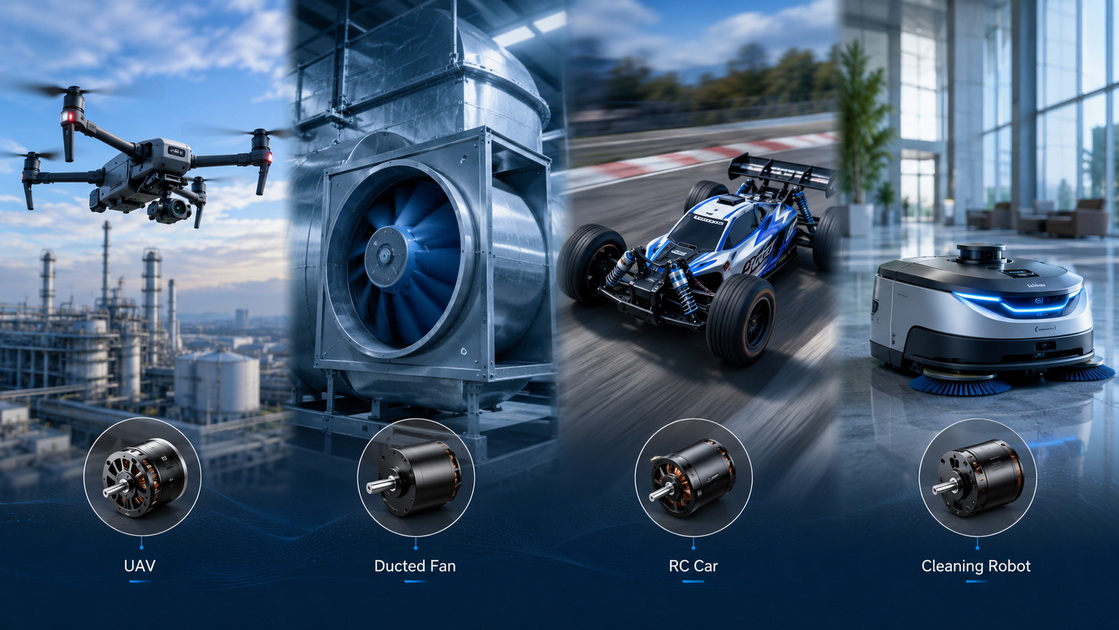
To illustrate how these trade-offs show up in real projects, consider several key application categories.
Modern UAVs and FPV crossing drones demand high thrust-to-weight ratios, precise control, and long flight times. BLDC motors deliver: [monolithicpower]
- High power density for lifting payloads such as cameras or multi-sensor arrays.
- Fast response to ESC commands for stable flight control and aggressive maneuvers.
- Reduced vibration and electrical noise, helping protect on-board electronics and improve sensor accuracy. [wevolver]
User feedback in the UAV community consistently highlights that well-designed BLDC propulsion systems can mean the difference between stable, efficient flight and frequent crashes or overheating. [monolithicpower]
In high-performance centrifugal fans and "violent fan" applications, such as industrial ventilation or ducted fan modules, BLDC motors provide:
- Smooth, high-RPM rotation with minimal vibration, critical for airflow consistency. [wevolver]
- Better thermal management, since higher efficiency means less wasted heat inside the housing.
- Longer bearing and motor life, even under continuous operation.
For ducted fan motors used in professional equipment, BLDC designs also allow tighter integration with control systems, including speed feedback, fault detection, and energy optimization. [monolithicpower]
High-performance RC cars and off-road vehicles place heavy shock and torque demands on the drivetrain. BLDC systems offer:
- Higher torque and acceleration, ideal for competitive setups.
- Consistent performance over repeated runs without significant brush wear or overheating. [a-m-c]
Brushed motors still appear in entry-level products, but serious hobbyists and pros increasingly adopt brushless combos (motor + ESC) for reliability and performance. [a-m-c]
Camera gimbals and other precision mechanisms require smooth, low-noise motion at relatively low speeds. BLDC motors, especially those optimized for gimbal use, provide: [wevolver]
- Minimal cogging and low vibration, which stabilizes footage.
- Fine-tuned torque control, important for compensating sudden motion without overshoot.
Combined with advanced ESC firmware, BLDC gimbal motors help achieve professional-grade stabilization even on compact platforms like drones or handheld rigs. [monolithicpower]
Floor-cleaning robots and service robots must operate quietly and efficiently in home or commercial environments. BLDC motors enable: [overfuel]
- Longer runtimes per charge due to higher efficiency.
- Lower noise levels, important for user comfort.
- Better durability, since many of these robots run daily for extended periods.
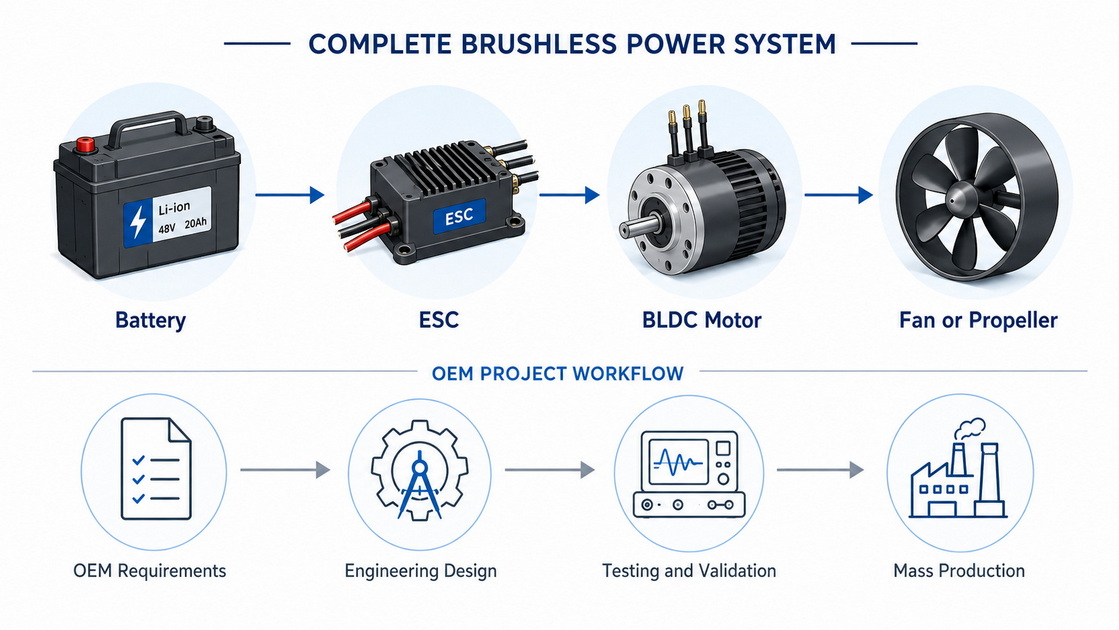
For OEMs and system integrators, it's not enough to choose between "brushless vs. brushed" on paper—you need a partner who can deliver complete, reliable power solutions, not just standalone motors. [marketveep]
Experienced BLDC manufacturers in China, particularly those focused on ducted fan motors and multi-application BLDC platforms, typically provide:
- End-to-end power system design, including motors, ESCs, propellers/fans, wiring, and matching algorithms. [overfuel]
- Application-specific tuning for UAVs, RC platforms, violent fans, gimbals, and robots.
- Customized OEM/ODM services, such as special mounting interfaces, specific Kv ratings, waterproofing, or extended temperature ranges. [marketveep]
From an operations perspective, this means shorter integration cycles, better alignment between design and real-world usage, and easier scaling across product lines.
If you are a product manager, hardware engineer, or procurement lead evaluating BLDC suppliers, focus on these criteria.
Look for manufacturers who can demonstrate:
- Proven performance data: torque-speed curves, efficiency maps, thermal tests. [wevolver]
- Application references in UAVs, RC platforms, industrial fans, or robotics similar to your use case. [overfuel]
- Integrated ESC solutions and experience with sensorless and sensored control across various load profiles. [a-m-c]
Ask for:
- Quality certifications and clear process documentation (e.g., QC steps, burn-in tests). [iodigital]
- Long-term client references or case studies demonstrating field performance.
- Support for environmental requirements, such as conformal coating, IP-rated housings, or salt-fog resistance where needed.
An effective OEM/ODM partner should offer:
- Co-design capability: joint work on shaft dimensions, mounting features, and ducting integration for fan motors.
- Firmware-level optimization: customized ESC parameters, soft-start profiles, and protective features tailored to your system. [a-m-c]
- Lifecycle support: clear roadmap for component availability, replacement, and next-generation upgrades. [marketveep]
To support both engineers and buyers, here is a practical decision framework.
- High efficiency and long runtime (e.g., UAVs, cleaning robots, underwater robots). [monolithicpower]
- Low noise and low EMI/ESD, especially near sensitive electronics. [wevolver]
- High power density, tight weight or size constraints (drones, ducted fans). [wevolver]
- Low maintenance and long service life, where access is difficult or downtime is costly. [monolithicpower]
- Ultra-low upfront cost and simple control without an ESC. [a-m-c]
- Short-duty or low-importance applications, where occasional failure is acceptable.
- A legacy-compatible design where replacing the control architecture is not feasible.
For most professional and industrial use cases in 2026, especially in BLDC fan motors and robotics, brushless is now the default choice, with brushed reserved for niche or low-end scenarios. [a-m-c]
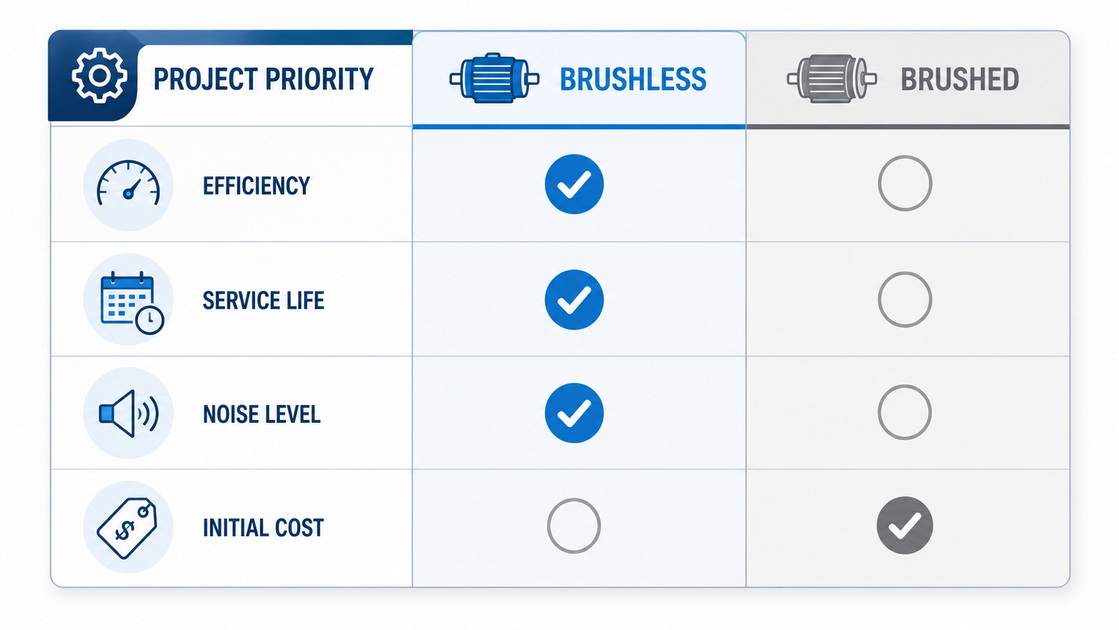
Below is a simplified comparison table to help teams quickly align on motor strategy for new projects.
| Factor | Brushless DC Motor (BLDC) | Brushed DC Motor |
|---|---|---|
| Commutation | Electronic via ESC, no brushes (monolithicpower) | Mechanical brushes + commutator |
| Typical efficiency | About 85–93% (wevolver) | About 75–80% (wevolver) |
| Maintenance | Low, no brush replacement (wevolver) | Regular brush replacement (a-m-c) |
| Noise / EMI / ESD | Very low, no sparking (wevolver) | Higher, visible sparking (wevolver) |
| Control | Advanced, ESC‑based (monolithicpower) | Basic voltage/PWM (a-m-c) |
| Cost (initial) | Higher (a-m-c) | Lower (a-m-c) |
| Total cost of ownership | Lower in pro/industrial use (wevolver) | Higher over long term (wevolver) |
If you are planning a new UAV platform, industrial ducted fan, robotics product, or customized OEM/ODM project, now is the time to standardize on high-efficiency brushless power systems.
By partnering with a specialized BLDC manufacturer that understands ducted fans, UAV propulsion, RC performance, gimbal control, and robotic drive systems, you can:
- Reduce time-to-market with pre-validated motor + ESC combinations.
- Improve reliability and customer satisfaction through optimized, application-specific designs.
- Lower total cost of ownership with energy-efficient, low-maintenance solutions. [overfuel]
For best results, prepare a clear requirements brief (operating voltage, target thrust or airflow, duty cycle, environment, size constraints), then engage with the manufacturer's engineering team to co-design the optimal brushless solution for your project. [marketveep]
1. Are brushless motors always better than brushed motors?
Not always. Brushless motors offer superior efficiency, longevity, and control, but brushed motors can still be appropriate where cost and simplicity matter more than performance or service life. [wevolver]
2. Why do brushless motors need an ESC?
BLDC motors have no mechanical commutator, so current must be electronically switched between stator phases based on rotor position, which is the job of an electronic speed controller. [monolithicpower]
3. How much efficiency gain can I expect when switching to brushless?
Typical gains are from around 75–80% efficiency with brushed motors to about 85–93% with well-designed BLDC motors, depending on the application and load profile. [wevolver]
4. Are brushless motors suitable for high-humidity or underwater environments?
Yes, but they require appropriate sealing, coatings, and materials; many underwater robots and pumps now use BLDC motors designed for these environments. [monolithicpower]
5. What data should I request from a BLDC supplier before making a decision?
Ask for torque-speed curves, efficiency maps, thermal test data, application references similar to yours, and details on their ESC compatibility and customization options. [overfuel]
1. Wevolver – "Brushless vs Brushed Motor: Engineering Trade-offs and Design Decisions."
https://www.wevolver.com/article/brushless-vs-brushed-motor-engineering-trade-offs-and-design-decisions [wevolver]
2. Monolithic Power Systems – "Brushless Vs Brushed DC Motors: When and Why to Use."
https://www.monolithicpower.com/en/learning/resources/brushless-vs-brushed-dc-motors [monolithicpower]
3. Advanced Motion Controls – "Brushed vs Brushless Motor: Key Differences, Performance."
https://www.a-m-c.com/brushed-vs-brushless-motor/ [a-m-c]
4. IO Digital – "Google E-E-A-T: Creating Content That Puts People First."
https://www.iodigital.com/en/insights/blogs/google-e-e-a-t-creating-content-that-puts-people-first [iodigital]
5. MarketVeep – "4 Best Practices for Effective Manufacturing Website Design."
https://www.marketveep.com/blog/4-best-practices-for-effective-manufacturing-website-design [marketveep]
6. Overfuel – "Key Features Every Vehicle OEM Website Should Have."
https://overfuel.com/resources/blog/key-features-every-vehicle-oem-website-should-have/ [overfuel]
7. Nautilus Marketing – "How to Write Killer Blogs: The Complete Guide to E-E-A-T."
https://nautilusmarketing.co.uk/how-write-killer-blogs-complete-guide-e-e-a-t/ [nautilusmarketing.co]


