Language


Views: 222 Author: Yuhang Power Publish Time: 2026-04-20 Origin: Site
In FPV racing, every millisecond between your stick input and what the quad actually does in the air can decide whether you win the heat or explode into a gate. As a Chinese manufacturer of FPV drone motors and complete brushless power systems, I've worked with hundreds of racing pilots and OEM partners, and one pattern is always the same: the pilots who understand their flight controller (FC) get the most out of their motors, ESCs, and frames. [instagram]
This guide combines hands‑on racing experience and engineering insight to help you choose the best flight controller for FPV racing in 2026, with a special focus on F4 vs F7 vs H7, gyro choices, compatibility, and real troubleshooting examples. [mepsking]
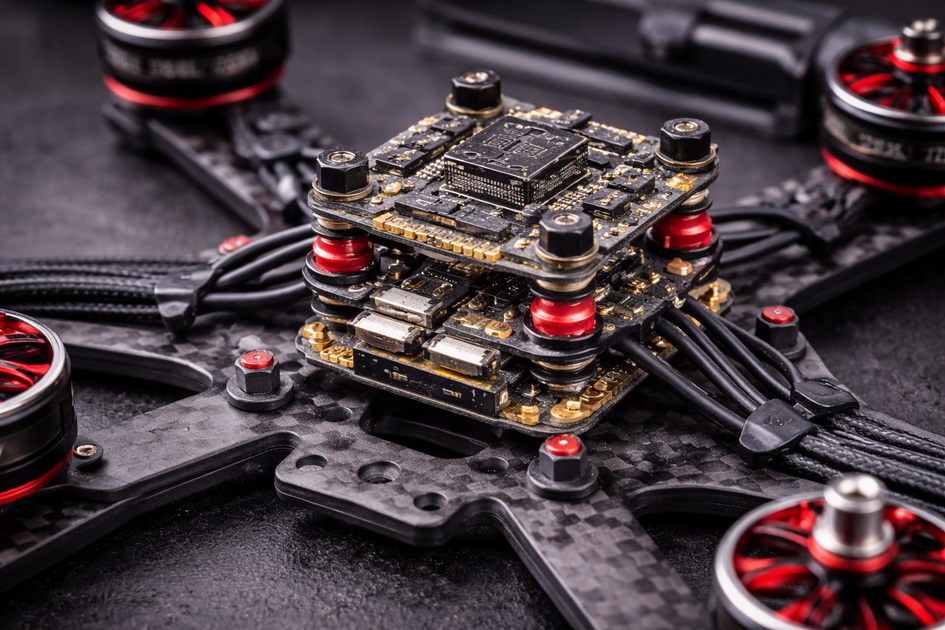
Think of your racing quad like a Formula 1 car: the FC is its onboard computer, constantly processing sensor data and adjusting motor outputs to keep you locked on the racing line.
A good racing flight controller directly affects:
- Stick feel and latency – how "connected" the quad feels to your fingers
- Stability in hard turns and dives – how well it holds attitude under high throttle
- Consistency over a full race – whether noise, heat, or vibration gradually destabilize the tune [mepsking]
For competitive FPV racing, the FC is not just another board in the stack—it's a strategic investment in control, confidence, and lap time.
Every modern racing FC includes an IMU (Inertial Measurement Unit) that combines a gyro and accelerometer.
- Gyro – measures rotation (roll, pitch, yaw)
- Accelerometer – measures linear acceleration
Since most racers fly in Acro mode, the gyro is the star; many pilots even disable the accelerometer to reduce CPU load.
Common gyro choices in FPV racing: [mepsking]
- MPU6000
- Sampling up to 8 kHz
- Excellent vibration resistance
- Very predictable flight feel
- Still a favorite on noisy, high‑power racing setups
- ICM20602
- Higher sampling rates and lower latency
- Great for high‑performance builds
- More sensitive to vibration; benefits from good soft‑mounting and stiff frames
PIDs (Proportional, Integral, Derivative) define how the FC corrects for error between your setpoint (stick command) and the gyro reading.
A racing flight controller needs:
- Sufficient CPU headroom to run:
- High PID loop frequencies
- Dynamic and gyro filtering
- Stable PID loop timing to keep the quad predictable at the edge of control
While deep PID tuning is a topic of its own, two practical rules from real race pits:
1. Underpowered FC + aggressive tune = hot motors and oscillations
2. Well‑matched FC + clean frame + solid tune = locked‑in feel, even at full throttle
That's why processor choice (F4/F7/H7) matters so much for serious racers. [mepsking]
In FPV racing, latency is everything. You want the path from thumb → radio → FC → ESC → motors to be as short and consistent as possible.
Modern F7 and H7 boards can:
- Run higher loop rates
- Handle dynamic filters and RPM filtering
- Process more data without choking
In real racing, this translates to:
- Cleaner lines through tight gates
- Less "overshoot" when you snap to a new heading
- More confidence to push closer to obstacles
The MCU (processor) on your FC largely defines how much performance headroom you have. The original article covered F4, F7, and H7; here's a deeper, race‑focused comparison. [mepsking]
| MCU Type | Typical Use In FPV Racing | Pros | Cons |
|---|---|---|---|
| F4 | Budget racing / beginner builds | Cheap, mature, widely supported | Fewer UARTs, more inversion hacks, less headroom |
| F7 | Mainstream and competitive racing | Fast CPU, more UARTs, native inversion, great value | Slightly pricier than F4 |
| H7 | Experimental / pro research / heavy setups | Massive processing power, very future‑proof | Highest price, overkill for many racers |
- Adequate for basic Betaflight setups
- May struggle if you combine:
- High looptimes
- Lots of filtering
- GPS, DJI, HD OSD, telemetry, and extras at once
Best for:
- New racers building their first budget quad
- Simple analog 5‑inch builds where price is critical
Currently the sweet spot for most serious pilots: [mepsking]
- Faster clock speed vs F4
- More UARTs for Crossfire/ELRS, GPS, VTX control, etc.
- Native inversion → fewer wiring tricks for receivers
- Comfortable running high loop rates + modern filters
Best for:
- Competitive racers who want strong performance and tuning flexibility
- Intermediate to advanced pilots who use blackbox, RPM filtering, and rich peripheral setups
H7 is the "race car with a supercomputer" approach: [mepsking]
- Very high clock speeds and memory
- Ideal for:
- Research, autonomous FPV projects
- Heavy digital stacks
- Experimental high‑rate logging
For most track racing, the jump from F7 to H7 is smaller in real‑world feel than many spec sheets suggest. [mepsking]
Best for:
- Engineers and pro teams testing next‑gen control algorithms
- Hybrid platforms (long range + racing, experimental autonomy)
The original article highlights MPU6000 and ICM20602, which are still highly relevant in 2026.
- MPU6000
- Outstanding for noisy racing frames
- Still widely trusted by top racers for its predictable feel
- ICM20602
- Supports higher sampling rates
- Better for ultra‑clean builds and advanced filtering
When we test motors and power systems for racing customers, we still see MPU6000‑equipped F7 boards as the most common "stable race stack" combination. [mepsking]
Most racing FCs use either:
- 30.5 × 30.5 mm mounting (classic 5‑inch racer stacks)
- 20 × 20 mm (compact racing or 3–4 inch builds)
For FPV racing:
- Choose a frame that matches your FC footprint
- Prefer stiff, lightweight carbon with good center‑stack protection
- Use soft‑mounting or gummies if your motors and props generate strong vibrations
Modern stacks usually pair:
- 4‑in‑1 ESCs with the FC as a plug‑and‑play stack
- Pinouts differ by brand; always confirm wiring before connecting or you risk burning your FC.
AIO FCs (board with integrated ESCs) still exist, mainly for micro builds, but 4‑in‑1 ESC + separate FC remains the dominant trend.
Common racing‑oriented firmwares:
- Betaflight – most popular, excellent GUI and tuning tools, supports a huge range of FCs
- Raceflight (FlightOne) – optimized for racing, removes non‑essential features to focus on acro performance
- KISS – closed‑source ecosystem with strong fans in the racing/freestyle community
When choosing an FC, confirm:
- It supports your preferred firmware
- The target is actively maintained (important for bug fixes and new filter features)
From a motor manufacturer's perspective, the FC is only one piece of a tightly coupled control loop with:
- Motors (KV, stator size, torque)
- ESC firmware (BLHeli_32, timing, PWM frequency)
- Power system (battery voltage, internal resistance) [yuhangmotor]
For pure racing:
1. Choose an FC (typically F7 + MPU6000) that can handle high‑RPM motor noise and aggressive filtering. [mepsking]
2. Pair it with high‑response ESCs (32‑bit, high PWM) to reduce delay between FC command and motor reaction.
3. Match your motor KV and prop size so that the FC + ESC can keep up with RPM changes without desync or oscillation.
This is exactly where a B2B partner like Zhongshan Yuhang Power Technology Co., Ltd. adds value: we can co‑design motor + ESC + FC recommendations for your OEM frames, so your customer doesn't just buy parts—they get a tested, tuned system.
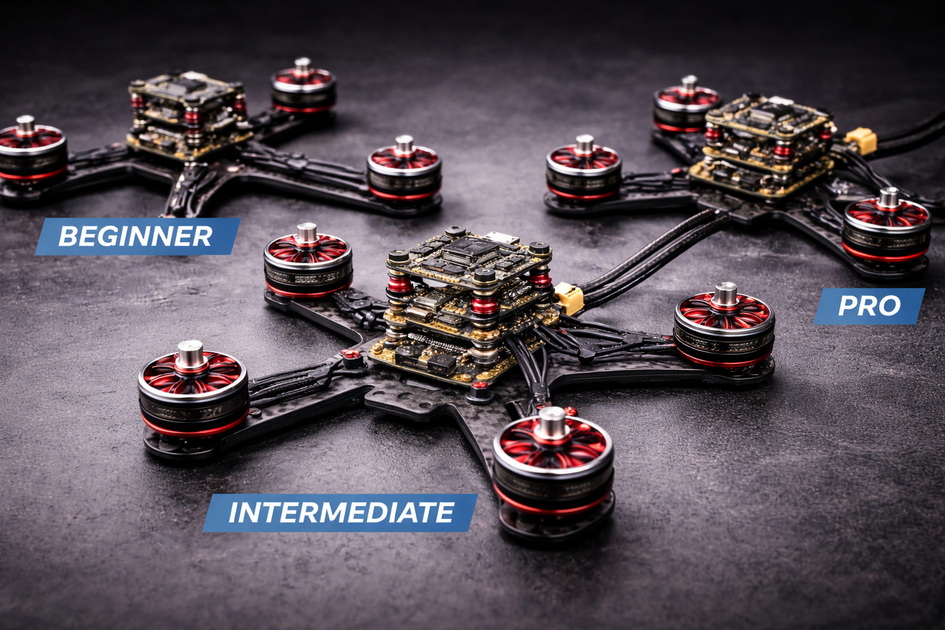
Focus on simplicity and reliability.
Recommended spec:
- F4 or F7 processor
- MPU6000 gyro
- 30.5 × 30.5 mm stack
- Betaflight support
This gives you:
- Easy community support
- Plenty of tutorials
- Enough performance to grow into real racing without immediate upgrades
You already know your way around Betaflight and blackbox.
Recommended spec:
- F7 processor
- ICM20602 or MPU6000 gyro
- Blackbox logging onboard
- Multiple UARTs (for GPS, Crossfire/ELRS, VTX control, etc.) [mepsking]
Now you can:
- Run advanced filters
- Fine‑tune stick feel for your track style
- Add telemetry and logging for race‑day analysis
You're chasing tenths of seconds and flying at the edge of what the track allows.
Recommended spec:
- F7 or H7 processor
- High‑quality gyro with excellent soft‑mounting
- Full blackbox + large flash/storage
- Strong power filtering and reliable voltage regulators
Paired with correctly spec'd motors, props, and ESCs, this kind of FC turns your quad into a precision instrument rather than just a fast toy.
FPV racing is brutal on electronics. Look for FCs that emphasize:
- Robust materials and layout – good PCB design, reinforced USB, protected corners
- Vibration damping – gummies, isolation mounts to keep gyros clean even with powerful motors
- Environmental protection – conformal coating and smart layout against moisture, dust, or grass dew
From our teardown experience, boards that survive repeated race seasons tend to have thoughtful component placement and mechanically protected IMUs, not just attractive specs on paper.
Even with the best hardware, things go wrong. Here are three common problems and how we see pilots solve them in the field.
Common causes:
- Betaflight arming flags failing (e.g., accelerometer not calibrated, failsafe conditions)
- Throttle not at zero
- Receiver signal not detected (RX protocol or mapping issue)
- Wrong firmware target flashed
Pro tip: Check the arming flags in Betaflight first; they often tell you exactly what's wrong.
Possible reasons:
- Frame vibration (bent prop, damaged motor, loose arm)
- PID too high or filters mis‑configured
- FC not properly soft‑mounted
- Incompatible stack fasteners causing mechanical stress
Our engineering team often starts by inspecting motors and props; a slightly damaged high‑KV motor easily pushes even a good gyro into noisy territory.
Symptoms:
- Betaflight shows "gyro" or "accelerometer" warning
- Quad drifts heavily or refuses to arm
Causes:
- Overheating gyro
- Soldering heat or crash damage near IMU
- Wrong target or bad firmware flash
Fixes usually involve reflashing firmware, checking 5V/3.3V rails, and in worst case, replacing the FC.
The original Mepsking article showcases several FCs that are popular in the community. Here's how they fit into the picture for racers:
- MEPS F7 Racing Flight Controller (30×30)
- STM32F722 + AT7456E OSD
- Large solder pads, logical layout → very friendly for B2B and OEM assembly lines
- Ideal for analog 5‑inch racing builds looking for durability and easy maintenance
- MEPS Mini F7 HD & Analog Flight Controller (20×20)
- STM32F722 with 6‑pin plug‑and‑play for digital HD VTX
- Excellent for compact 3–4 inch racers or freestyle rigs where weight matters
- Betaflight‑friendly and future‑proof for most racing applications
- Other referenced options like T‑Hobby F7, FlightOne MillivoltOSD, Foxeer F722 and T‑MOTOR F7 cover different niches from pure racing to mixed freestyle, but as a racing‑focused buyer, your priority should be an F7 platform with proven reliability under race conditions.
If you're a B2B buyer, FPV brand, or OEM planning a new racing drone line, choosing the right flight controller is only half the equation. The real performance comes from a matched power system – motors, ESCs, FC, and batteries working together.
As Zhongshan Yuhang Power Technology Co., Ltd., we provide:
- FPV drone motors optimized for racing, freestyle, and long‑range setups
- Complete brushless power system solutions for drones, RC cars, gimbals, aircraft, cleaning robots, and underwater robots [instagram]
- OEM / ODM services including custom KV tuning, branding, and engineering support for your next racing platform
If you need help selecting or co‑designing the best FPV racing flight controller + motor combo for your project or product line, contact our engineering team for a tailored recommendation and testing plan.
1: What is the best flight controller for FPV racing in 2026?
For most pilots, an F7 flight controller with MPU6000 or ICM20602, Betaflight support, and good blackbox logging offers the best balance of performance, price, and tuning headroom. [mepsking]
2: Is F4 still usable for FPV racing?
Yes. F4 boards are still fine for budget and beginner racing builds, but they have fewer UARTs and less processing headroom compared with F7, making them less future‑proof.
3: Do I really need an H7 flight controller for racing?
Not for most tracks. H7 is mainly for advanced or experimental setups; a well‑tuned F7 will meet the needs of the vast majority of competitive FPV racers. [mepsking]
4: Which gyro should I choose for a 5‑inch racing quad?
If your frame and motors are aggressive and noisy, pick MPU6000 for robust, predictable performance. For extremely clean builds and advanced filtering, ICM20602 can provide higher responsiveness. [mepsking]
5: How do I avoid flight controller damage in crashes?
Use frames that protect the stack, avoid overtightening screws, use soft‑mount gummies, and consider conformal coating in humid or wet environments. Regularly inspect solder joints and connectors after hard crashes.
1. Mepsking. "Choosing the Best Flight Controller for FPV Racing."https://www.mepsking.shop/blog/choosing-the-best-flight-controller-for-fpv-racing.html
2. Mepsking. "FPV Drone Flight Controllers Latest Version 2026."https://www.mepsking.shop/blog/fpv-drone-flight-controllers-explained-f1-f3-f4-f7-h7-latest-version-2024.html
3. Oscar Liang. "Flight Controller Explained: How to Choose the Best FC for FPV Drone."https://oscarliang.com/flight-controller/
4. Instructables. "Our Guide to Top Flight Controllers in 2024."https://www.instructables.com/Our-Guide-to-Top-Flight-Controllers-in-2024/
5. Zhongshan Yuhang Power Technology Co., Ltd. "Building A 5‑Inch Racing Drone Under $300 (From A Motor Manufacturer's FPV Perspective)."https://www.yuhangmotor.com/building-a-5-inch-racing-drone-under-300-from-a-motor-manufacturer-s-fpv-perspective.html
6. Zhongshan Yuhang Power Technology Co., Ltd. "Long‑Range FPV Drone Guide (2026): How I Build Reliable Setups, Choose Motors & Accessories, And Fly Safely."https://www.yuhangmotor.com/long-range-fpv-drone-guide-2026-how-i-build-reliable-setups-choose-motors-accessories-and-fly-safely


