Language


Views: 211 Author: Yuhang Power Publish Time: 2026-07-07 Origin: Site
Content Menu
● What Is KV in a Brushless Motor?
● How KV Affects Motor Speed and Torque
● How KV Is Determined (And Why Two 2306 Motors Aren't the Same)
● How to Measure KV Yourself (Advanced Users)
● High KV vs Low KV Motors in FPV
>> High KV vs Low KV at a Glance
● Why Bigger FPV Motors Usually Have Lower KV
● KV and Torque Constant: Efficiency Behind the Scenes
● Matching KV to Drone Type and Flying Style
>> Cinematic Freestyle and Cinewhoops
>> Tiny Whoops and Micro Drones
● Practical KV Recommendations for Common Setups
>> Quick KV Ranges by Pack and Prop
● Prop Size, Battery Voltage, and KV: The Core Matching Rules
● Real‑World Misconceptions About KV
● How to Choose the Right KV for Your FPV Build
● FAQ
KV in FPV motors is the single spec that quietly decides whether your drone feels locked‑in and efficient or hot, noisy, and underperforming. As someone who has burned more than a few motors in early FPV builds, I learned the hard way that understanding KV—and matching it to prop size, battery, and flying style—is what separates guesswork from professional‑grade power system design. [hammermissions]
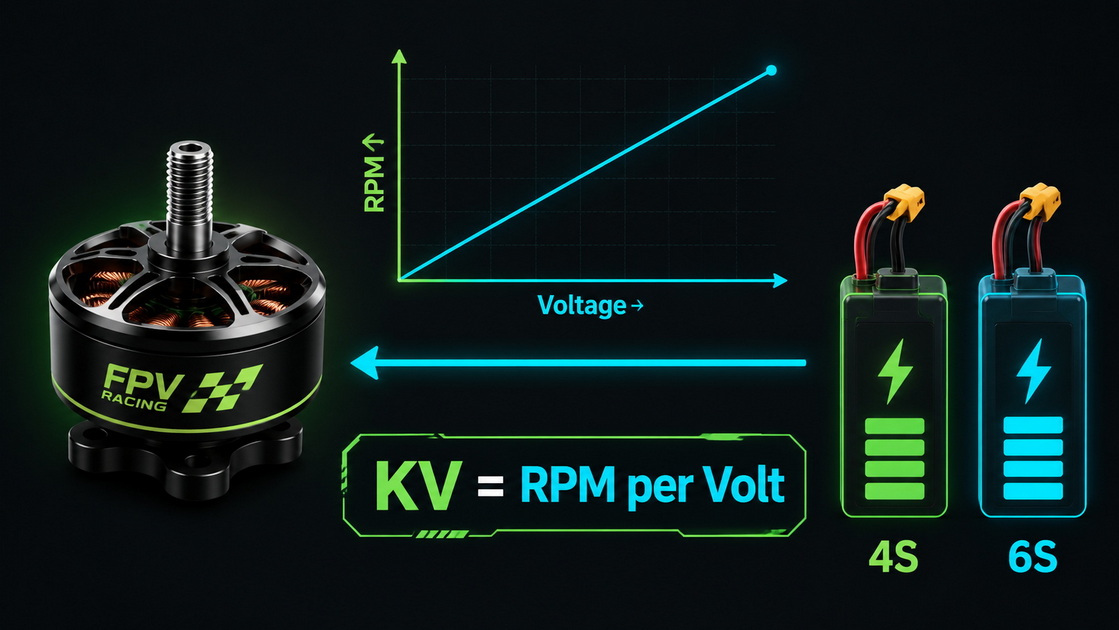
In plain terms, KV tells you how many revolutions per minute (RPM) a motor will spin per volt with no load attached. It is a speed constant, not a power rating. [hammermissions]
- A 2300 KV FPV motor on a fully charged 3S LiPo (12.6 V) will spin at about \( 2300 × 12.6 ≈ 28,980 \) RPM with no prop installed. [hammermissions]
- A 1700 KV motor on the same voltage spins slower, but usually delivers more usable torque under load. [hammermissions]
From an FPV pilot's perspective, KV directly shapes:
- Throttle feel and responsiveness
- Heat generation and efficiency
- Which battery voltage and propeller size you should run [hammermissions]
Key idea: KV is fixed by the motor's design and does not change in flight, even though real RPM drops when you mount a propeller and add load. [hammermissions]
The basic relationship between KV, voltage, and no‑load speed is:
Motor Speed (RPM)=KV×Voltage (V)
For example, with a 2300 KV motor on 12.6 V, theoretical no‑load speed is 28,980 RPM. [hammermissions]
What this means in practice:
- Higher KV → higher RPM → lower torque per amp
- Lower KV → lower RPM → higher torque per amp and better efficiency at the same thrust level [hammermissions]
Of course, this is theoretical. Once you add:
- Propeller drag
- Air resistance
- Frame and payload weight
the actual RPM will be lower, but KV remains a reliable guide to how the motor behaves in a given setup. [hammermissions]
KV is baked into the motor by its physical design. [hammermissions]
Main factors:
- Number of stator windings (more turns → lower KV; fewer turns → higher KV)
- Magnet strength and material
- Core material, air gap, and overall construction quality [hammermissions]
This is why two 2306 motors from different brands can have completely different KV ratings and behavior, even though the size number is identical. [hammermissions]
The theoretical formula is:
KV=RPM/Voltage
So if a motor spins at 22,000 RPM on 11 V with no prop, its KV is roughly 2000 KV. [hammermissions]
Practical note: Most pilots never calculate KV themselves—they trust the manufacturer specs unless they are testing custom or unmarked motors. [hammermissions]
If you are tuning or validating custom motors, you can measure KV in your workshop. [hammermissions]
1. Remove the propeller – this is critical for safety.
2. Power the motor with a known voltage.
3. Measure unloaded RPM using ESC telemetry or an optical tachometer.
4. Divide RPM by voltage to get KV. [hammermissions]
Example:
- 18,500 RPM at 7.4 V
- KV ≈ 18,500 ÷ 7.4 ≈ 2500 KV [hammermissions]
This is mainly useful for:
- Checking that motors match their advertised KV
- Characterizing unknown motors
- Engineering one‑off power systems
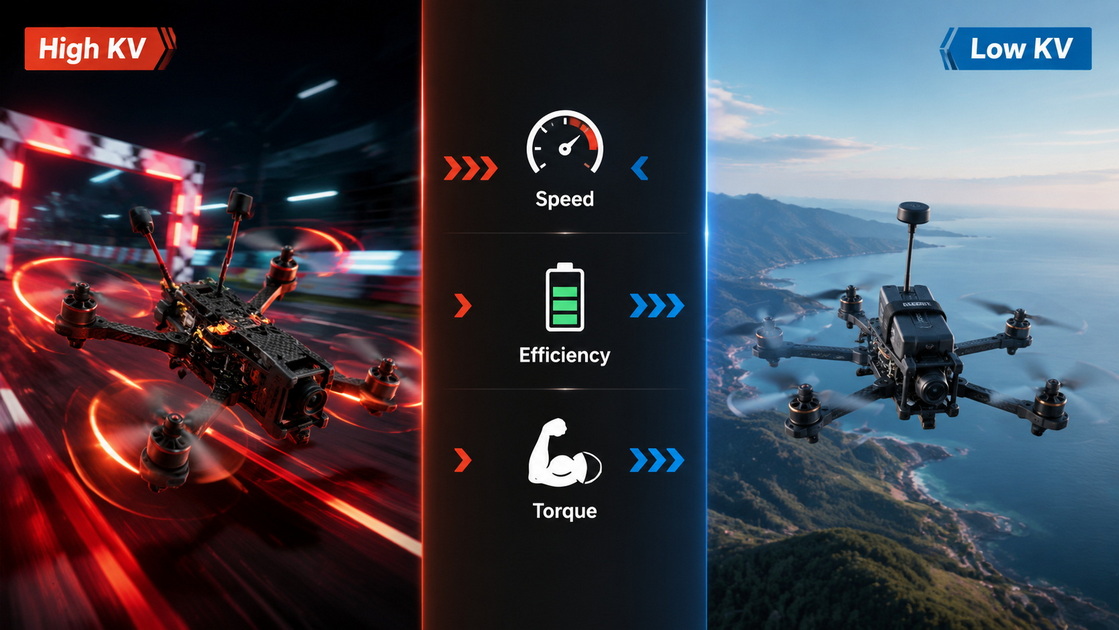
Once you understand KV as a speed constant, the real question becomes: should you choose high KV or low KV? Each comes with clear trade‑offs. [hammermissions]
| Feature | High KV motor | Low KV motor |
|---|---|---|
| RPM | Higher (faster rotation) (hammermissions) | Lower (slower rotation) (hammermissions) |
| Torque | Lower torque (hammermissions) | Higher torque (hammermissions) |
| Efficiency with large props | Lower efficiency (hammermissions) | Higher efficiency (hammermissions) |
| Battery usage | Higher current draw (hammermissions) | Lower current draw (hammermissions) |
| Best for | Racing, tight freestyle, acro (hammermissions) | Long range, cinematic, payload (hammermissions) |
Rule of thumb from real builds: If I'm racing a light 5‑inch quad, I'm comfortable pushing into 2400–2700 KV on 4S; if I'm flying long‑range mountains on 7‑inch, I deliberately stay in the 1200–1500 KV bracket on 6S to keep amps down and packs cool. [hammermissions]
If you look across motor lines, you'll notice a consistent pattern: as motor size and prop size go up, KV tends to come down. [hammermissions]
Typical examples: [hammermissions]
| Motor size | Typical KV |
|---|---|
| 0802 Tiny Whoop | 19,000 KV |
| 1404 Micro | 4,500 KV |
| 2207 Freestyle | 1,750 KV |
| 2806.5 Long Range | 1,300 KV |
Reason: big motors are designed to spin larger propellers, which create much more aerodynamic resistance and generate a lot of thrust even at moderate RPM. [hammermissions]
So:
- Small motors + small props → need high KV to get enough RPM.
- Large motors + big props → prefer low KV for torque and efficiency. [hammermissions]
You can think of KV like gear ratio in a car:
- High KV = low gear, high revs, huge response, low efficiency at cruise.
- Low KV = high gear, more torque, lower revs, excellent for long‑distance cruising or carrying a camera. [hammermissions]
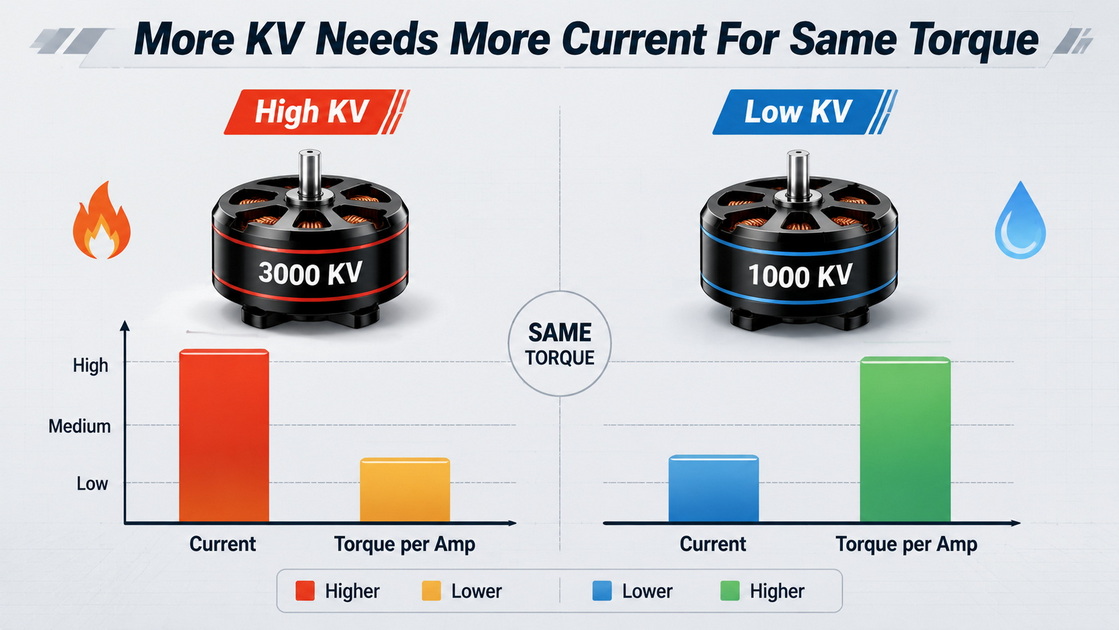
A common misunderstanding is "higher KV = more torque." In reality, the opposite is usually true in FPV operating ranges. [hammermissions]
- The amount of current needed to generate a given torque is determined by the motor's torque constant, which is inversely related to KV.
- Higher KV motors need more current to produce the same torque as a lower KV version, which increases losses in the battery, ESC, and wiring and produces more heat. [hammermissions]
In practice:
- If you match thrust requirements and fly both setups at the same speed, the higher KV setup will often be less efficient and run hotter than the lower KV equivalent. [hammermissions]
- For long‑range rigs, it is almost always wiser to avoid excessive KV, prioritize efficiency, and keep temps under control. [hammermissions]
A useful summary from real‑world data: [hammermissions]
| rating | Thrust | Efficiency | Torque | Heat generation | Application |
|---|---|---|---|---|---|
| Low KV (1000–1600) | Medium | High | High | Low | Long‑range / Cinewhoop |
| Mid KV (1700–2300) | Balanced | Balanced | Balanced | Medium | Freestyle / General FPV |
| High KV (2400–2700+) | High | Low | Low | High | Racing / Lightweight builds |
Where KV really shines is when you stop looking at it in isolation and start pairing it with frame size, prop, and battery. [hammermissions]
- Typical motors: 2300–2800 KV on 2205, 2207, 2306 stators [hammermissions]
- Common batteries: 4S; some racers move to 6S with lower KV (1900–2100 KV) [hammermissions]
- Goal: maximum agility and instant throttle response
High KV here spins 5‑inch props at very high RPM, giving explosive acceleration at the cost of shorter flight time and higher battery stress. [hammermissions]
Example: A 2306 2400 KV motor on 4S with 5‑inch props can push competitive race builds beyond 150 km/h in the right setup. [hammermissions]
- Typical motors: 1500–2300 KV, usually on 3–5 inch props [hammermissions]
- Batteries: 4S–6S depending on weight and camera payload [hammermissions]
- Goal: smooth footage, predictable throttle, enough torque to carry GoPro‑class cameras
Cinewhoops have ducts that add drag, so they benefit from lower KV with higher torque, often on 6S, to keep flight smooth and controlled. [hammermissions]
Example: A 2004 1700 KV motor on 6S is a popular cinewhoop choice for lifting a GoPro Hero while still maintaining 5–7 minutes of usable flight time. [hammermissions]
- Typical motors: 1000–1800 KV on 7–8 inch builds [hammermissions]
- Batteries: 6S–7S for endurance and efficiency
- Goal: 20–40 minutes of stable cruising and safe return margins [hammermissions]
These builds prioritize:
- Low amp draw at cruise
- Cool running motors and ESCs
- Stable response at mid‑throttle [hammermissions]
Example: A 2807 1300 KV motor on 7S with 8‑inch props balances thrust and efficiency, keeping amp draw manageable over long missions. [hammermissions]
- Motors: 15,000–20,000 KV
- Battery: 1S (sometimes 2S for "toothpick" builds) [hammermissions]
- Goal: ultra‑agile indoor flying, safe proximity, fun freestyle
With 31–40 mm props and low voltage, very high KV is necessary to generate enough RPM for responsive flight. [hammermissions]
Example: An 0802 19,000 KV motor on 1S is a typical 65 mm whoop setup that delivers snappy throttle indoors. [hammermissions]
To move from theory into practical build planning, it helps to anchor KV to battery and prop size. [hammermissions]
| Battery type | Prop size | Recommended KV range | Typical use |
|---|---|---|---|
| 4S (14.8 V) | 5 inch | 2300–2700 KV | Freestyle / Racing (hammermissions) |
| 6S (22.2 V) | 5 inch | 1600–1900 KV | Freestyle / Long‑range (hammermissions) |
| 6S (22.2 V) | 7 inch | 1100–1500 KV | Long‑range / Efficiency (hammermissions) |
| 4S (14.8 V) | 3 inch | 3000–4000 KV | Toothpick / Micro freestyle (hammermissions) |
| 3S (11.1 V) | 2.5 inch | 3500–5000 KV | Ultralight micros (hammermissions) |
And typical choices for a 5‑inch FPV quad: [hammermissions]
| Battery | Motor KV | Prop size | Use case |
|---|---|---|---|
| 4S | 2300–2700 KV | 5 inch | Freestyle / Racing (hammermissions) |
| 6S | 1600–1900 KV | 5 inch | Long‑range / Cinematic (hammermissions) |
For 6S 5‑inch builds, testing data shows:
- Around 1750 KV favors cooler running and more distance‑oriented flying.
- Around 1950 KV delivers higher peak thrust for heavy payloads, at the expense of more current and heat. [hammermissions]
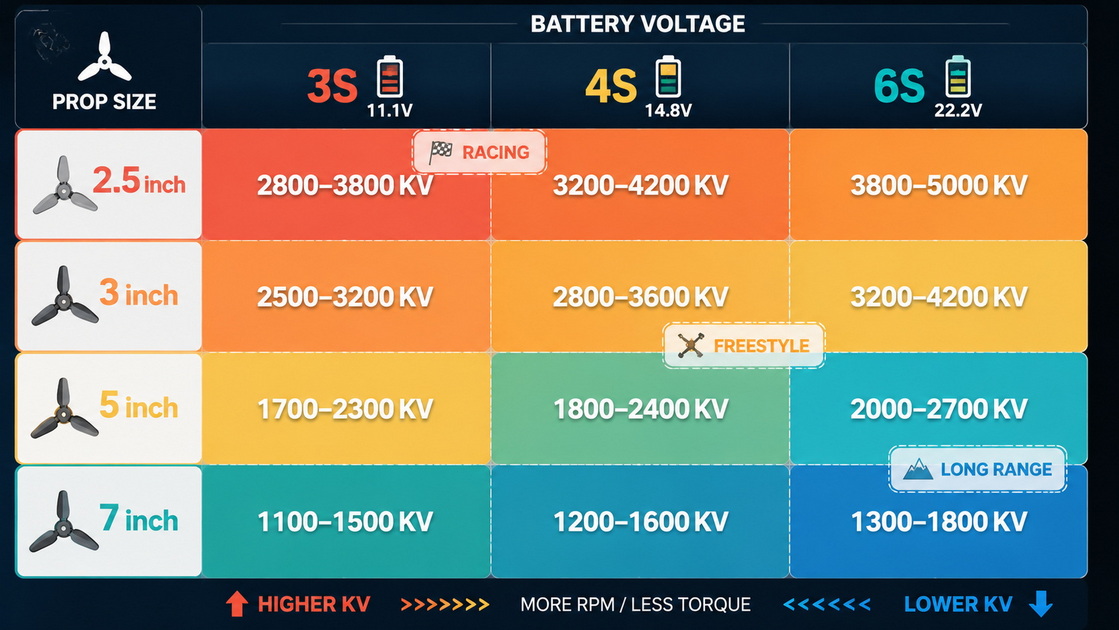
From both lab data and field experience, two core rules keep your builds safe and efficient: [hammermissions]
1. Bigger props → lower KV
- 6–7 inch props on 6S should rarely be paired with high KV.
- Trying to spin a large prop on a high KV motor risks overheating, ESC stress, and premature failure. [hammermissions]
2. Higher voltage → lower KV
- Moving from 4S to 6S, you typically drop KV significantly while keeping similar top speed.
- The benefit is lower current for the same power, which reduces heat and improves efficiency when tuned correctly. [hammermissions]
A simple mental model:
- High KV + small prop + low–mid voltage→ racing and aggressive freestyle
- Low KV + big prop + high voltage → long range, cinematic, and payload work [hammermissions]
Even among experienced pilots, some myths keep coming back. [hammermissions]
1. "Higher KV is always better."
Higher KV can increase top speed but usually at the cost of flight time, heat, and sometimes controllability—especially on heavier builds or large props. [hammermissions]
2. "KV tells you how good a motor is."
KV is just a constant. Real quality lives in bearing choice, magnet grade, balancing, stator lamination, and manufacturing tolerances. [hammermissions]
3. "Low KV motors are weak."
Low KV motors often deliver more torque and better efficiency, making them ideal for long‑range, heavy payloads, and cinematic flying where stability matters more than instant punch‑outs. [hammermissions]
4. "KV doesn't affect flight time much."
In practice, high KV (2400+) can drain packs up to 30% faster than well‑chosen low‑KV long‑range setups on comparable frames, simply because of higher current draw at similar thrust levels. [hammermissions]
When I help newer pilots or customers choose KV, we always walk through the same three‑step framework:
1. Define your flying style.
- Racing? Focus on high KV ranges for your battery/prop combo.
- Freestyle? Aim for mid KV with a balance of torque and response.
- Long range / cinematic? Choose lower KV and larger props. [hammermissions]
2. Fix your battery and prop.
Many pilots already own a stack of 4S or 6S packs and a preferred frame. Lock those in first, then map KV around them using the ranges above. [hammermissions]
3. Check motor size and ESC limits.
Larger stators (2207, 2306.5, 2806.5, etc.) can handle more torque and current, but you still need to ensure your ESC and battery can safely support peak amp draw at your chosen KV. [hammermissions]
1: What does a 1000 KV motor actually mean?
A 1000 KV motor will theoretically spin at 1000 RPM for every volt supplied with no load. On a 10 V pack, that works out to about 10,000 RPM without a prop attached. [hammermissions]
2: Is higher KV always better for drone racing?
Not always. On 4S 5‑inch builds, many successful race pilots sit in the 2400–2700 KV range; on 6S, they often drop to around 1900–2100 KV to avoid thermal and efficiency penalties while maintaining speed. [hammermissions]
3: How do I pick KV for freestyle FPV?
For 5‑inch freestyle, a good starting point is about 2300–2500 KV on 4S or 1700–1900 KV on 6S, paired with typical 5‑inch props. This keeps a balance between punch and mid‑throttle smoothness. [hammermissions]
4: Does KV change during flight?
No. KV is a design constant determined by windings and magnet configuration. Only RPM changes with throttle, voltage sag, and prop load; the KV rating itself stays fixed. [hammermissions]
5: Can I use the same KV for 4S and 6S by just changing props?
You can compensate a bit with smaller props on higher voltage, but it is rarely ideal. A motor optimized for 4S KV ranges may run hot or inefficient on 6S, even with smaller props, and vice versa. It's better to choose KV specifically for your primary voltage and prop size. [hammermissions]
1. MEPSKING. "What is KV in Motor: A Beginner's Guide to FPV Motor Ratings." "MEPSKING Blog". [hammermissions]
2. Boostability. "Google E‑E‑A‑T (2024 Ultimate Guide)." "Boostability". [boostability]
3. Momentic Marketing. "EEAT & SEO: How to Make Your Content More Helpful." "Momentic". [momenticmarketing]
4. Stellar Content. "The Complete Guide to Google E‑E‑A‑T: How to Improve SEO." "Stellar Content". [stellarcontent]
5. Connor Gillivan. "How to Optimize Blog Content for SEO." "LinkedIn Post". [linkedin]


