Language


Views: 222 Author: Yuhang Power Publish Time: 2026-05-26 Origin: Site
As an engineer working with FPV drone motors and other brushless power systems, I have seen firsthand how the right torque motor can transform a design—from ultra‑smooth gimbals to high‑precision robotics and compact industrial equipment. This guide explains how torque motors work, why frameless designs matter, and how to choose between inrunner and outrunner torque motors for applications such as FPV drones, gimbals, robots, AGVs and more. [hammermissions]
A torque motor is a type of brushless electric motor designed to deliver high continuous torque at low speeds, often in a direct‑drive configuration without gearboxes. Instead of focusing on very high RPM, torque motors prioritize smooth, controllable rotational force and precise positioning. [hammermissions]
In practical engineering projects, I use torque motors when I need:
- High torque at low or zero speed (direct drive).
- Very smooth motion with minimal cogging and vibration.
- Precise positioning and repeatability, often with encoders.
- Compact, integrated mechanisms without bulky gearboxes.
Typical torque motor applications include:
- FPV camera gimbals and stabilizers.
- Collaborative robots and industrial automation.
- Medical devices and imaging systems.
- Machine tools, rotary tables and indexing systems.
- AGVs, AMRs and mobile robots.
- High‑end drones and inspection platforms. [serpsgrowth]
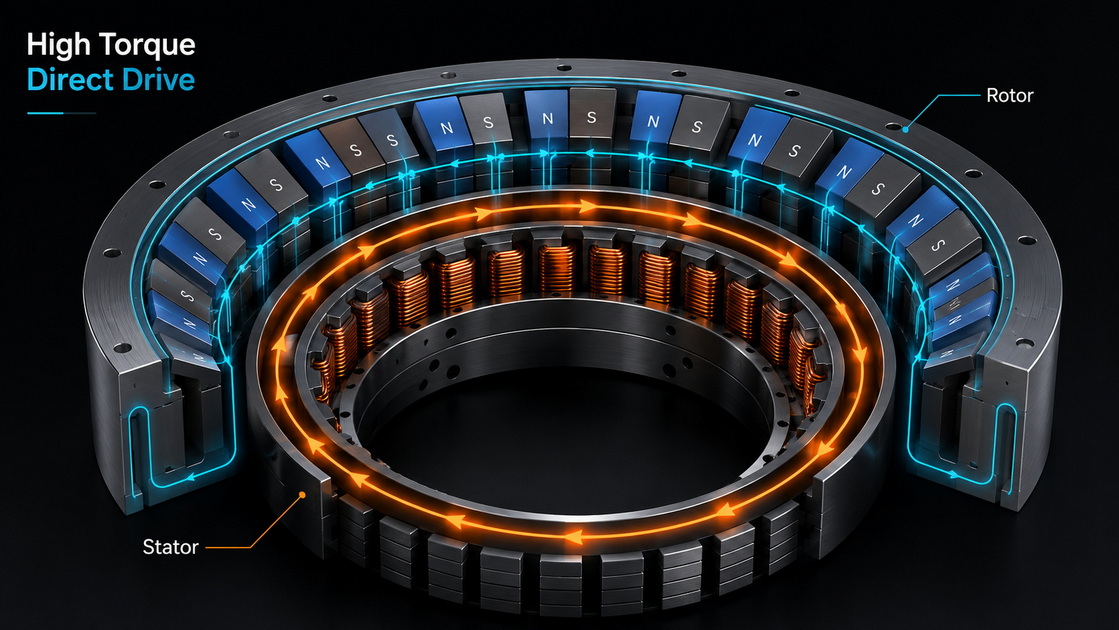
At its core, a torque motor operates on electromagnetic interaction between a stator and a rotor. [hammermissions]
- Stator: The stationary part with copper windings (electromagnets) arranged in a circular pattern. [hammermissions]
- Rotor: The rotating part, typically equipped with permanent magnets or, in some designs, additional windings. [hammermissions]
When current flows through the stator windings, it generates a magnetic field that interacts with the rotor magnets, creating torque—the rotational force that turns the rotor. [hammermissions]
By adjusting the current in the stator windings, the motor controller directly regulates the output torque. Voltage and control algorithms then determine the speed. In a high‑quality torque motor system: [hammermissions]
- Torque is roughly proportional to current.
- Speed is controlled via voltage and commutation strategy.
- Closed‑loop feedback with encoders or resolvers provides precise position and velocity control.
Because torque motors are optimized for direct drive, they can deliver:
- High torque at very low speeds.
- Excellent responsiveness without backlash.
- Quiet and smooth operation, ideal for sensitive equipment. [hammermissions]
A frameless torque motor is essentially a "motor kit" consisting only of the rotor and stator, supplied without a traditional housing or shaft. The OEM or integrator builds these components directly into the machine structure. [hammermissions]
In my projects, I recommend frameless torque motors when:
- Space is limited and every millimeter matters.
- Weight reduction is critical (e.g., drones, robotic arms, medical devices).
- The mechanical structure can serve as the motor housing.
- Higher integration and compactness: The motor becomes part of the mechanism instead of an external add‑on. [hammermissions]
- Lower inertia: Reduced rotating mass improves acceleration and dynamic response. [hammermissions]
- Higher torque density: More torque in a smaller package, ideal for lightweight systems. [hammermissions]
- Design flexibility: Custom diameters, lengths, and mounting interfaces are easier to implement than with fully housed motors. [hammermissions]
Frameless torque motors are widely used in robotics, aerospace, medical devices, and advanced automation where performance, cleanliness and size are critical. [hammermissions]
When engineers talk about torque motors, a common question is: Should I choose an inrunner or an outrunner design? The key difference lies in the rotor's location relative to the stator. [hammermissions]
- Frameless Inrunner Torque Motor
The rotor is on the inside, rotating within the stator. [hammermissions]
- Frameless Outrunner Torque Motor
The rotor is on the outside, rotating around the stator. [hammermissions]
- In an outrunner, the larger rotor diameter allows for higher torque at a given motor length because torque is proportional to force times radius. [hammermissions]
- In an inrunner, the design is generally more compact with lower rotor inertia, which can offer faster acceleration and deceleration. [hammermissions]
- Outrunner torque motors
- Often mounted via a flange or shaft connected to the rotating outer shell. [hammermissions]
- Preferred when you need significant torque at lower speeds, as in heavy machinery, AGVs, or large‑diameter gimbal axes. [hammermissions]
- Inrunner frameless torque motors
- Integrated directly into the customer's mechanical structure—such as robot joints, medical systems or compact rotary tables. [hammermissions]
- Ideal where size, weight and responsiveness dominate the design requirements. [hammermissions]
Ultimately, the choice between an inrunner and outrunner torque motor depends on:
- Required torque and speed.
- Available space and system diameter.
- Inertia and dynamic response targets.
- Mounting and integration constraints. [hammermissions]

From a practical perspective, here is how I guide teams choosing between torque motor types.
- Requirements: High positional accuracy, low backlash, compact form factor.
- Recommended: Frameless inrunner torque motor integrated into the joint, paired with a high‑resolution encoder.
- Reason: Lower inertia and compact design help achieve fast, precise motion with minimal overshoot. [hammermissions]
- Requirements: High torque at low speed, smooth rotation, large aperture or large mounting diameter.
- Recommended: Frameless outrunner torque motor with a large rotor diameter.
- Reason: The larger radius delivers high torque for smooth, direct‑drive motion without bulky gearboxes. [hammermissions]
- Requirements: Lightweight, low vibration, high stability, and fine control of camera angles.
- Recommended: Lightweight frameless torque motors (often inrunner) integrated directly into the gimbal axes with advanced control firmware.
- Reason: Direct‑drive torque motors reduce backlash and noise, improving image quality and stabilization performance. [hammermissions]
While FPV drone builders may be more familiar with standard BLDC outrunner motors, torque motors have distinct characteristics.
| Feature | Conventional BLDC Motor (FPV‑style) | Frameless Torque Motor |
|---|---|---|
| Primary design goal | High RPM and power | High torque, low speed, direct drive |
| Typical use | Propulsion for drones, RC vehicles | Gimbals, robotics, automation, medical devices |
| Gearbox requirement | Often needed for high torque drives | Often used without gearbox |
| Integration style | Housed motor with shaft | Rotor and stator integrated into mechanism |
| Positional accuracy | Moderate | High, especially with encoder feedback |
| Torque at zero speed | Limited in standard use | Designed for continuous torque at low / zero RPM |
This distinction is essential when designing complete power system solutions for drones, robots, or professional equipment: use conventional BLDC for propulsion and torque motors where precision torque and positioning are critical. [hammermissions]
Based on real projects in drones, robots, and industrial machines, here are actionable guidelines for integrating frameless torque motors.
- Define shaft diameters, bearing positions and structure stiffness before finalizing the motor. [hammermissions]
- Make sure the surrounding structure can efficiently dissipate heat from the stator for continuous torque performance.
- Calculate required continuous and peak torque based on load inertia, target acceleration, friction, and duty cycle.
- Choose a motor with a comfortable margin—this improves reliability and temperature behavior.
- Integrate encoders or resolvers as close as possible to the output axis for accurate control.
- Use a high‑quality motor controller that supports field‑oriented control (FOC) for smooth, efficient operation.
- Design cable routing and connectors early to avoid EMI issues and mechanical interference.
- Ensure that rotor installation procedures are clearly defined because strong magnets can pose assembly risks if mishandled.
Recent trends in industrial automation, medical devices, and service robotics favor direct‑drive torque motors because they improve both performance and reliability. [linkedin]
- Eliminating gearboxes and belts reduces mechanical backlash, noise, and wear.
- Fewer components mean lower maintenance costs and less downtime over the life of the machine.
- Low inertia and direct‑drive architectures enable fast acceleration and deceleration, supporting complex motion profiles and high‑speed positioning.
- Applications such as pick‑and‑place robots, semiconductor equipment, and advanced imaging systems benefit from shorter cycle times and higher throughput. [hammermissions]
- Direct‑drive torque motors paired with high‑resolution encoders deliver excellent repeatability and control, even at very low speeds. [hammermissions]
- This is critical in inspection systems, laser processing, and automated assembly where micrometer‑level movements matter.
For manufacturers of FPV drones, UAVs and UGVs, torque motors are not just for lab equipment—they are increasingly used in field‑ready platforms. [serpsgrowth]
- Camera gimbals using frameless torque motors provide superior stabilization compared with geared solutions, improving image clarity in windy or high‑speed flight conditions. [hammermissions]
- LiDAR, radar and multi‑sensor payloads benefit from smoother scanning motion and reduced vibration, which directly improves data quality.
- Autonomous ground vehicles, inspection robots and underwater robots use torque motors in wheel hubs, joints and manipulators.
- Frameless torque motors allow designers to hide the motors inside structural elements, improving protection against dust, water and impact.
- Direct‑drive torque motors produce less mechanical noise than geared systems, which is valuable for surveillance drones, indoor inspection robots, and medical platforms.
- Reduced vibration also lowers the risk of sensor drift and hardware fatigue.

When specifying a torque motor for your project, I recommend focusing on the following parameters:
1. Continuous Torque and Peak Torque
- Ensure the continuous torque rating covers your typical operating conditions.
- Check that peak torque is sufficient for short‑term acceleration and shock loads.
2. Speed Range
- Define maximum speed in RPM and confirm that the motor can deliver the required torque at that speed without overheating.
3. Motor Diameter and Length
- For frameless motors, outer and inner diameters must match your mechanical design.
- Larger diameters generally provide higher torque for the same axial length.
4. Thermal Management
- Evaluate mounting surfaces and possible cooling methods (natural convection, forced air, or liquid cooling).
- Overheating reduces motor life and can degrade magnets and insulation.
5. Control and Feedback Compatibility
- Confirm that your drive electronics support the motor's electrical characteristics (voltage, current, number of pole pairs).
- Integrate encoder or resolver interfaces that match your control system.

In the torque motor market, frameless inrunner series and frameless outrunner series are widely recognized by industrial and robotics customers for their compact size, torque density and integration flexibility. The inrunner series typically targets applications like collaborative robots, gimbals, and precision stages, while outrunner series are preferred in applications needing larger diameters and higher torque, such as rotary tables and heavy‑duty positioning systems. [hammermissions]
When evaluating suppliers, engineers often look at:
- Field track record in robotics, UAV, AGV and industrial sectors.
- Technical support for OEM and ODM customization (custom windings, diameters, mounting features).
- Available documentation, integration guides and sample projects.
If you are designing FPV drones, gimbals, robots, AGVs, medical systems or industrial automation equipment and need high‑torque, low‑speed, direct‑drive performance, a frameless torque motor is often the most efficient solution. [hammermissions]
Define your basic requirements—torque, speed, diameter, voltage and duty cycle—and share your project details with a specialized torque motor manufacturer. An experienced engineering team can help you:
- Select the right inrunner or outrunner frameless torque motor.
- Optimize winding, diameter and length for your mechanical concept.
- Integrate encoders, drivers and complete motion systems tailored to your application.
1. What is the main advantage of a torque motor compared with a geared motor?
The main advantage is direct‑drive performance: torque motors deliver high torque at low speeds without gearboxes, which reduces backlash, noise, and maintenance while improving precision and responsiveness. [hammermissions]
2. Are torque motors suitable for continuous 24/7 operation?
Yes, as long as the continuous torque rating is respected and the motor is properly cooled, torque motors can operate continuously in industrial environments, machine tools, and robotics. [hammermissions]
3. Can I use a torque motor in a standard FPV drone propulsion system?
Most FPV drones use high‑RPM BLDC motors optimized for propellers, while torque motors are designed for low‑speed, high‑torque actuation (e.g., gimbals, joints, rotary axes). Using a torque motor as a main propulsion motor is usually not efficient. [hammermissions]
4. How do I choose between an inrunner and an outrunner torque motor?
Choose an outrunner if you need higher torque from a larger diameter and space is available; choose an inrunner if you need a compact, low‑inertia design integrated into tight mechanisms such as robot joints or medical systems. [hammermissions]
5. What control electronics do torque motors require?
Torque motors typically use brushless servo drives or advanced BLDC controllers with field‑oriented control (FOC), combined with encoders or resolvers for precise feedback and closed‑loop positioning. [hammermissions]
1. CubeMars. "Torque motor, How does it work?"[hammermissions]
2. Hammer Missions. "SEO Tips for Drone Operators."[hammermissions]
3. Oneupweb. "How to Optimize Your Product Pages for More Sales."[oneupweb]
4. Fylje (LinkedIn). "Using Technical Writing to Ensure Compliance with Industry Regulations and Standards."[linkedin]
5. Serps Growth. "Top Marketing Strategies for Drone Companies to Thrive."[serpsgrowth]
6. Promptitude. "Boost Your Writing: 5 Prompts Every Technical Writer Should Try."[promptitude]


