Language


Views: 277 Author: Yuhang Power Publish Time: 2026-08-12 Origin: Site
Content Menu
● Why Fixed Wing Motor Sourcing Is a System Decision
● Fixed Wing Motor vs Multirotor Motor Requirements
● Information Gaps in Typical Motor Sourcing Discussions
>> Replacement Motors Need Full System Validation
>> Supplier Qualification Must Be Repeatable
>> Project Requirements Can Differ Widely
● How to Match a Fixed Wing Motor to the Aircraft
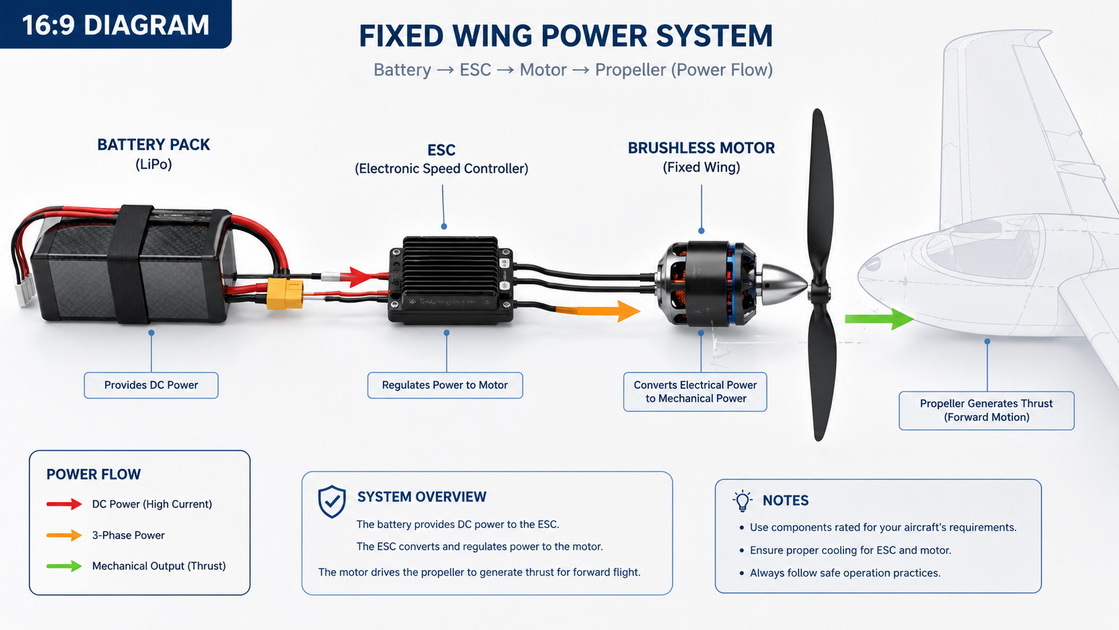
>> Match KV, Voltage, and Propeller Load
>> Validate With Bench and Flight Testing
● What to Request From a Fixed Wing Motor Manufacturer
>> Performance and Quality Information
>> Commercial Program Information
● A Practical Fixed Wing Motor Supplier Scorecard
● Building a Resilient Propulsion Supply Strategy
● Fixed Wing Motor Customization for OEM and ODM Projects
● Common Fixed Wing Motor Buying Mistakes
>> Choosing a Motor by KV Alone
>> Comparing Thrust Results Without Test Conditions
>> Ignoring Cruise-Load Efficiency
>> Overlooking Motor Temperature
>> Treating Customization as Decoration Only
>> 1. What is the difference between a fixed-wing motor and a multirotor motor?
>> 2. How do I choose the correct KV for a fixed-wing UAV motor?
>> 3. Can one fixed-wing motor work with multiple propellers?
>> 4. What should I request before purchasing fixed-wing motors in bulk?
>> 5. Why is motor temperature important in a fixed-wing UAV?
The market for fixed wing motors, VTOL propulsion systems, and UAV brushless motors is changing quickly. For drone brands, aircraft integrators, distributors, and procurement teams, motor sourcing is no longer only about thrust, efficiency, price, or delivery time.
It also involves supply continuity, quality consistency, technical documentation, component traceability, export requirements, and engineering support.
Recent supply-chain changes have made many UAV buyers reassess their existing motor sources. However, a supplier-specific restriction or procurement requirement should not lead buyers to assume that every motor from a particular country is unavailable or unsuitable. The requirements may vary according to the destination market, end use, customer type, funding source, system architecture, and applicable regulations.
For commercial fixed-wing aircraft projects, the most effective approach is to establish a documented, diversified, and technically validated propulsion strategy.
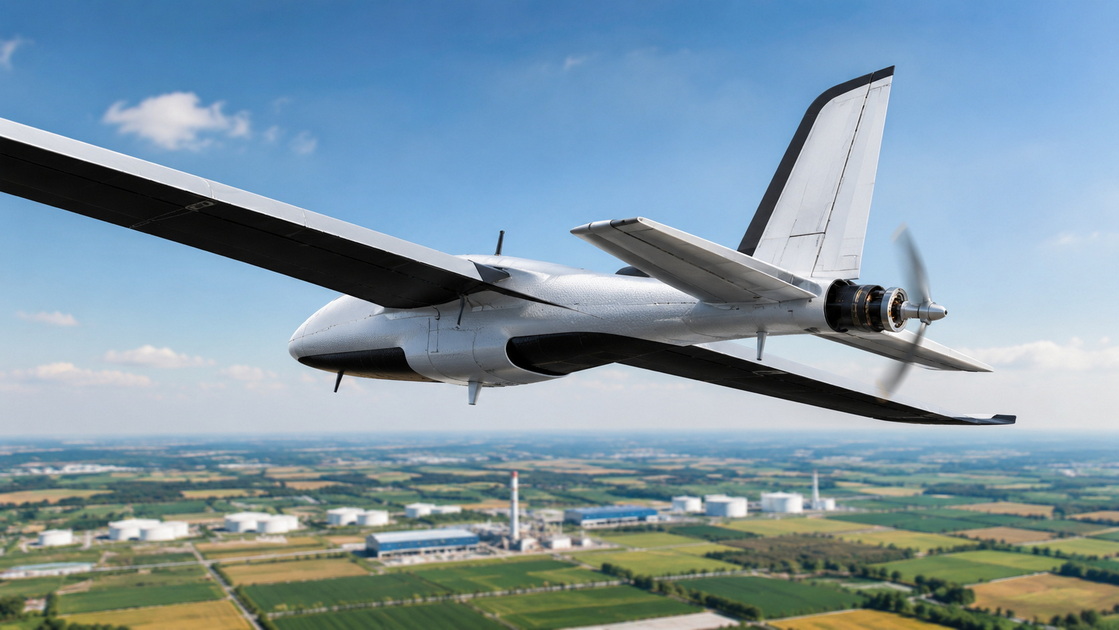
A fixed-wing UAV motor is not simply a rotating component. It is a central part of the aircraft propulsion system.
The motor influences:
- Takeoff thrust
- Climb capability
- Cruise efficiency
- Maximum payload
- Flight endurance
- Noise level
- Thermal stability
- Aircraft vibration
- Maintenance cost
A motor that appears suitable in a catalog may still perform poorly after installation if it is not properly matched with the propeller, ESC, battery, airframe, cooling path, and intended mission.
For example, a fixed-wing mapping drone may prioritize low cruise current, quiet operation, long endurance, and stable temperature during extended survey flights.
A VTOL fixed-wing aircraft may require high lift-motor thrust, reliable vertical takeoff performance, rapid transition response, and carefully matched lift and cruise propulsion systems.
A long-range surveillance UAV may place greater value on low-RPM efficiency, large propeller compatibility, low vibration, extended bearing life, and predictable performance across changing weather conditions.
Motor selection should therefore begin with the aircraft mission, not with a catalog model number.
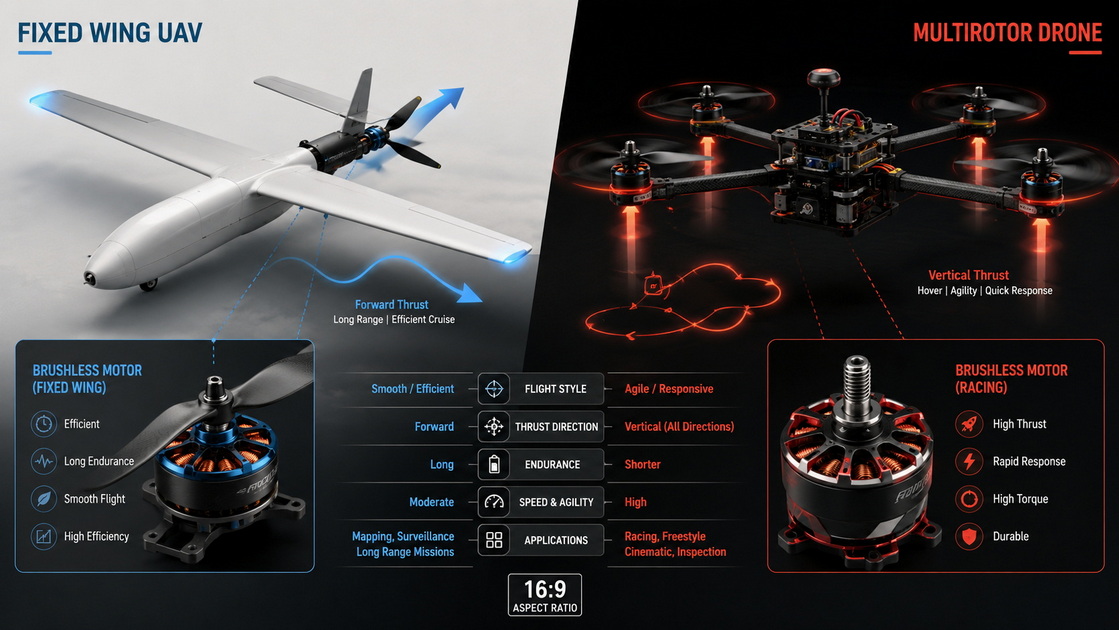
Fixed-wing motors and multirotor motors are both brushless propulsion products. However, they typically operate under very different conditions.
| Selection Factor | Fixed Wing UAV Motor | Multirotor UAV Motor |
|---|---|---|
| Primary operating condition | Sustained cruise and climb | Frequent RPM changes and hovering |
| Propeller type | Larger diameter and often lower RPM | Smaller diameter and generally higher RPM |
| Main efficiency target | Long-duration cruise efficiency | Hover efficiency and maneuvering response |
| Thermal requirement | Stable temperature during long flights | Fast heat dissipation during power bursts |
| Torque demand | Strong torque for larger propellers | Based on propeller size and flight style |
| Motor structure | Outrunner or inrunner, depending on aircraft design | Usually compact outrunner |
| Key performance focus | Endurance, smoothness, and reliability | Thrust-to-weight ratio and response |
| Typical aircraft | Fixed wing, VTOL, mapping, inspection UAV | FPV, camera drone, industrial multirotor |
A fixed-wing UAV motor commonly works within a relatively stable throttle range for a long period. This makes cruise efficiency, vibration control, bearing durability, and continuous thermal behavior especially important.
A multirotor motor changes RPM constantly to stabilize the aircraft and control movement. It normally requires faster throttle response and high thrust within a compact structure.
The motors may appear similar from the outside. Their ideal engineering priorities can be very different.
Many UAV sourcing discussions focus on country of origin, supplier availability, or policy announcements. These topics matter, but they do not provide enough detail for an engineering team developing or upgrading an aircraft.
Three practical gaps are often overlooked.
A replacement motor with the same KV rating, stator size, shaft diameter, and mounting pattern may not create the same flight result.
Performance can change because of differences in:
- Winding resistance
- Copper fill ratio
- Magnet grade
- Stator laminations
- Rotor-bell weight
- Air-gap control
- Bearing quality
- Shaft material
- Dynamic balancing
- Manufacturing tolerances
A replacement motor should be evaluated with the exact propeller, battery, ESC, and airframe configuration intended for production.
Physical fit does not guarantee equal propulsion performance.
A product page cannot confirm production consistency, engineering responsiveness, batch traceability, or change-control capability.
A suitable supplier-evaluation process should include sample approval, performance testing, quality-process review, production-capacity evaluation, and pre-production verification.
Commercial drone projects, government procurement programs, industrial inspection applications, and export-focused UAV systems may face different documentation and sourcing requirements.
Buyers should clarify applicable rules before committing to a motor platform. Legal, procurement, and compliance professionals should review program-specific requirements when necessary.
The most reliable motor-selection process starts with operational requirements.
Before comparing motor models, document the actual mission.
Key inputs include:
1. Aircraft takeoff weight
2. Payload weight
3. Battery voltage and capacity
4. Target flight time
5. Cruise speed
6. Required climb rate
7. Maximum thrust requirement
8. Takeoff method
9. Operating altitude
10. Ambient temperature range
11. Expected daily flight cycles
12. Planned maintenance interval
A hand-launched reconnaissance aircraft, a catapult-launched survey drone, and a VTOL delivery platform may use similar fixed-wing layouts. Their propulsion requirements can still be very different.
A mission profile gives motor engineers the information needed to recommend suitable stator dimensions, KV ranges, shaft options, cooling features, and propeller combinations.
The propeller has a major influence on thrust, current draw, noise, efficiency, and motor temperature.
For many fixed-wing applications, a larger propeller operating at lower RPM can create efficient thrust. However, the propeller size may be limited by ground clearance, fuselage configuration, landing gear, wing geometry, transport dimensions, and safety needs.
Review these propeller factors:
- Diameter
- Pitch
- Blade count
- Material
- Folding or fixed configuration
- Maximum recommended RPM
- Hub dimensions
- Shaft compatibility
- Intended cruise speed
- Required climb behavior
Once the propeller is defined, the motor torque and KV requirements can be matched more accurately.
KV indicates the approximate no-load RPM per volt applied to a brushless motor.
No-load RPM≈KV×Voltage
Actual operating RPM is lower because the motor must overcome propeller load, aerodynamic resistance, electrical losses, and battery-voltage changes.
As a general principle, lower-KV motors are often paired with higher-voltage systems and larger propellers. Higher-KV motors are often used with smaller propellers or lower-voltage battery systems.
The complete configuration should include:
- Motor KV
- Battery voltage
- Battery discharge capability
- Propeller diameter
- Propeller pitch
- ESC current rating
- Aircraft weight
- Required thrust
- Flight duration
- Operating temperature
A poorly matched combination may cause high current draw, insufficient climb thrust, poor cruise efficiency, excessive heat, or shortened battery life.
Balance is more valuable than a single impressive specification.
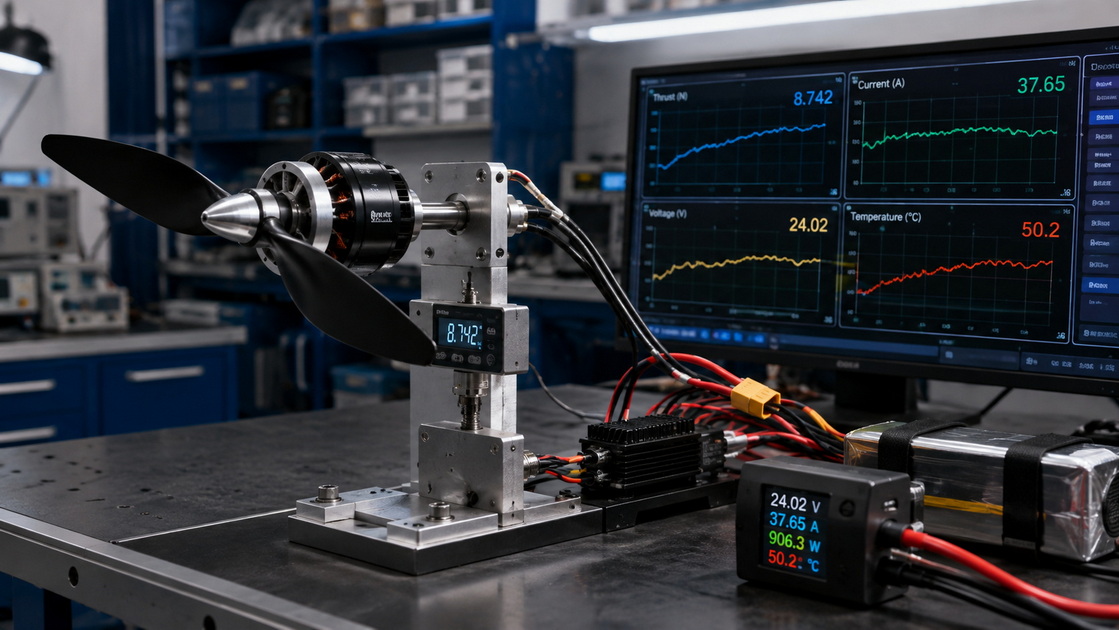
A short full-throttle test is not enough to qualify a motor for a fixed-wing UAV.
A useful validation program should include:
- Static thrust measurement
- Current measurement
- Power measurement
- Efficiency comparison
- Motor-temperature recording
- ESC-temperature recording
- Vibration testing
- Propeller-balance inspection
- Sustained cruise-load testing
- Repeated climb-cycle testing
- Full-aircraft flight trials
Bench testing provides an initial performance baseline. Flight testing confirms how the motor behaves under real propeller loading, airflow, aircraft vibration, battery discharge, and environmental conditions.
Professional buyers should request complete technical and commercial information before approving a motor for bulk production.
- Motor model and KV rating
- Stator diameter and height
- Motor weight
- Shaft diameter and shaft material
- Mounting-hole pattern
- Motor dimensions
- Pole configuration
- Internal resistance
- Recommended voltage range
- Maximum current
- Maximum power
- Recommended propeller range
- Wire length
- Connector options
- Bearing specification
- Thrust-test data
- Current and power data
- Efficiency information
- Temperature-test results
- Test conditions and equipment
- Dynamic-balance process
- Incoming-material inspection method
- Final-inspection procedure
- Batch traceability method
- Failure-analysis process
- Engineering-change notification process
- Sample lead time
- Production lead time
- Minimum order quantity
- Monthly production capacity
- Packaging options
- Branding options
- Spare-parts availability
- Warranty terms
- Technical-support process
A reliable manufacturer should explain both the motor specification and the method used to verify its performance.
A weighted scorecard helps procurement and engineering teams compare suppliers objectively.
| Evaluation Area | Questions to Ask | Importance |
|---|---|---|
| Technical fit | Does the motor meet thrust, KV, weight, efficiency, and temperature targets? | High |
| Test transparency | Are propeller, voltage, ESC, current, and temperature conditions clearly recorded? | High |
| Manufacturing quality | Are winding, balancing, bearings, assembly, and inspection properly controlled? | High |
| Supply continuity | Can the supplier support repeat orders, forecasts, spare parts, and production changes? | High |
| Customization ability | Can the supplier adjust KV, shaft, mounting, wires, connectors, branding, or packaging? | Medium |
| Documentation | Can the supplier provide drawings, specifications, batch records, and requested declarations? | High |
| Engineering support | Can technical questions be answered accurately and efficiently? | Medium |
| Total program cost | Does the solution reduce redesign, failure, delay, and warranty risk? | High |
The lowest unit price does not always create the lowest total cost.
A lower-cost motor may become expensive if it causes unsuccessful flight tests, inconsistent production batches, increased returns, delayed product launches, or repeated redesign work.
A resilient sourcing strategy does not mean qualifying a large number of suppliers without technical control. It means reducing dependency while maintaining clear quality and performance standards.
Consider the following measures:
- Approve at least two technically validated motor options for critical projects
- Maintain controlled motor drawings and performance specifications
- Define acceptable KV, weight, resistance, and shaft-dimension tolerances
- Keep approved reference samples from production batches
- Require written notice before material or process changes
- Track production lots and shipment batches
- Maintain reasonable safety stock for critical motor models
- Validate substitute motors before an urgent supply interruption occurs
- Keep test records for each approved propeller and battery combination
For larger projects, buyers should also retain control of their own technical requirements. Approved drawings, test targets, mechanical dimensions, and quality standards should remain accessible to the product owner.
Documentation protects long-term product consistency.
Standard motors are useful for prototypes and early testing. A production UAV platform may require a customized solution to meet performance, installation, or branding needs.
Zhongshan Yuhang Power Technology Co., Ltd. develops and manufactures brushless motors for fixed-wing UAVs, FPV drones, RC vehicles, high-speed fans, gimbal cameras, aircraft, robotic cleaning equipment, underwater robots, and other specialized applications.
Fixed-wing motor customization may include:
- KV winding adjustment
- Stator-size selection
- Shaft-diameter modification
- Shaft-length adjustment
- Mounting-pattern design
- Wire-length configuration
- Connector selection
- Rotation-direction options
- Propeller-adapter design
- Bearing upgrades
- Motor-bell color
- Laser-marked logo
- Product-label design
- Retail or industrial packaging
The most effective customization request uses measurable engineering targets.
For example, "more powerful motor" is difficult to evaluate. A more useful requirement would be: "Improve climb performance with a 15-inch folding propeller on a 6S battery system while keeping continuous motor temperature within the project limit."
This allows engineers to evaluate winding design, torque, resistance, cooling, propeller load, and expected current draw.
KV is important, but it is only one part of the propulsion system.
A correct selection must also consider the propeller, battery voltage, aircraft weight, ESC, intended cruise speed, and target flight duration.
A thrust figure is meaningful only when the test conditions are known.
Always compare motors using similar voltage, propeller, ESC, ambient temperature, and measurement methods.
A motor may produce strong full-throttle thrust but consume too much power at normal cruise throttle.
Fixed-wing aircraft often spend much of their flight time in cruise operation. Efficiency in that range can have a major effect on endurance.
High temperature can affect winding insulation, magnet performance, bearing life, and overall service life.
A motor should be evaluated under sustained operating conditions, not only during short test runs.
Color, logo, and packaging are useful for product identity. Functional customization can be more valuable.
KV, shaft geometry, wire length, connector configuration, and bearing selection can directly affect installation efficiency and aircraft performance.
A fixed-wing UAV manufacturer does not simply need a motor replacement when supply conditions change. The business needs a stable propulsion platform that supports aircraft performance, production continuity, documentation requirements, and long-term service.
The best fixed-wing motor is not automatically the largest, lowest-KV, highest-thrust, or lowest-cost option. It is the motor that provides reliable thrust, efficient cruising, controlled temperature, stable production quality, and compatibility with the complete aircraft system.
For fixed-wing drones, VTOL aircraft, RC airplanes, robotics, marine equipment, and other brushless-power projects, Zhongshan Yuhang Power Technology Co., Ltd. can support motor selection, sample development, power-system matching, OEM production, and ODM customization based on the project's actual engineering requirements.
A fixed-wing motor is designed for aircraft that generate lift through wings and forward motion. A multirotor motor is designed for aircraft that rely on multiple propellers for lift, stability, and maneuvering. Their propeller loads, RPM ranges, operating conditions, and efficiency priorities are often different.
Choose KV by considering the battery voltage, propeller size, propeller pitch, aircraft weight, required thrust, cruise speed, and expected mission duration. The final configuration should be confirmed through bench and flight testing.
Yes, within the recommended operating range. However, each propeller changes thrust, current draw, RPM, noise, efficiency, and motor temperature. Test the exact propeller before finalizing a production configuration.
Request technical drawings, KV tolerance, motor weight, voltage range, propeller recommendations, thrust data, current data, efficiency data, temperature results, bearing information, quality-control records, batch traceability details, and production lead times.
Fixed-wing aircraft often operate at stable throttle for long periods. Excessive temperature can affect magnets, windings, bearings, and long-term reliability. Continuous-load testing helps verify whether the motor can complete the intended mission safely.
1. ePropelled, [USA-Made UAV Motors Give Buyers of Banned China Drone Motors Safe New Options] — background source reviewed for UAV motor supply-chain context. [epropelled]
2. U.S. Federal Register, [Addition of Entities to and Revision of Entry on the Entity List] — Entity List action published in April 2024. [federalregister]
3. Electronic Code of Federal Regulations, [15 CFR Part 744 Control Policy End User and End Use Based] — current regulatory information concerning Entity List entries. [ecfr.federalregister]
4. U.S. Bureau of Industry and Security, [Export Administration Regulations Part 744] — guidance on Entity List-related authorization requirements. [bis]
5. Defense Innovation Unit, [Blue UAS Refresh List Framework Platforms And Capabilities Selected] — overview of the Blue UAS Framework and verified component ecosystem. [diu]
6. Defense Innovation Unit, [Updates to the DIU Blue UAS List Framework Supply Chain and Cybersecurity] — information on supply-chain verification and component sourcing approaches. [diu]
7. State Council Information Office of China, [China Commerce Ministry Clarifies UAV Export Controls] — official background on UAV-related export-control measures. [english.scio.gov]


