Language


Views: 222 Author: Yuhang Power Publish Time: 2026-04-25 Origin: Site
When I first started tuning FPV drones, I thought every problem could be fixed in Betaflight. If my quad oscillated, I blamed the PID profile. If it desynced, I blamed the ESC firmware. Only later—after working closely with pilots and OEM customers at Zhongshan Yuhang Power Technology Co., Ltd.—did I realize how much performance depends on one quiet component: the flight controller MCU. [oscarliang]
The jump from F1/F3 to today's F4, F7, and H7 FPV flight controllers is one of the biggest technology shifts in our industry. In 2026, choosing the right FPV drone flight controller means balancing processing power, memory, UARTs, and long‑term firmware support—not just picking the newest chip. [oscarliang]
In this guide, I'll explain:
- What the F1, F3, F4, F7, and H7 flight controller families are
- Which MCU families are still relevant in Betaflight and INAV in 2026
- How to choose the best FPV flight controller for freestyle, racing, long‑range, and cinewhoops
- How FC selection interacts with your motors, ESCs and power system from a manufacturer's perspective [mepsking]
Every FPV flight controller is built around an MCU (microcontroller unit)—the small processor that:
- Reads sensor data (gyros, accelerometers, barometers, GPS)
- Runs your firmware (Betaflight, INAV, ArduPilot, etc.)
- Calculates control outputs (PID loops, filters)
- Sends commands to your ESCs to drive the motors [oscarliang]
In FPV drones, the most common MCUs come from the STM32 family:
- F1, F3 – older MCUs, now effectively retired from modern FPV firmware
- F4 – mature, widely supported workhorse
- F7 – higher performance, more features and UARTs
- H7 – latest high‑end processors with very high clock speeds [blog.quadmeup]

The table below summarizes key MCU families commonly used in FPV drones. [instructables]
| MCU Family | Core | Typical Clock (MHz) | Flash (KB) | RAM (KB) | Status In 2026 |
|---|---|---|---|---|---|
| F1 | Cortex‑M3 | ~72 | Up to 1024 | ~96 | Legacy, no current support |
| F3 | Cortex‑M4 | ~72 | Up to 512 | ~80 | Legacy, no current support |
| F4 | Cortex‑M4 | ~168–180 | Up to 2048 | ~384 | Mainstream, cost‑effective |
| F7 | Cortex‑M7 | ~216 | Up to 2048 | ~512 | High performance, mainstream |
| H7 | Cortex‑M7 | Up to 400 | Up to 2048 | Up to 1024 | High‑end, emerging standard |
Short answer: no, not for a new FPV build in 2026. [blog.quadmeup]
F1 boards were popular in the early days of Cleanflight and Betaflight. But as firmware added:
- Dynamic filters
- RPM filtering
- Advanced OSD and serial features
- the memory and processing limits of F1 chips were quickly exceeded. [oscarliang]
Today:
- Modern Betaflight builds no longer support F1
- You'll struggle with features, updates, and tuning presets
F3 boards improved on F1, but they still have limited flash and RAM. Due to firmware growth, F3 has also dropped out of mainstream support. [oscarliang]
In 2026:
- F3 is considered legacy hardware
- Good for historical builds only, not recommended for new projects [oscarliang]
F4 flight controllers are the current value king of FPV builds. [mepsking]
- Core: Cortex‑M4
- Clock speed: typically 168–180 MHz
- Supported firmware: Betaflight, INAV (with appropriate targets)
- Good balance of processing power, cost, and availability [blog.quadmeup]
- Proven and stable platform with wide firmware support
- Enough performance for:
- Standard 4 kHz gyro and PID loop rates
- Most modern filters and features
- Lower price than F7 and H7
- Available in many form factors: 20×20, 30.5×30.5, and AIO boards [instructables]
- Fewer UARTs than a typical F7 or H7 board
- Lack of built‑in inversion on some serial ports, making certain receiver setups more complex
- Less headroom for extremely heavy configurations (multiple sensors, GPS, HD systems, complex scripts) [multirotorguide]
Best use cases for F4:
- Beginners building their first 5‑inch freestyle quad
- Budget‑conscious 3–5 inch racers
- Cinewhoops where complexity is moderate and cost matters [mepsking]
F7 flight controllers are now a mainstream choice for pilots who want more advanced capabilities. [oscarliang]
- Core: Cortex‑M7
- Clock speed: ~216 MHz
- More UARTs, often with built‑in inversion
- Better support for high‑rate gyro sampling and advanced features [blog.quadmeup]
- More headroom for: [oscarliang]
- High‑frequency PID loops (8 kHz and beyond)
- Multiple peripherals (GPS, SmartPort, HD systems, ESC telemetry, LEDs)
- Advanced filters and dynamic notch setups
- Built‑in UART inversion simplifies SBUS and other serial protocols
- Ideal for complex 5‑inch and long‑range builds
- More expensive than F4
- Slightly higher power consumption
- For very simple micro builds, F7 performance may be underused [instructables]
Best use cases for F7:
- Cinematic and long‑range rigs that run GPS + HD system + telemetry
- High‑end freestyle quads where tuning and Blackbox logging matter
- Pro pilots and commercial platforms needing more than the basics [mepsking]
H7 flight controllers are the newest high‑performance option in the FPV world. [oscarliang]
- Core: Cortex‑M7
- Clock speed: up to 400 MHz (nearly double many F7 boards) [blog.quadmeup]
- Higher RAM and flexible external flash options
- Designed to be a faster, more efficient successor to F7 in many use cases [mepsking]
- 2–3× faster than F7 in many workloads [multirotorguide]
- Huge performance headroom for:
- Very high loop rates
- Advanced filtering and computations
- Complex autopilot or INAV / ArduPilot tasks
- Power‑efficient manufacturing node (40 nm vs older 90 nm) helps keep power usage reasonable [blog.quadmeup]
- Still more expensive than F4/F7 on average
- Not all firmware features fully exploit H7's potential yet
- Early adoption means you must choose well‑supported boards to avoid compatibility issues [instructables]
Best use cases for H7:
- Cutting‑edge builds with many sensors and peripherals
- Hybrid FPV / autopilot platforms (mapping, inspections, robotics)
- Pilots who want maximum future‑proofing and top‑tier performance [oscarliang]
| Feature / Aspect | F4 FC | F7 FC | H7 FC |
|---|---|---|---|
| Typical Clock Speed | ~168–180 MHz | ~216 MHz | Up to 400 MHz |
| Firmware Support | Excellent | Excellent | Growing, strong on newer boards |
| UART Count | Moderate | High | High to very high |
| Signal Inversion | Often limited | Built‑in on many UARTs | Built‑in on most boards |
| Cost | Low to medium | Medium | Medium to high |
| Best For | Budget and mid‑range builds | Advanced freestyle and long range | High‑end, complex or pro platforms |
| Recommended For Beginners | Yes | Yes (if budget allows) | Only if you know you need the headroom |
From the perspective of a motor and power‑system manufacturer, flight controllers are not isolated parts; they define how well you can control motors, ESCs and batteries together. [mepsking]
Higher‑end FCs (F7/H7) handle:
- Faster PID and gyro sampling
- High‑speed protocols (like DShot, bidirectional DShot for RPM filtering)
- More stable control at high KV and high RPM motor setups [oscarliang]
This matters when:
- You use high‑KV FPV motors for racing
- You push ESCs close to their current limit
Filtering, Blackbox, And Thermal Behavior
On F7/H7 boards, advanced filters and logging reduce:
- Unwanted oscillations
- Excess heat from poorly tuned motors and ESCs
- Bearing wear due to vibration and micro‑oscillation [oscarliang]
The result: smoother motors, longer lifespan, and less risk of mid‑air ESC failures.
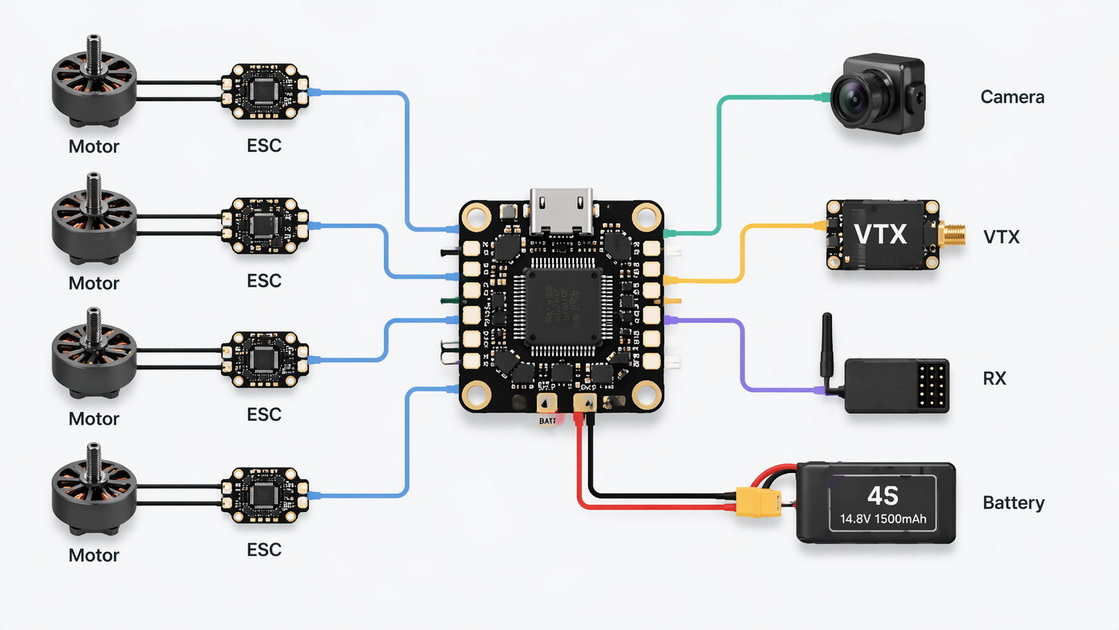
Goal: Freestyle flying and learning acro with 4S or 6S setups.
- Recommended FC: F4 or F7
- Why: F4 gives enough performance at a lower cost; F7 adds more UARTs for GPS/HD if you expand later. [oscarliang]
Goal: Long‑range missions with GPS, HD system (e.g., DJI), ESC telemetry, and return‑to‑home.
- Recommended FC: F7 or H7
- Why: You need more UARTs, processing headroom, and reliable GPS + HD integration with advanced filtering. [intofpv]

Goal: Compact 3‑inch cinewhoop carrying a small HD cam for indoor work.
- Recommended FC: F4 or F7 AIO
- Why: Form factor and weight are critical, and F4/F7 AIO boards can integrate FC+ESC (and sometimes VTX) on a single PCB. [mepsking]
Goal: Stable control in inspection drones, gimbal systems or robots with multiple sensors.
- Recommended FC: F7 or H7
- Why: Additional I/O, processing, and firmware options (including INAV/ArduPilot) require a more capable MCU. [mepsking]

1. Define your frame and use case
- Tiny whoop, 5‑inch racer, 7‑inch long range, cinewhoop, or industrial platform. [oscarliang]
2. List your peripherals
- Analog or digital FPV system
- GPS, barometer, compass
- ESC telemetry, LEDs, SmartAudio/Tramp, crossfire/ELRS, etc. [multirotorguide]
3. Check UART requirements
- Count how many serial ports you need for all those peripherals.
- F7/H7 boards are usually better when UART count is high. [intofpv]
4. Decide your performance headroom
- Basic freestyle and racing → F4 or F7
- Complex systems with GPS + HD + scripting → F7 or H7 [instructables]
5. Confirm firmware support
- Check that your chosen FC has current Betaflight/INAV targets and that the manufacturer maintains updates. [oscarliang]
6. Match FC to your power system
- Ensure it supports your voltage range and ESC protocol
- For high‑power FPV motors and 6S setups, pick well‑tested, robust FC + ESC combos. [mepsking]
Selecting an FPV flight controller is not just choosing an F4, F7, or H7 label—it's a system decision. The MCU family, ESC, motors, and battery must work together to deliver reliable performance for your flying style and business needs.
As Zhongshan Yuhang Power Technology Co., Ltd., we specialize in:
- FPV drone motors for racing, freestyle, cinewhoops and long‑range
- Brushless power systems for RC cars, high‑thrust fans, gimbals, service robots and underwater robots
- OEM/ODM services where we co‑design motors + ESCs + control electronics around your flight controller choice [mepsking]
If you're planning a new FPV platform or industrial project, talk to us about matching motors, ESCs, and flight controllers so your system is not only powerful, but also efficient, cool‑running, and maintainable in the field.
1. Are F1 or F3 flight controllers still supported in Betaflight in 2026?
No. Due to memory and performance limitations, F1 and F3 are no longer supported by current Betaflight releases and are not recommended for new builds. [blog.quadmeup]
2. Is an F4 flight controller enough for a modern 5‑inch FPV quad?
Yes. F4 boards remain a solid choice for most 5‑inch freestyle and racing quads, offering good performance and firmware support at a lower cost than F7 or H7. [instructables]
3. When should I choose an F7 over an F4 flight controller?
Choose F7 if you need more UARTs, built‑in inversion, and extra headroom for GPS, HD video systems and telemetry, or if you plan to add more advanced features in the future. [mepsking]
4. Is it worth paying more for an H7 flight controller?
H7 boards make sense for complex, sensor‑heavy, or pro‑grade builds that push firmware features and processing, such as long‑range platforms with INAV/ArduPilot or advanced logging and filters. [oscarliang]
5. Which flight controller is best for beginners?
Most beginners do well with a reliable F4 or F7 board. F4 keeps costs down; F7 offers more room to grow if you later add GPS or HD systems. [oscarliang]
1. Mepsking. "FPV Drone Flight Controllers Latest Version 2026."
https://www.mepsking.shop/blog/fpv-drone-flight-controllers-explained-f1-f3-f4-f7-h7-latest-version-2024.html [mepsking]
2. Oscar Liang. "Flight Controller Processors Explained: AT32, STM32 F4/G4/F7/H7."
https://oscarliang.com/f1-f3-f4-flight-controller/ [oscarliang]
3. Oscar Liang. "Flight Controller Explained: How to Choose the Best FC for FPV Drone."
https://oscarliang.com/flight-controller/ [oscarliang]
4. QuadMeUp. "STM32 F1, F3, F4, G4, F7 and H7 Flight Controllers."
https://blog.quadmeup.com/2020/04/16/stm32-f1-f3-f4-g4-f7-and-h7-flight-controllers/ [blog.quadmeup]
5. Multirotor Guide. "Flight Controller MCU – F1, F3, G4, F4, F7 and H7."
https://www.multirotorguide.com/guide/f1-f3-f4-f7-and-h7-mcu-for-flight-controllers-explained/ [multirotorguide]
6. Mepsking. "How To Choose FPV Drone Motor – A Detailed Guide 2026."
https://www.mepsking.shop/blog/how-to-choose-fpv-drone-motor.html [mepsking]
7. MEPSKING Blog. "What Are The Parts Of FPV Drone?"
https://www.mepsking.shop/blog/what-are-the-parts-of-fpv-drone.html [mepsking]
8. Motor & Prop Matching Guide.
https://oscarliang.com/table-prop-motor-lipo-weight/ [oscarliang]
9. Instructables. "Our Guide to Top Flight Controllers in 2024."
https://www.instructables.com/Our-Guide-to-Top-Flight-Controllers-in-2024/ [instructables]
10. Mini 20×20 F7/H7 Flight Controller Feature Comparison.
https://intofpv.com/t-mini-20x20-f7-h7-flight-controller-feature-comparison-spreadsheet-updated-june-2022 [intofpv]


