Language


Views: 217 Author: Yuhang Power Publish Time: 2026-08-08 Origin: Site
Content Menu
● What Is a Standard Drone Motor?
● FPV Drone Motor and Standard Drone Motor Comparison
● KV Rating, Torque, and Battery Voltage
>> Typical Motor Matching Logic
● Stator Size and Motor Performance
● Thrust Response, Efficiency, and Flight Behavior
● Durability, Bearings, and Thermal Management
>> Selecting a Motor by KV Alone
● Motor Selection for OEM and ODM Projects
>> Practical Motor Validation Process
>> 1. Are FPV drone motors brushless motors?
>> 2. Is a higher KV motor always better for FPV drones?
>> 3. Can I use an FPV motor on a camera drone?
>> 4. What does motor size such as 2207 mean?
>> 5. How do I choose a motor for a custom drone project?
An FPV drone motor is designed to provide rapid throttle response, high power density, and strong acceleration for racing, freestyle, and agile first-person-view flight. A standard drone motor is usually optimized for smooth operation, stable hovering, lower noise, longer flight time, or controlled payload carrying.
The difference matters because a motor that performs well on a camera drone may feel slow, inefficient, or unstable on an FPV quadcopter. Likewise, a high-KV FPV motor may draw too much current and create too much vibration for a stable aerial-imaging platform.
For drone manufacturers, OEM brands, and system integrators, motor selection should start with the mission profile. Propeller diameter, battery voltage, target thrust, aircraft weight, flight duration, payload, electronic speed controller, and operating environment all influence the final propulsion-system design.
Zhongshan Yuhang Power Technology Co., Ltd. develops and manufactures brushless motors for FPV drones, RC vehicles, ducted fans, gimbal systems, aircraft, robotic cleaners, underwater robots, and other professional equipment. The company provides complete power-system solutions as well as customized OEM and ODM support for specialized applications.
An FPV drone motor is generally a high-performance brushless outrunner motor designed for rapid speed changes and dynamic flight behavior. It is commonly used on racing drones, freestyle quadcopters, cinewhoops, long-range FPV aircraft, and custom UAV platforms.
Most modern FPV motors use brushless DC technology. Instead of mechanical brushes, they use an electronic speed controller to control current delivered to the motor windings. This supports fast throttle response, high rotational speed, and strong power-to-weight performance.
Common FPV motor characteristics include:
- High thrust-to-weight ratio
- Fast throttle response
- High rotational-speed capability
- Lightweight rotor and bell design
- Strong cooling airflow from exposed propellers
- Compatibility with high-discharge batteries
- Compatibility with fast electronic speed controller protocols
- Flexible KV options for different propeller sizes and battery voltages
FPV motors are often identified by stator dimensions, such as 2207, 2306, 2806.5, or 3115. The first two digits usually indicate stator diameter, while the final two digits indicate stator height.
For example, a 2207 motor has a 22 mm stator diameter and a 7 mm stator height. A larger stator volume can generally support more torque and thermal capacity, although final performance also depends on magnet design, winding, bearings, motor weight, propeller selection, and operating conditions.
"Standard drone motor" is not a strict engineering category. In most commercial discussions, it refers to motors used on consumer camera drones, entry-level drones, inspection platforms, mapping drones, delivery UAVs, and stable aerial-photography systems.
These motors are usually optimized for controlled, efficient, and stable flight rather than sudden acceleration or aggressive maneuvering.
Standard drone motors may prioritize:
- Long hover endurance
- Smooth low-throttle operation
- Low vibration
- Lower acoustic noise
- Stable payload support
- Larger, slower propellers
- Lower current draw
- Higher torque at lower rotational speeds
- Long service life during repeated hover cycles
Many standard drone platforms use lower-KV motors combined with larger propellers and higher battery voltage. This setup can generate stable lift efficiently and reduce unnecessary energy loss during hovering or long-range cruising.
A motor built for a camera drone may be brushless and similar in overall structure to an FPV motor. However, its winding configuration, KV rating, stator design, propeller compatibility, bearing requirements, control strategy, and thermal priorities can be very different.
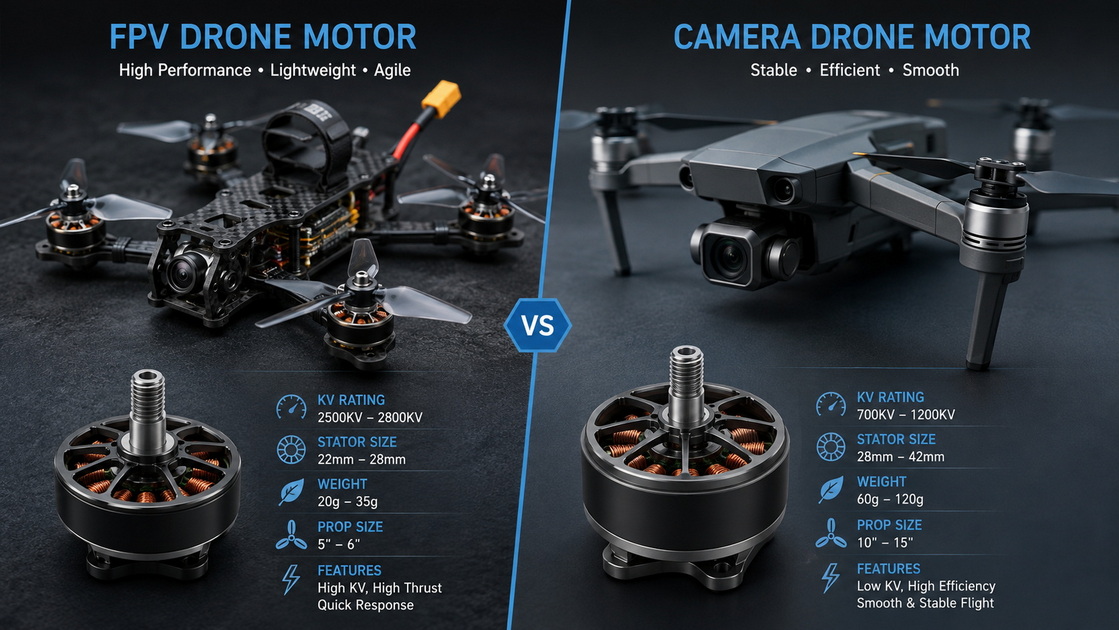
| Feature | FPV Drone Motor | Standard Drone Motor |
|---|---|---|
| Main objective | Speed, agility, acceleration, rapid response | Stability, endurance, smooth hovering, payload support |
| Typical flight style | Racing, freestyle, cinematic FPV, dynamic maneuvering | Photography, inspection, mapping, delivery, steady flight |
| KV range | Often medium to high, depending on battery voltage and propeller size | Often lower for efficient large-propeller operation |
| Throttle response | Fast and aggressive | Smooth and controlled |
| Propeller size | Usually small to medium, such as 2 to 10 inches | Often medium to large for stable lift and endurance |
| Motor structure | Lightweight, high-power outrunner design | Optimized for lower vibration and efficient sustained operation |
| Current demand | Can be high during rapid acceleration | Usually controlled during hovering and cruising |
| Cooling approach | Strong airflow from exposed rotating propellers | More conservative thermal design for long-duration operation |
| Vibration priority | Dynamic performance with careful balancing | Low vibration for cameras, sensors, and payloads |
| Main selection factors | Thrust, response, KV, stator size, current capability | Efficiency, torque, endurance, vibration, payload capacity |
The main difference is not whether one motor is brushless and the other is not. The real difference is how the brushless motor is designed and matched to the aircraft system.
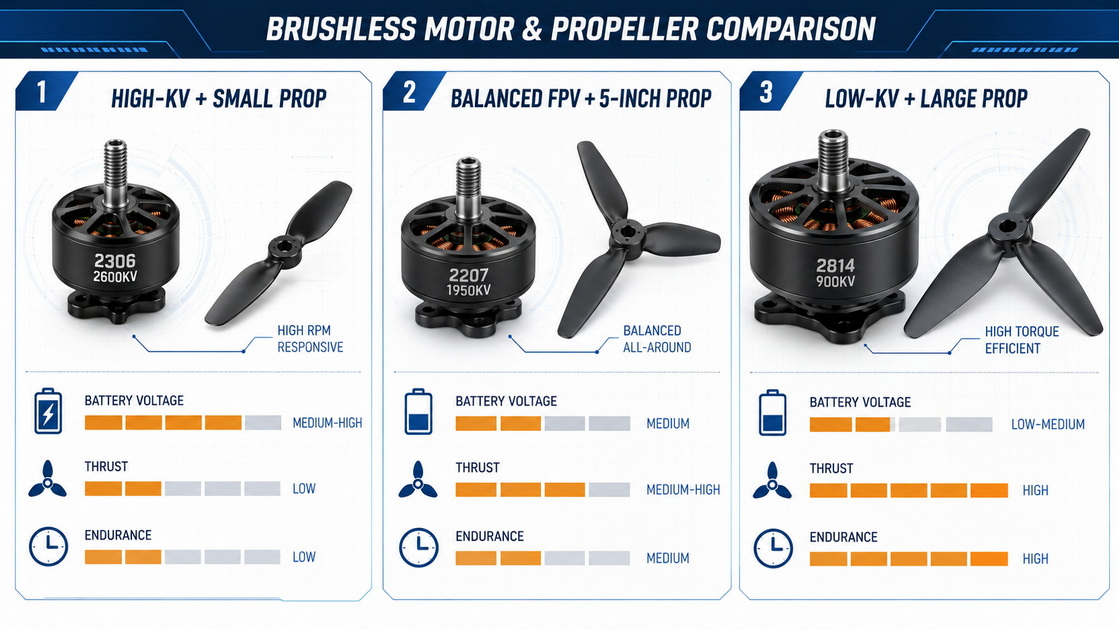
KV is one of the most misunderstood motor specifications.
KV indicates the approximate no-load rotational speed of a motor per volt applied. A 2300KV motor theoretically spins faster per volt than a 900KV motor under no-load conditions.
However, higher KV does not automatically mean better performance.
Motor performance depends on the complete propulsion system:
- Motor stator size
- Winding design
- Battery voltage
- Battery discharge capability
- Propeller diameter
- Propeller pitch
- Propeller blade count
- Electronic speed controller current rating
- Aircraft weight
- Cooling airflow
- Flight profile
A high-KV motor may suit a smaller propeller and lower-voltage battery in a racing configuration. The same high-KV motor can draw excessive current if paired with an oversized propeller or unsuitable battery voltage.
A lower-KV motor may turn a larger propeller efficiently and generate stable torque for heavier aircraft, long-range platforms, camera drones, or industrial UAVs.
| Application | Typical Propeller Size | Common Motor Approach | Main Priority |
|---|---|---|---|
| Tinywhoop | 1 to 2 inches | Small, lightweight high-KV motors | Low mass and agile control |
| Micro FPV | 2 to 3 inches | Compact motors with relatively high KV | Speed and fast response |
| Freestyle FPV | 5 inches | Medium stator motors with balanced KV | Power, control, and durability |
| Racing FPV | 5 inches | High-response motors with high current capability | Maximum acceleration |
| Long-Range FPV | 6 to 10 inches | Larger stator and lower-KV motors | Efficiency and flight endurance |
| Camera Drone | 8 inches and above | Lower-KV motors with larger propellers | Stability and payload efficiency |
| Industrial UAV | Varies by payload | Custom torque-focused power system | Reliability and mission endurance |
Motor selection should always be validated with thrust testing, current measurement, temperature testing, and real-flight evaluation.
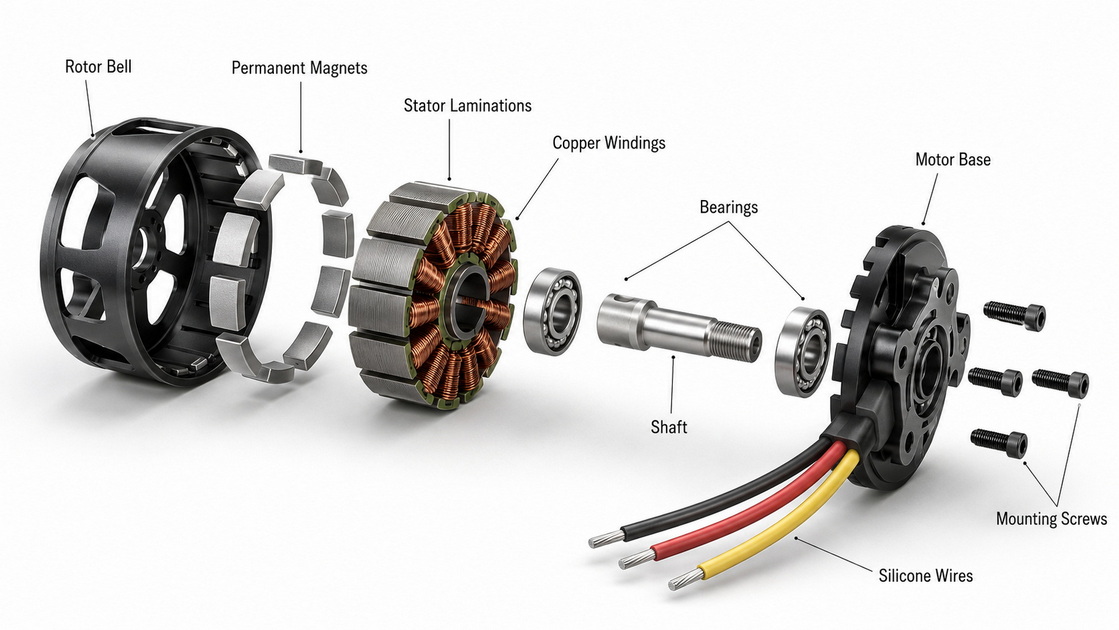
A motor's stator dimensions influence torque potential, heat dissipation, weight, and responsiveness.
The stator is the stationary part of the motor containing copper windings. The rotor bell contains magnets and rotates around the stator.
A larger stator diameter can support stronger torque and higher current capability. It is often useful for larger propellers, heavier aircraft, or applications requiring stable thrust under load.
However, a larger motor also adds weight. Excess motor weight can reduce agility and may not provide a performance advantage on lightweight FPV frames.
A taller stator can increase magnetic interaction and torque potential. For example, a 2207 motor typically has a taller stator than a 2205 motor with the same diameter.
In general:
- Wider stators can provide stronger torque
- Taller stators can support higher sustained load
- Smaller stators can reduce weight and improve agility
- Larger motors require more careful current and thermal management
The best stator size depends on the propeller, frame, battery voltage, intended flight style, and total aircraft weight.
FPV pilots often describe a motor as responsive, smooth, powerful, or efficient. These performance characteristics result from multiple engineering factors working together.
FPV motors are designed to change speed quickly. Rapid throttle response helps pilots recover from dives, complete flips and rolls, hold a line through turns, and maintain control during aggressive maneuvers.
Fast motor response depends on:
- Rotor mass
- Magnet strength
- Stator design
- Winding configuration
- Electronic speed controller firmware
- Battery voltage
- Battery internal resistance
- Propeller weight
- Flight-controller tuning
A heavy propeller or poorly matched motor can make an FPV drone feel slow even when the motor has a high KV rating.
Standard drone motors often focus more on sustained efficiency than sudden acceleration. A camera drone may spend much of its flight time hovering or flying at steady speed. In this situation, stable thrust and low current draw are often more valuable than rapid RPM changes.
This is why larger propellers and lower-KV motors are frequently used on photography, mapping, inspection, and payload-carrying drones.
FPV motors experience frequent rapid acceleration, hard landings, propeller strikes, dust, vibration, and high current peaks. Durability is therefore a major consideration.
Motor reliability depends on:
- Bearing type and bearing quality
- Shaft material and diameter
- Bell strength
- Magnet bonding
- Stator-lamination quality
- Copper-winding insulation
- Wire-exit protection
- Screw length and mounting method
- Cooling structure
- Production consistency
FPV motors should be inspected after crashes. Bent shafts, damaged bells, loose magnets, rough bearings, cracked windings, and damaged wires can create vibration and unstable flight.
Standard drone motors may experience fewer impacts, but they often operate for longer hover periods. For these systems, continuous thermal performance, bearing life, vibration control, and balanced propellers are particularly important.
A common sourcing mistake is choosing a motor based only on KV.
Two 2207 motors with the same KV can perform differently because of differences in:
- Stator material
- Magnet strength
- Winding turns
- Copper fill
- Bell weight
- Bearing quality
- Motor resistance
- Shaft design
- Cooling structure
- Manufacturing tolerances
For this reason, buyers should request thrust-test results, current-draw data, recommended propeller range, recommended battery voltage, motor weight, mounting pattern, shaft specification, and operating-temperature guidance.
For drone brands and professional-equipment manufacturers, off-the-shelf motors may not fully match the final application.
A custom brushless motor can be developed around:
- Required thrust range
- Target propeller diameter and pitch
- Battery voltage
- Maximum current
- Desired KV rating
- Motor dimensions and mounting pattern
- Shaft size and propeller adapter
- Weight limit
- Waterproofing or dust protection
- Continuous and peak operating load
- Noise requirements
- Vibration requirements
- Operating-temperature range
- Electronic speed controller compatibility
- Branding and packaging requirements
Yuhang Power supports complete power-system development and customized OEM and ODM services for drone, underwater, gimbal, robotic, RC, and other specialized equipment projects.
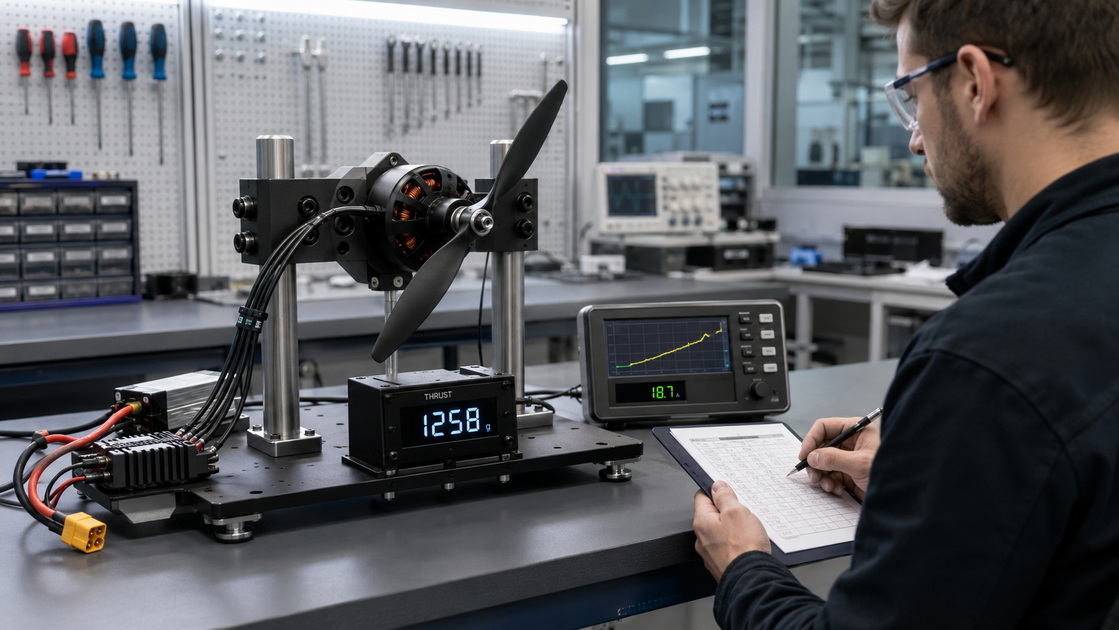
Before mass production, the complete propulsion system should be tested.
1. Define aircraft weight, propeller, battery voltage, payload, and target flight duration.
2. Select a preliminary motor size and KV range.
3. Test thrust, current draw, RPM response, and motor temperature.
4. Check electronic speed controller temperature and battery voltage sag.
5. Test vibration levels using the final propeller and frame.
6. Perform hover, cruise, full-throttle, and thermal endurance tests.
7. Confirm production tolerances and quality-inspection standards.
8. Approve samples before mass production.
This process is more reliable than selecting a motor based only on online KV charts.
FPV drone motors and standard drone motors are both commonly brushless, but they are engineered for different flight priorities.
FPV motors focus on throttle response, acceleration, power density, and agile maneuvering. Standard drone motors often prioritize efficiency, low vibration, stable hovering, payload support, and endurance.
The best motor is not the one with the highest KV or largest stator. It is the motor that matches the aircraft, propeller, battery, electronic speed controller, payload, and flight mission as a complete propulsion system.
For drone brands, equipment manufacturers, and specialized UAV projects, Zhongshan Yuhang Power Technology Co., Ltd. can support brushless-motor selection, complete power-system development, and customized OEM or ODM manufacturing requirements.
Most modern FPV drone motors are brushless DC outrunner motors. They use electronic speed controllers instead of mechanical brushes, supporting fast response, high efficiency, and strong power-to-weight performance.
No. Higher KV can produce faster RPM per volt, but the correct KV depends on propeller size, battery voltage, motor stator size, aircraft weight, and intended flight style. An excessively high-KV setup can draw too much current and overheat.
It is possible, but the motor must be matched to the propeller, battery, payload, and stability requirements. A high-KV FPV motor may create excessive vibration, noise, or current draw on a camera platform.
The first two digits refer to stator diameter, while the final two digits refer to stator height. A 2207 motor has a 22 mm stator diameter and a 7 mm stator height.
Start with aircraft weight, propeller size, battery voltage, target thrust, flight duration, payload, and operating environment. Then validate the selected motor through thrust, current, temperature, vibration, and endurance testing.
1. [Yuhang Power, FPV Drone Motor and Brushless Motor Solutions] [yuhangmotor]
2. [Yuhang Power, About Zhongshan Yuhang Power Technology Co., Ltd.] [yuhangmotor]
3. [Yuhang Power, FPV Drone Motors] [yuhangmotor]
4. [Mepsking, How to Choose an FPV Drone Motor] [mepsking]
5. [LIGPOWER, The Ultimate FPV Drone Motors Guide] [ligpower]
6. [T-Motor, UAV Propulsion System Customization] [uav-en.tmotor]


