Language


Views: 222 Author: Yuhang Power Publish Time: 2026-05-02 Origin: Site
As an FPV drone motor manufacturer working with pilots, builders, and commercial drone integrators every day, I get asked one question more than almost any other: "How much weight can a drone actually carry?" [mepsking]
From hobby-grade FPV quads to industrial cargo platforms, the real answer is: it depends entirely on the motors, propellers, and system design behind the drone. In this guide, I'll walk you through payload capacity from a hands‑on, engineering‑driven perspective, and show you how to choose or design a power system that safely lifts the weight you need. [tytorobotics]
In practice, drones can carry anything from a few dozen grams to hundreds of kilograms, depending on their class, propulsion system, and legal limits. [jouav]
From my experience working with FPV drone motors and custom brushless motor solutions, here's a realistic overview of what different drone categories can lift under safe, controlled conditions:
- Mini & hobby drones: ~100–200 g [yrdrone]
- Prosumer / camera drones: ~500 g–1 kg [mepsking]
- Professional drones: ~2–5 kg [zjiecdrone]
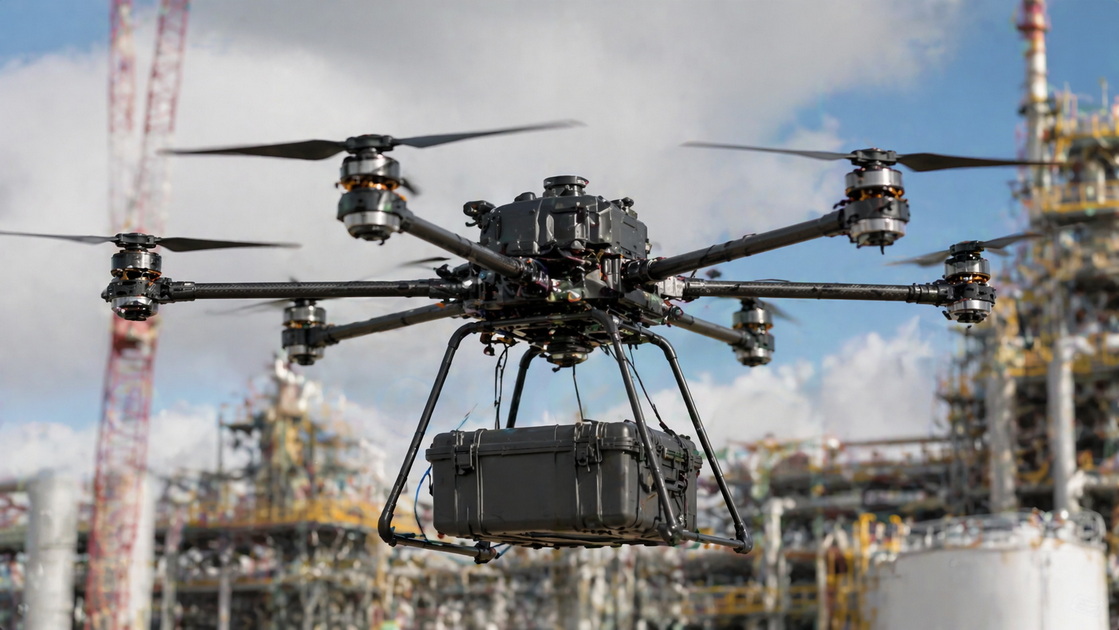
- Heavy‑lift & industrial cargo drones: 20–100+ kg, with specialized airframes exceeding 500 kg in extreme cases [jouav]
- Key takeaway: Most everyday pilots will operate somewhere between 100 g and 3 kg of useful payload—far more if you move into heavy‑lift or cargo platforms. [yrdrone]
To make this more actionable, here's a structured overview of drone classes and typical payload capacities you can expect in 2025–2026. [dronepilotgroundschool]
Drone Class | Typical Own Weight | Safe Payload Range | Typical Use Case |
Mini / Hobby (<250 g) | <250 g | 100–200 g (yrdrone) | Practice, fun, basic FPV |
Prosumer / Camera | 1–3 kg | 500 g–1 kg (mepsking) | Aerial photo & video |
Professional / Enterprise | 5–10 kg | 2–5 kg (zjiecdrone) | Mapping, inspection |
Heavy‑Lift Drone | 15–30 kg | 20–100+ kg (jouav) | Logistics, construction |
Industrial Cargo Drone | 50–100+ kg | 100–500+ kg (jouav) | Cargo, special missions |
A typical mid‑sized consumer drone (think DJI Air 3–class) can carry roughly 300–500 g before flight time drops noticeably, while larger platforms can push toward 1–2 kg for short, controlled test flights—but that doesn't mean it's wise for regular use. Heavy‑lift platforms, by contrast, are designed from the ground up around their payload. [zjiecdrone]
From an engineering standpoint, payload capacity is simply the difference between the thrust your motors can generate and the thrust required to keep the drone in the air. [foxtechuav]
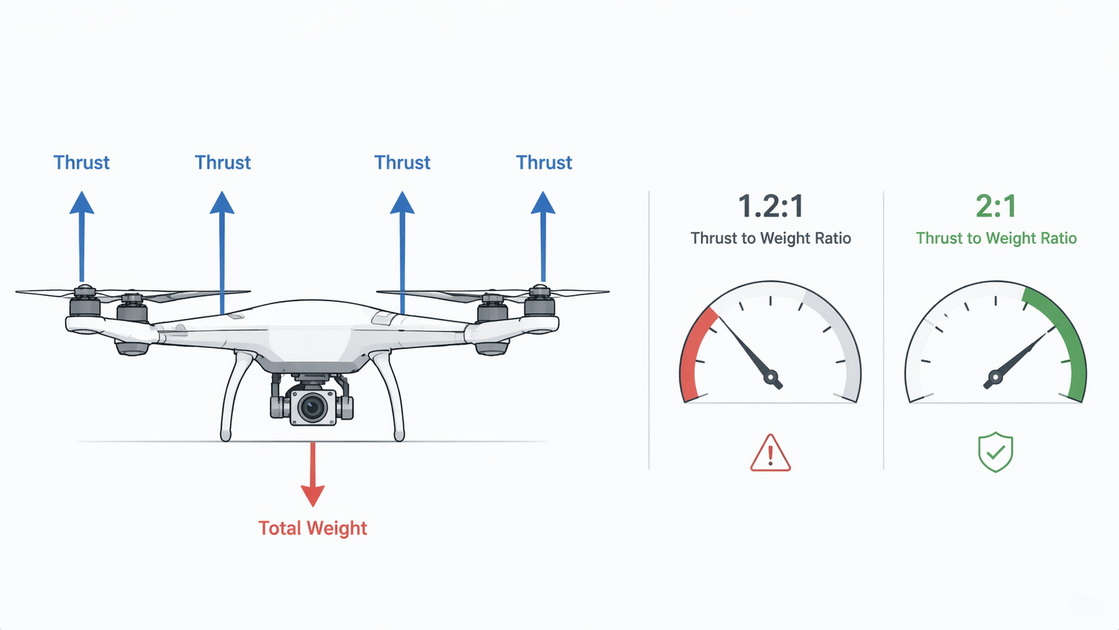
The thrust‑to‑weight ratio (TWR) tells you how powerful your propulsion system is compared to your total takeoff weight (drone + payload + battery). [jouav]
- TWR = Total Available Thrust ÷ Total Weight [tytorobotics]
- A 2:1 TWR is a common target for practical, safe operations in FPV and commercial work. [foxtechuav]
For example, if your drone plus payload weigh 2 kg, you want your motors to deliver at least 4 kg of thrust in total, so the quad can hover at roughly 50% throttle, leaving reserve thrust for climbing, wind corrections, and emergency maneuvers. [mepsking]
- From our own test benches with FPV long‑range motors and heavy‑lift setups, we consistently see that pilots who design for 2:1–2.5:1 TWR get the best mix of control, efficiency, and motor longevity.
A practical way many engineers and pilots approximate optimal payload capacity is: [tytorobotics]
1. Determine the maximum takeoff weight your frame and propulsion system can safely support. [foxtechuav]
2. Subtract the empty weight (frame + motors + ESC + battery + electronics). [foxtechuav]
3. The difference is the maximum payload capacity under ideal conditions. [foxtechuav]
- Payload Capacity ≈ Max Takeoff Weight – Empty Weight [foxtechuav]
This method doesn't replace test flights and tuning, but it gives you a reliable starting point when selecting motors and batteries.
From both lab testing and field feedback, four pillars consistently determine how much weight a drone can carry safely and efficiently: motors, propellers, battery, and aerodynamics. [gminsights]
Brushless motors are the heart of your lifting capability. The industry trend over the next decade is clear: ultra‑light, high‑efficiency brushless motors that increase payload while reducing energy consumption. [gminsights]
- Low‑KV, high‑torque motors paired with large‑diameter props are ideal for heavy payloads and long‑range FPV. [gminsights]
- High‑KV motors spin faster with smaller props—great for racing or acro, but not optimized for lifting heavy loads. [mepsking]
As a manufacturer, when we help customers design for payload, we almost always recommend low‑KV, high‑torque stators with robust bearings and efficient winding schemes for stability under load.
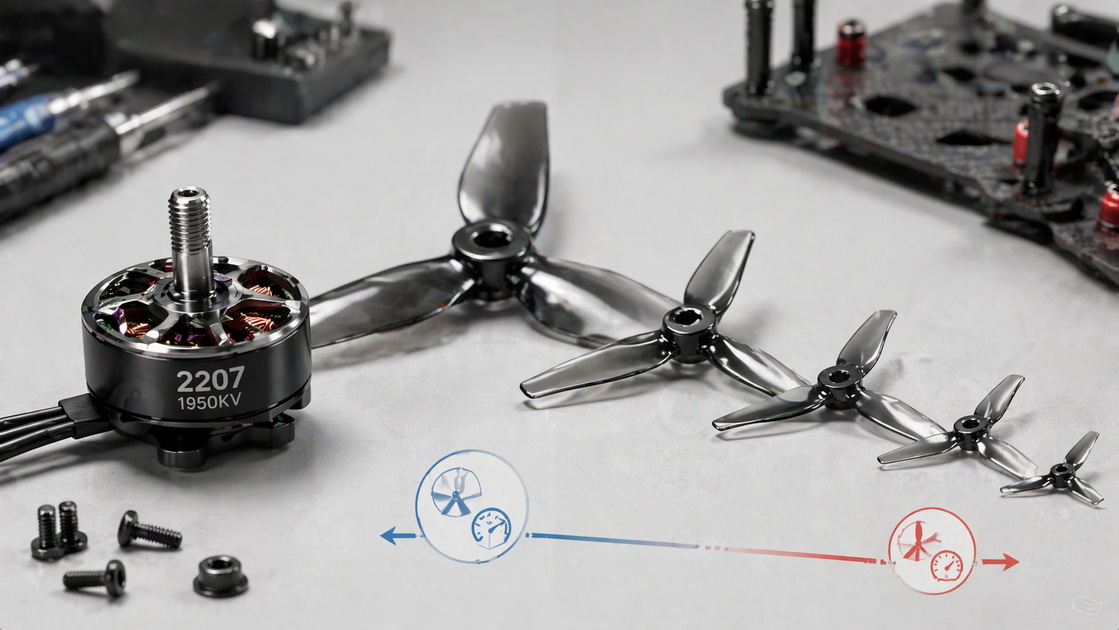
Large, aerodynamically optimized propellers can dramatically increase lift:
- Larger diameter + lower pitch → more static thrust and better efficiency for heavy lifting. [jouav]
- Carbon fiber props are common on heavy‑lift drones because they are stiff, durable, and efficient under high loads. [jouav]
Industrial heavy‑lift platforms often use 12‑inch or larger carbon fiber props combined with high‑power motors to carry 30–50+ lbs. [jouav]
Heavier payloads draw more current, accelerating battery drain. [muginuav]
- More voltage (higher cell count) can improve efficiency for some setups. [muginuav]
- A higher battery capacity (mAh) can extend flight time—but also increases total weight. [muginuav]
The most successful industrial drone operators we work with obsess over finding the balance between payload mass and flight time, not just maximizing one dimension. [muginuav]
Airframe weight and stiffness directly impact how much payload you can carry:
- Lightweight, rigid frames help reserve more lift for payload. [edstechnologies]
- Structural performance analysis of payload attachment points is essential to handle repeated loading cycles without fatigue. [edstechnologies]
Top‑tier industrial designers increasingly rely on simulation to optimize load‑bearing parts, attachment points, and weight distribution for more stable flight with heavy payloads. [edstechnologies]
From our vantage point in the FPV and brushless motor industry, these are the payload ranges pilots and engineers actually fly in 2025–2026. [droneii]
- Typical sub‑250 g drones can carry 100–200 g of extra weight. [yrdrone]
- Overloading these platforms quickly leads to unstable flight and severely reduced flight times. [yrdrone]
- Common camera drones can safely handle 500 g–1 kg under controlled conditions. [yrdrone]
- That's enough for a 360° action cam, small searchlight, or lightweight drop mechanism, but not for sustained cargo missions. [mepsking]
A mid‑sized consumer drone like a DJI Air‑class aircraft usually begins to show noticeable performance degradation above ~300–500 g of payload. [mepsking]
- Professional drones in the 5–10 kg own‑weight class often carry 2–5 kg payloads for mapping, LiDAR, or inspection gear. [zjiecdrone]
- Heavy‑lift and cargo drones are engineered to haul 20–100+ kg, with some industrial systems lifting over 500 kg in experimental or niche applications. [dronepilotgroundschool]
These platforms rely on high‑power brushless motors, large carbon props, advanced flight controllers, and carefully engineered frames. [gminsights]
As a manufacturer providing FPV drone motors, gimbal motors, and custom OEM/ODM brushless solutions for drones, robots, RC vehicles, and more, we see payload design from two key angles:
1. Experimental testing – thrust benchmarks, thermal monitoring, and long‑duration test stands with different props and voltages.
2. Customer feedback – what actually works in the field for FPV pilots, cinematographers, industrial inspectors, and logistics operators.
Here's the practical framework we recommend to clients who need to maximize payload without compromising safety or reliability.
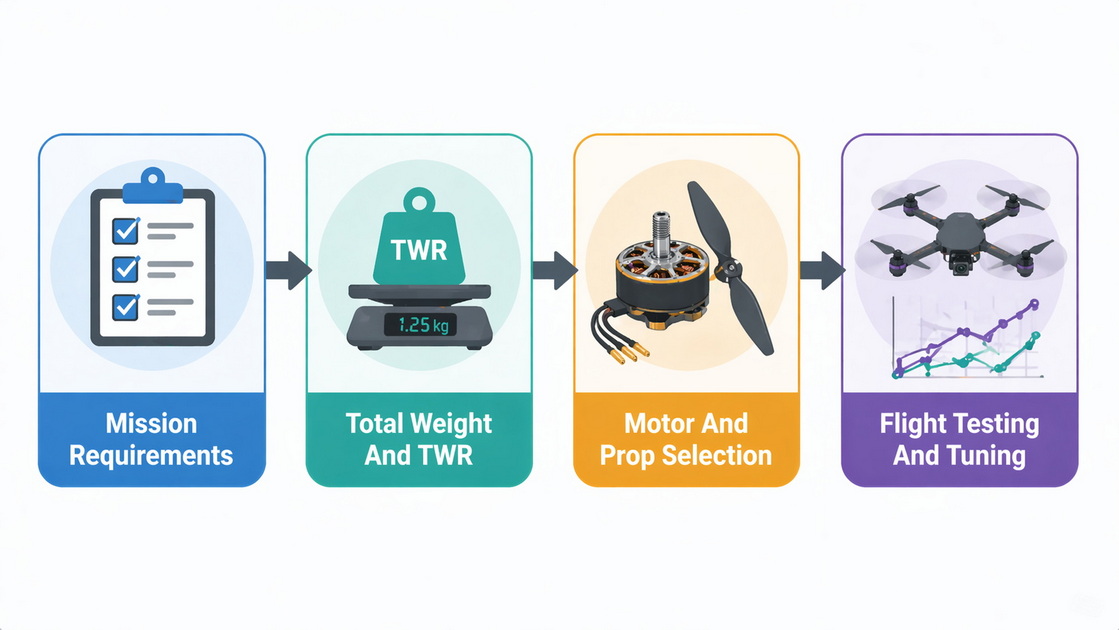
Start with mission requirements, not an arbitrary weight target:
- What are you carrying? (camera, LiDAR, cargo, sensor package)
- How long do you need to fly?
- What safety margin do you consider acceptable (2:1 TWR or higher)? [muginuav]
- What regulations apply in your region (e.g., 55 lb total limit in many FAA contexts)? [flyingmag]
1. Add up airframe + electronics + battery + expected payload.
2. Multiply by gravity (9.81 m/s⊃2;) to get required hover thrust. [jouav]
3. Multiply by your safety factor (typically 2) to get the total required thrust. [mepsking]
- For stable operation, engineers and pilots commonly work toward 2× the hover thrust as a safety baseline. [foxtechuav]
Using manufacturer thrust data and test stand measurements: [tytorobotics]
- Choose low‑KV, high‑torque motors matched to large, efficient props for heavy payloads. [gminsights]
- Verify that each motor can deliver the required thrust while staying within safe current and temperature limits. [gminsights]
From our own FPV motor lines, we frequently help customers tune stator size, KV, and winding around a specific prop and payload target to avoid thermal overloading.
Even the best calculations must be validated with real‑world test flights:
- Start with lighter payloads and gradually increase.
- Monitor motor temperature, battery sag, current draw, and flight behavior.
- Adjust prop size, motor KV, or battery configuration based on data. [tytorobotics]
If you follow the drone industry closely, you'll notice a consistent trend: more payload, longer flight, smaller platforms. [droneii]
The global drone motor market is growing steadily, driven by the push for lightweight, high‑efficiency brushless motors that extend flight time and increase payload capability. This directly benefits FPV pilots and industrial operators alike. [gminsights]
Engineers increasingly rely on simulation‑driven structural analysis to optimize payload attachment points, weight distribution, and fatigue resistance. This enables drones to carry heavier, asymmetrical loads more safely over time. [edstechnologies]
From cinematography and inspection to more sensitive applications, FPV and heavy‑lift drones are expected to see improvements in energy efficiency and payload capacity, making them more resilient and capable in demanding environments. [droneii]
Combined, these trends mean that motor and airframe choices today will age better if you design with efficiency and structural integrity in mind.
One of the most important expert lessons we share with clients is this:
- The maximum weight a drone can momentarily lift is not the same as the weight it can safely operate with in real missions.
- Many jurisdictions cap small unmanned aircraft at 55 lb (≈25 kg) including payload and power source. [flyingmag]
- Large payloads reduce maneuverability, flight time, and safety margins, especially in wind and high‑altitude environments. [muginuav]
For commercial operations, we strongly recommend designing well within the legal and mechanical limits, and validating performance through documented test procedures.
If your mission involves non‑standard payloads, unusual installation spaces, or demanding duty cycles, off‑the‑shelf motors may not be enough. That's where OEM/ODM motor customization becomes valuable.
Typical scenarios where our engineering team gets involved:
- Your payload requires a specific TWR at a fixed prop size, and you need a motor optimized for that combination.
- You're designing underwater or harsh‑environment robots, where sealing, materials, and thermal behavior matter as much as thrust.
- You need a matched power system (motor + ESC + prop + mounting + wiring) for scale manufacturing.
Working directly with a motor manufacturer, you can optimize:
- KV and stator dimensions for your voltage and prop size.
- Winding, magnets, and bearings for efficiency and durability.
- Mechanical interfaces and cable routing for easier integration.
This kind of collaboration ensures your drone can carry the weight you need with the safety and reliability your application demands.
If you're planning a new FPV platform, inspection drone, or custom robot and need to answer "How much weight can my system truly carry?" with confidence, don't guess.
- Define your mission and target payload range.
- Estimate your TWR and maximum takeoff weight.
- Collaborate with a motor manufacturer to select or customize the right brushless motors and propellers.
Our engineering team works daily with FPV pilots, aerial cinematographers, logistics operators, and robotics integrators to design payload‑optimized power systems. Whether you're building a long‑range FPV quad or a heavy‑lift industrial platform, we can help you choose the right motor KV, stator size, and prop combo to safely carry your intended payload.
Ready to optimize your drone's lifting power?
Get in touch with our team, share your target payload, flight time, and frame size, and we'll help you build a propulsion system that does more than just "get off the ground"—it will perform reliably, efficiently, and safely.
1. How much weight can a typical consumer drone carry?
Most consumer camera drones can fly with 300–500 g of extra payload before flight time and handling degrade significantly; in tightly controlled tests, some setups can approach 1–2 kg, but this is not recommended for routine operation. [yrdrone]
2. What thrust‑to‑weight ratio should I target for a payload‑carrying drone?
For FPV and commercial work, 2:1 TWR or higher is widely used as a practical baseline, allowing stable hover below 50–60% throttle and enough reserve for safe maneuvering. [jouav]
3. Does increasing battery size always increase payload capability?
Not necessarily. A larger battery adds weight, and beyond a certain point, the extra energy is offset by the extra mass, reducing overall efficiency and flight time. The goal is to balance battery size and payload for your mission profile. [muginuav]
4. Can I use high‑KV racing motors for heavy‑lift applications?
High‑KV racing motors are optimized for high RPM with small props, not for sustained high‑torque operation with large props and heavy payloads. For lifting, low‑KV, high‑torque motors are generally more efficient and reliable. [mepsking]
5. What's the difference between "maximum lift" and "safe payload"?
"Maximum lift" is the absolute thrust ceiling your motors can generate, often measured briefly on a test stand. "Safe payload" is the weight your drone can carry repeatedly in real conditions while maintaining stability, adequate flight time, and system reliability. [tytorobotics]
1. Jouav – "How Much Weight Can a Drone Carry? (Comprehensive Guide)"
https://www.jouav.com/blog/how-much-weight-can-a-drone-carry.html [jouav]
2. Tyto Robotics – "How Much Weight Can a Drone Carry"
https://www.tytorobotics.com/blogs/articles/how-much-weight-can-a-drone-carry [tytorobotics]
3. Mepsking – "How Much Weight Can A Drone Carry?"
https://www.mepsking.shop/blog/how-much-weight-can-a-drone-carry.html [mepsking]
4. YR Drone – "How Much Weight Can a Drone Carry? (2026 Payload Chart & Guide)"
https://yrdrone.com/blog/industry-news/how-much-weight-can-drone-carry/ [yrdrone]
5. ZJIEC – "How Much Weight Can a Cargo Drone Carry?"
https://zjiecdrone.com/how-much-weight-can-a-drone-carry/ [zjiecdrone]
6. Foxtech – "How Do You Calculate the Optimal Payload for Drones?"
https://www.flyingmag.com/darpa-drones-carry-4-times-their-weight/ [flyingmag]
https://www.foxtechuav.com/a-how-do-you-calculate-the-optimal-payload-for-drones.html [foxtechuav]
7. Global Market Insights – "Drone Motors Market Size, Share & Forecast Report"
https://www.gminsights.com/industry-analysis/drone-motors-market [gminsights]
8. EDS Technologies – "Optimize Payload Handling for Drones"
https://edstechnologies.com/industries/aerospace-defence/optimize-payload-handling-for-drones/ [edstechnologies]
9. Drone Industry Insights – "FPV Drones and Military Use"
https://droneii.com/military-fpv-drones [droneii]
10. Mugin UAV – "Industrial Drone Payload & Flight Time Guide"
https://www.muginuav.com/payload-capacity-flight-time-industrial-drones/ [muginuav]


