Language


Views: 222 Author: Yuhang Power Publish Time: 2026-05-16 Origin: Site


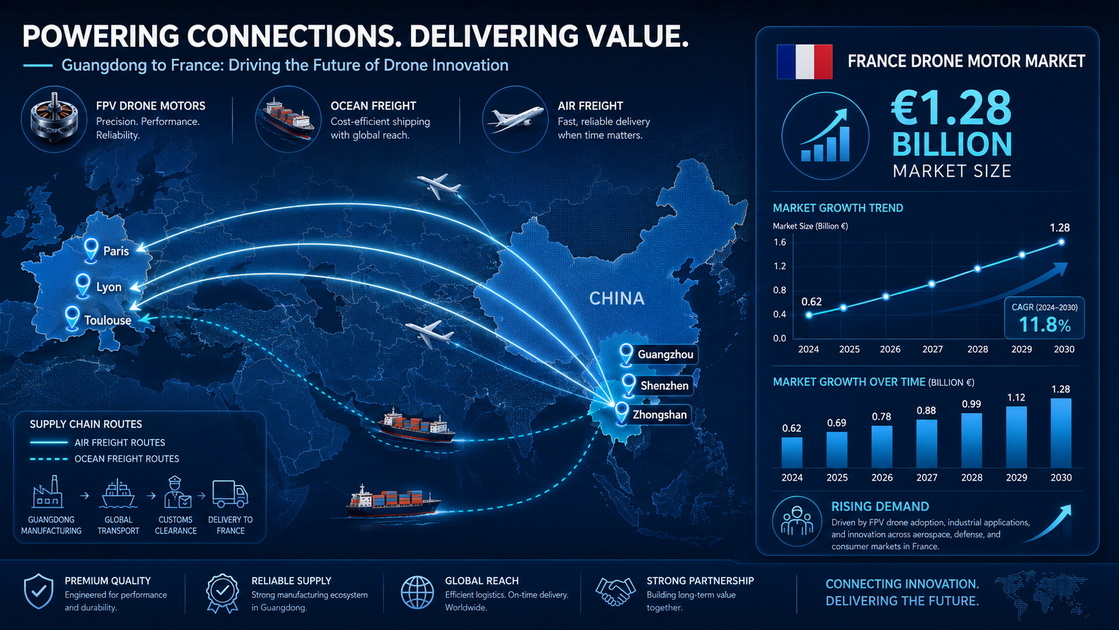
Frances drone motor market is experiencing rapid expansion, projected to reach €1.28 billion by 2026 with a compound annual growth rate of 12-14.5%. The French governments ambitious Drone Strategy 2023allocated over €5 billion to expand military UAV fleets, creating substantial demand for high-efficiency brushless DC motors with advanced thermal and vibration control capabilities. While France has traditionally relied on international suppliers—particularly from Chinas Guangdong manufacturing cluster—the country is simultaneously developing domestic capabilities to ensure technological sovereignty in critical defense and industrial applications. [sourceready]
Frances strategic position in the European drone ecosystem offers unique advantages for both buyers and suppliers. The country serves as a regulatory innovation hub within the EU framework while maintaining strong industrial automation adoption across agriculture, infrastructure inspection, and defense sectors. French buyers increasingly prioritize motors delivering superior power-to-weight ratios, extended flight times, and compliance with CE/RoHS environmental certifications—requirements that align perfectly with modern brushless DC motor technology incorporating advanced composites and high-performance magnets. [linkedin]
The global drone motor market is expanding from USD 3,371.6 million in 2025 to USD 15,980.7 million by 2035, with brushless motors commanding 86.1% market share due to efficiency gains. Frances participation in this growth is driven by both military modernization and commercial applications in precision farming, energy sector inspections, and autonomous logistics. [futuremarketinsights]
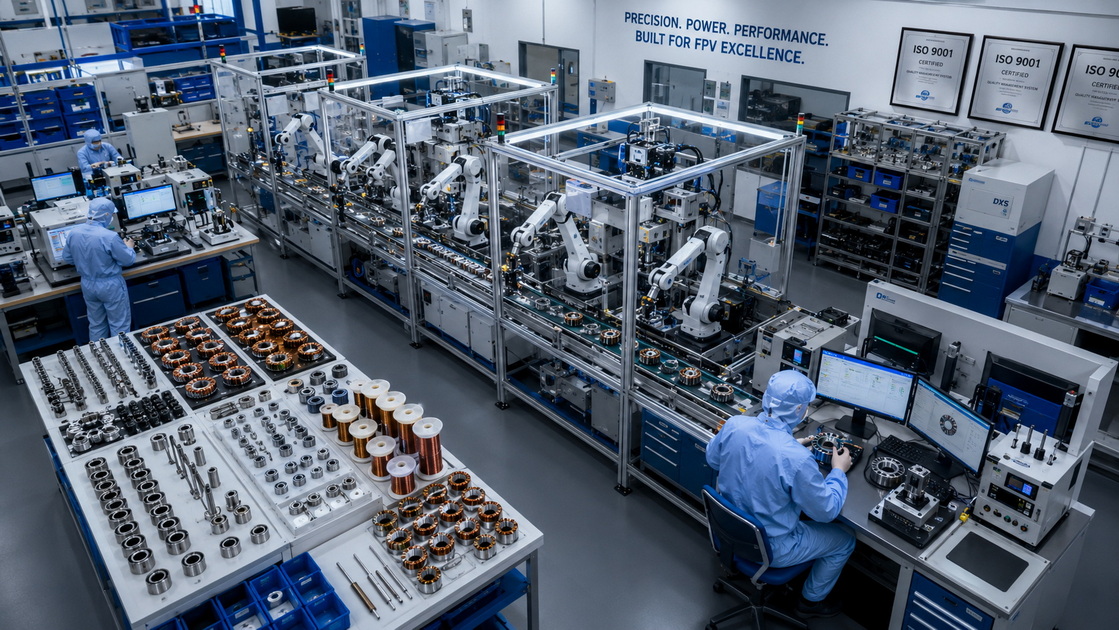
Zhongshan Yuhang Power Technology Co., Ltd. has established itself as a versatile brushless motor specialist serving diverse applications from FPV racing drones to underwater robotics and gimbal stabilization systems. Located in Guangdong Provinces manufacturing corridor, the company differentiates itself through exceptional OEM/ODM flexibility rather than mass-market standardization. [yuhangmotor]
Their core strength lies in providing complete power system solutions rather than standalone motors—an approach that resonates with emerging brands requiring integrated engineering support from motor selection through ESC compatibility and propeller matching. The company maintains particularly strong capabilities in mid-to-low volume custom runs, making them suitable for specialized applications like thermal imaging drones, extended-range surveillance platforms, and agricultural spray systems requiring non-standard power configurations. [yuhangmotor]
Yuhangs technical team demonstrates proficiency in adapting motor parameters (KV ratings, stator dimensions, magnet grades) to specific mission profiles, supported by rapid prototyping capabilities that compress development cycles. Their manufacturing infrastructure accommodates both precision assembly for high-tolerance aerospace applications and cost-optimized production for commercial-grade systems, providing buyers with pathway scalability as product volumes evolve. [yuhangmotor]
For French procurement teams, Yuhang represents a practical middle-ground option: more responsive than large-scale commodity manufacturers yet more established than startup suppliers. Their multi-application experience (covering drones, robotic vacuums, electric vehicles, and industrial fans) translates to broader problem-solving perspective when addressing uncommon technical challenges.
Founded in 1994, BG Motor has accumulated over three decades of motor manufacturing expertise with significant intellectual property portfolios including numerous patents for UAV-specific brushless DC motor designs. The company recognized early market shifts toward high-performance drone motors and invested heavily in R&D infrastructure tailored specifically for aerial platform applications. [china-bgmotor]
BG Motor manufactures across the full drone spectrum: multirotor motors optimized for aerial photography requiring precise maneuverability, fixed-wing motors engineered for sustained power delivery during long-distance agricultural mapping, and hybrid drone motors supporting diverse operational modes. Their product lines serve both consumer and industrial segments, with particularly strong capabilities in motors requiring advanced cooling systems and vibration damping—critical for stabilizing sensor packages during extended flight operations. [china-bgmotor]
The companys maturity shows in its systematic approach to quality control and its established export channels to over 50 countries. BG Motors scale provides procurement advantages including inventory depth, component sourcing leverage, and financial stability for multi-year supply agreements. [chinese.alibaba]
Drone Français represents Frances domestic manufacturing response to technological sovereignty concerns within defense and critical infrastructure sectors. As the first French company to design entirely domestic flight controllers and electronic speed controllers for observation and FPV drones, they address specific requirements from French armed forces and strategic industries prioritizing supply chain independence. [dronefrancais]
Their component ecosystem includes the Abell flight card, Centurion ESC engine controllers, and precision power regulators engineered for harsh operational environments. While their motor production focuses on sovereign defense applications rather than commercial export markets, they demonstrate Frances emerging capability to produce complete drone propulsion systems without external dependencies. [dronefrancais]
For buyers prioritizing European-manufactured components to comply with defense procurement regulations or critical infrastructure security requirements, Drone Français offers alternatives to Asian supply chains. However, their current focus on military applications means limited availability for commercial buyers and typically higher unit costs reflecting low-volume specialized production.
TT Motor Industrial Co., Ltd. operates from Shenzhens electronics manufacturing hub, providing access to the regions concentrated supply chain ecosystem for magnets, bearings, electronic controllers, and precision machining. Their proximity to component suppliers enables rapid design iterations and cost-efficient sourcing of specialty materials. [ttmotor]
The company positions itself across the versatility spectrum, serving hobbyist drone enthusiasts through professional UAV operators. Their state-of-the-art manufacturing facility implements strict quality control protocols emphasizing durability and reliability even under challenging environmental conditions—addressing common failure modes in motors exposed to dust, moisture, and temperature extremes. [ttmotor]
TT Motors Shenzhen location provides logistical advantages for European buyers, with established shipping infrastructure and freight forwarding partnerships reducing lead times compared to inland manufacturers. Their manufacturing capacity supports both standard catalog products and customized specifications, though with less emphasis on low-volume prototyping compared to Yuhang.
Safran represents the premium segment of the European drone motor market, leveraging deep aerospace engineering expertise to develop the ENGINeUS line of smart motors featuring integrated motor controllers and sealed designs for harsh-environment operation. Their brushless motors serve primarily eVTOL aircraft and heavy-lift industrial drones rather than consumer FPV applications. [tytorobotics]
With specifications including maximum power output of 1 MW, operating speeds to 3,500 RPM, and voltage handling to 850V, Safrans motors target applications far beyond typical FPV drone requirements. Their technology already powers Bye Aerospaces eFlyer, demonstrating proven performance in demanding aviation contexts. [tytorobotics]
Headquartered in Paris, Safran offers European buyers the advantages of local engineering support, regulatory alignment, and cultural familiarity. However, their focus on large-scale aviation applications means pricing structures and minimum engagement scales typically exceed requirements for FPV drone manufacturers. They serve best as a technology benchmark and potential partner for high-end industrial surveillance or cargo delivery drones requiring exceptional reliability. [tytorobotics]
MAD Components appears among Chinas recognized FPV drone motor manufacturers, though with less public documentation than larger competitors. Their inclusion in industry compilations suggests established presence within FPV racing and freestyle drone communities, where performance reputation spreads through pilot networks and competition results. [yuhangmotor]
Manufacturers serving the FPV racing segment typically prioritize rapid throttle response, minimal rotational inertia, and peak power output over endurance—different engineering optimization targets than industrial inspection or agricultural drones. MAD Components specialization indicates expertise in high-KV motor designs (above 2,500 KV) favored by competitive pilots. [factmr]
Topu Motors manufactures high-performance brushless motors across multiple application categories including FPV drones, underwater ROVs, agricultural spray systems, electric bicycles, and electric scooters. This diversification demonstrates adaptable engineering capabilities and reduces business risk concentration in any single market segment. [aibangfly]
Their multi-application approach mirrors Yuhangs strategy, providing procurement teams confidence in the manufacturers ability to solve unconventional technical challenges by applying insights from adjacent industries. For instance, waterproofing expertise from underwater ROV motors can inform ruggedized designs for agricultural drones operating in humid environments.

Manufacturer |
Primary Strength |
Typical MOQ |
Key Certifications |
Best For |
Zhongshan Yuhang Power |
OEM/ODM flexibility, multi-application |
Flexible (low-mid volume) |
ISO 9001, CE, RoHS |
Custom solutions, emerging brands |
BG Motor |
Established reputation, IP portfolio |
Mid-high volume |
ISO 9001, industry patents |
Standardized products, scale production |
Drone Français |
European sovereignty, defense-grade |
Specialized military |
EN 9100 equivalent |
Defense procurement, critical infrastructure |
TT Motor |
Shenzhen supply chain access |
Mid volume |
Quality control systems |
Standard commercial drones |
Safran Electrical & Power |
Aerospace engineering, high power |
Very high (aviation-scale) |
EN 9100, aerospace standards |
Heavy-lift industrial, eVTOL |
MAD Components |
FPV racing performance |
Varies |
Community reputation |
Racing drones, high-KV applications |
Topu Motor |
Multi-industry experience |
Mid volume |
Export certifications |
Diverse application portfolios |
The most prevalent quality issue in drone motor procurement involves magnet grade substitution—manufacturers listing N52 neodymium magnets in specifications but delivering N42 or N45 grades in production units. This reduces peak torque output by 8-12% and accelerates demagnetization under high operating temperatures common in aggressive flight profiles. [linkedin]
Mitigation strategy: Request samples from actual production batches (not pre-production prototypes). Conduct comparative dynamometer testing measuring KV rating, peak current draw, and thermal performance against specifications. Significant deviations indicate material substitution or manufacturing tolerance issues.
Many buyers accept manufacturer-provided ISO 9001 certificates without verification, exposing themselves to expired or fraudulent credentials. Chinas Certification and Accreditation Administration (CNCA) oversees legitimate certifications, but their verification databases often require Chinese-language navigation. [shieldworksmfg]
Verification process: Examine the certificate for the issuing certification bodys logo and accreditation marks. Contact the certifying organization directly using contact information from their official website (not from the certificate itself, which could be fabricated). Verify three critical details: the manufacturers registration number matches their business license, the certification scope explicitly covers brushless motors or UAV components, and the validity dates show current certification. [shieldworksmfg]
Request audit reports if establishing strategic supplier relationships. Legitimate manufacturers maintain detailed quality management system documentation available for serious buyers.
Manufacturers sometimes display ISO 9001 certificates covering unrelated product categories (like consumer electronics) while claiming certification extends to drone motors. Certification bodies audit specific production processes and product categories—a certificate for smartphone assembly does not validate brushless motor manufacturing capabilities. [metafuro]
Due diligence requirement: Verify the product scope listed on the certification explicitly mentions brushless motors, UAV components, or BLDC motor assembly. Generic certifications for electronic manufacturingmay not cover the specialized processes (magnet installation, bearing precision fitting, balance testing) critical to motor quality.
Manufacturers often quote optimistic lead times during initial negotiations but lack production capacity to fulfill commitments when orders materialize, particularly during peak seasons (pre-summer for agricultural drones, Q4 for consumer products). [factmr]
Capacity assessment: Request production floor photographs showing assembly line configuration and ask specific questions about monthly output volumes, shift scheduling, and current capacity utilization rates. Cross-reference claimed production volumes against facility size—a 2,000 square meter facility cannot realistically produce 100,000 motors monthly using manual assembly processes.
Establish penalty clauses for delivery delays in contracts, or structure payments to retain leverage (e.g., 30% deposit, 60% upon production completion with buyer inspection, 10% after delivery).
Technical misunderstandings during motor specification discussions frequently cause costly redesign cycles and schedule delays. While many Chinese manufacturers maintain English-speaking sales teams, technical engineering support often requires translation or operates within China Standard Time business hours. [metafuro]
Best practice: Conduct video calls with actual engineering teams (not just sales representatives) before finalizing contracts. Assess their understanding of your application requirements and their ability to discuss technical tradeoffs (e.g., motor efficiency versus peak power, weight reduction versus thermal capacity). Manufacturers providing detailed technical responses in writing demonstrate stronger engineering depth than those relying on generic sales presentations.
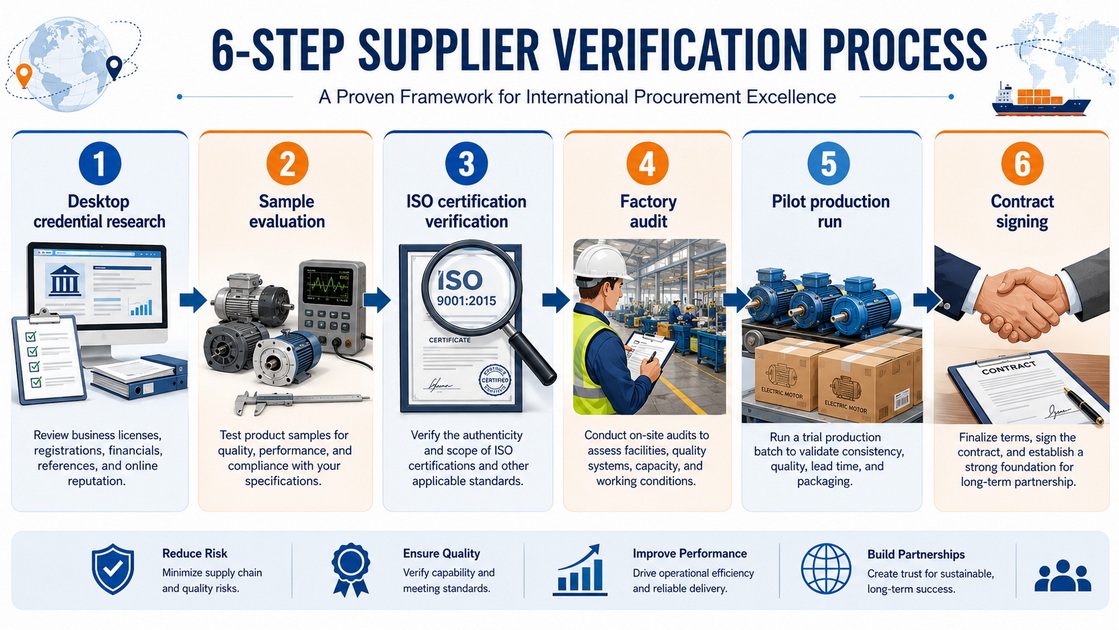
Begin with desktop research validating basic credentials: business license registration, stated years of operation, facility location verification using satellite imagery, and preliminary certification document review. Eliminate suppliers showing red flags such as generic trading company addresses, absence of verifiable production facilities, or recycled product photography.
Create a request for quotation (RFQ) including detailed specifications: KV rating range, stator dimensions, shaft diameter, mounting pattern, wire gauge, connector type, operating voltage range, continuous current rating, peak current capability, and efficiency requirements at specific operating points. Detailed RFQs help differentiate manufacturers with genuine engineering capabilities from resellers quoting generic products.
Request samples from at least three manufacturers, paying for units at standard pricing to ensure receiving production-representative quality rather than hand-selected prototypes. Specify that samples must come from regular production batches with batch numbers and manufacturing dates traceable in the suppliers QC records.
Conduct systematic testing: no-load KV measurement, continuous thrust testing at 50% throttle for thermal stability, peak thrust measurement, efficiency mapping across throttle range, vibration analysis, and disassembly inspection of internal components (magnet quality, bearing specification, wire gauge, solder joint quality).
Document all results quantitatively. Subjective assessments (seems good quality) provide insufficient basis for supplier selection decisions involving thousands of units.
For strategic supplier relationships exceeding $50,000 annual volume, conduct on-site factory audits or engage third-party inspection services like SGS or Bureau Veritas. Virtual audits via video call provide moderate value but cannot substitute for physical inspection of production equipment, material storage conditions, and QC testing infrastructure.
Audit checklist priorities: production equipment maintenance status, calibration records for testing equipment (dynamometers, multimeters, tachometers), raw material traceability systems, work instruction documentation, and employee training records. Well-managed factories maintain organized, documented systems readily accessible for audit review.
Before committing to large-scale orders, execute pilot production runs of 100-500 units. This quantity reveals manufacturing consistency issues invisible in 5-10 piece sample batches. Inspect random samples from the pilot run using the same testing protocols applied to initial samples, comparing performance distributions rather than single-unit results.
Pilot runs also validate the manufacturers packaging adequacy (motors arriving with damaged shafts indicate insufficient protection), documentation accuracy (labeled specifications matching actual performance), and logistics coordination capabilities.
Negotiate payment structures protecting both parties: initial deposit (typically 30%) funds material procurement, mid-production payment (40-50%) upon completion with buyer inspection opportunity, and final payment (20-30%) after delivery confirmation. Avoid 100% advance payment regardless of claimed company policyunless the manufacturer accepts letter of credit arrangements through reputable banks.
Include specific quality acceptance criteria in contracts with defined testing procedures and tolerance ranges. Ambiguous quality clauses (industry standard quality) create dispute resolution challenges. Precise specifications enable objective pass/fail determinations.
French drone operators and manufacturers increasingly emphasize technological sovereignty following supply chain disruptions during 2020-2023 and escalating concerns about dependency on single-source regions. This trend creates opportunities for suppliers demonstrating supply chain transparency, dual-sourcing capabilities, or willingness to establish European inventory positions. [dronefrancais]
The French Ministry of Armed Forces substantial investment in military UAV expansion creates demand patterns distinct from consumer drone markets: emphasis on ruggedization for field deployment, extended warranty expectations, and requirement for long-term spare parts availability. Manufacturers accustomed to consumer electronics product cycles must adapt to defense and industrial service expectations spanning 5-10 years. [factmr]
Environmental compliance receives particular attention in French procurement, with CE marking and RoHS certification functioning as minimum entry requirements rather than differentiators. Forward-looking suppliers are preparing for emerging REACH substance restrictions and developing motor designs facilitating end-of-life recycling in anticipation of expanding extended producer responsibility regulations. [linkedin]
1. How can I verify a Chinese manufacturers ISO 9001 certification hasnt expired or been suspended?
Contact the certification body directly using contact information from their official website. Provide the manufacturers certificate number and company name for verification. Legitimate certification bodies maintain searchable databases showing current certification status, though many require Chinese-language navigation. Request the most recent surveillance audit report—ISO 9001 requires annual surveillance audits, so reports older than 15 months indicate potential certification issues. Additionally, examine the certificates validity period carefully, as certifications typically last three years before requiring recertification. A manufacturer showing a certificate dated more than 2.5 years ago should be actively pursuing recertification. [shieldworksmfg]
2. What performance differences should I expect between N42, N45, and N52 magnet grades in FPV motors?
Magnet grade primarily affects maximum magnetic flux density, directly impacting motor torque and efficiency. N52 magnets (highest commonly available grade) produce approximately 8% stronger magnetic fields than N45 and 12% stronger than N42. In practical terms, identical motor designs using N52 magnets deliver 10-15% higher peak thrust and 5-8% better efficiency at high throttle compared to N42 equivalents. However, N52 magnets show greater sensitivity to temperature demagnetization, losing performance above 80°C operating temperatures. For aggressive racing applications generating significant heat, N45 or specialized high-temperature N grades may outperform N52 in sustained operations. Request magnet grade documentation and consider thermal imaging testing during extended flight profiles to verify performance retention. [linkedin]
3. Should I prioritize lower KV ratings for longer flight times or higher KV for better performance?
KV rating (RPM per volt) represents fundamental motor design optimization requiring careful matching to your specific application. Lower KV motors (1,200-1,800) generate higher torque, enabling larger propeller diameters that produce thrust more efficiently, extending flight times by 20-35% compared to high-KV equivalents in endurance applications. Higher KV motors (2,500-3,800+) excel in racing and freestyle applications requiring rapid acceleration and responsive control authority, though at significant efficiency cost. The global trend toward 3,000+ KV motors reflects growing racing drone popularity, where performance overwhelms endurance considerations. Define your priority mission profile—inspection drones requiring 25+ minute flights need low-KV optimization, while FPV racing platforms prioritizing 3-5 minute aggressive flights benefit from high-KV responsiveness. Manufacturers offering wide KV range customization provide flexibility as your application requirements evolve. [factmr]
4. What minimum order quantities should I expect for custom motor specifications versus catalog products?
Standard catalog products typically require MOQs of 50-100 units from Chinese manufacturers, enabling reasonable pricing without customization costs. Custom specifications involving non-standard KV ratings, shaft lengths, or connector types generally require 300-500 unit MOQs to justify engineering time and production line reconfiguration. Complete custom designs (unique stator dimensions, specialized magnet configurations, integrated sensors) typically demand 1,000+ unit commitments. However, manufacturers specializing in OEM/ODM flexibility like Zhongshan Yuhang Power often accommodate lower custom MOQs (200-300 units) by leveraging modular design platforms where customer-specific elements integrate into standardized base motor architectures. Negotiate MOQ flexibility by accepting longer lead times (allowing manufacturers to batch multiple custom orders) or by committing to multi-year supply agreements providing volume certainty across incremental deliveries. [yuhangmotor]
5. How should I structure quality inspection for a 5,000-unit production run when I cannot inspect every motor?
Implement statistical sampling inspection following internationally recognized standards like ISO 2859 (Acceptance Sampling Procedures). For a 5,000-unit lot with general inspection level II and acceptable quality limit (AQL) of 1.5% for critical defects, sample 200 units randomly selected throughout the production batch. Test these samples across your defined acceptance criteria (KV rating tolerance, thrust output, efficiency, vibration level, visual inspection). If failures exceed the acceptance number defined in sampling tables (typically 7-10 defects in 200 samples for 1.5% AQL), reject the entire batch. Conduct inspection at the manufacturers facility before shipment rather than after delivery to avoid costly return logistics. For critical applications, consider 100% automated testing of key parameters (KV rating, resistance) supplemented by statistical sampling of comprehensive performance testing. Many Chinese manufacturers now offer factory-based third-party inspection services through SGS, Bureau Veritas, or TÜV at costs of $200-400 per day, providing independent verification while motors remain in the manufacturers control for rework if needed. [shieldworksmfg]
1. France Fpv Drone Motors Market Strategic Evolution - LinkedIn (November 26, 2025) [linkedin]
2. Drone Motor Industry Analysis in North America - Fact.MR (July 31, 2025) [factmr]
3. France Drone Market Report 2026 - SourceReady (April 14, 2026) [sourceready]
4. Our 5-Step Comprehensive Process to Verify Chinese Manufacturers - Metafuro (November 10, 2020) [metafuro]
5. Drone Français - Designer and Manufacturer of Drone Electronics (February 23, 2026) [dronefrancais]
6. Drone Motor Market Size & Forecast 2025-2035 - Future Market Insights (May 14, 2026) [futuremarketinsights]
7. Europe Drone Motor Market Share and Growth Statistics - 2035 - Fact.MR (July 30, 2025) [factmr]
8. Finding the Best China Contract Manufacturer with ISO Certification - Shield Works (July 31, 2025) [shieldworksmfg]
9. The Best Drone Motor Manufacturer in China - BG Motor (December 5, 2024) [china-bgmotor]
10. Top 10 FPV Drone Motor Manufacturers in China - Yuhang Power (May 10, 2026) [yuhangmotor]
11. Big Brushless Motor Manufacturers for Drones and eVTOL - Tyto Robotics (May 23, 2024) [tytorobotics]
12. Top 10 Drone Motor Manufacturers in China - Yuhang Power (May 14, 2026) [yuhangmotor]


