Language


Views: 276 Author: Yuhang Power Publish Time: 2026-08-01 Origin: Site
Content Menu
● Multi-Rotor vs Single-Rotor at a Glance
● What Makes Multi-Rotor Drones Popular
● FPV and Industrial Use Cases
● Real-World Selection Framework
● Regulatory and Safety Considerations
>> 1. What is the main difference between multi-rotor and single-rotor drones?
>> 2. Which is better for FPV drones?
>> 3. Which platform carries heavier payloads?
>> 4. Are single-rotor drones more dangerous?
>> 5. Which type is easier to maintain?
Choosing between a multi-rotor drone and a single-rotor UAV is not just a design preference. It is a system-level decision that affects payload capacity, flight endurance, stability, maintenance, safety, and propulsion performance.
For FPV drones, industrial inspection platforms, agricultural aircraft, and custom OEM or ODM projects, the best choice depends on the mission profile rather than on which drone type is better in general.
The drone industry continues to expand, and FPV applications are growing across racing, cinematography, agriculture, inspection, and teleoperated robotics. As these use cases diversify, propulsion systems must support different requirements in speed, endurance, vibration control, and thermal stability.
That growth matters because rotor architecture directly influences the demand placed on motors, ESCs, propellers, and battery systems. In practical terms, the airframe determines what kind of power system will perform reliably in real working conditions.
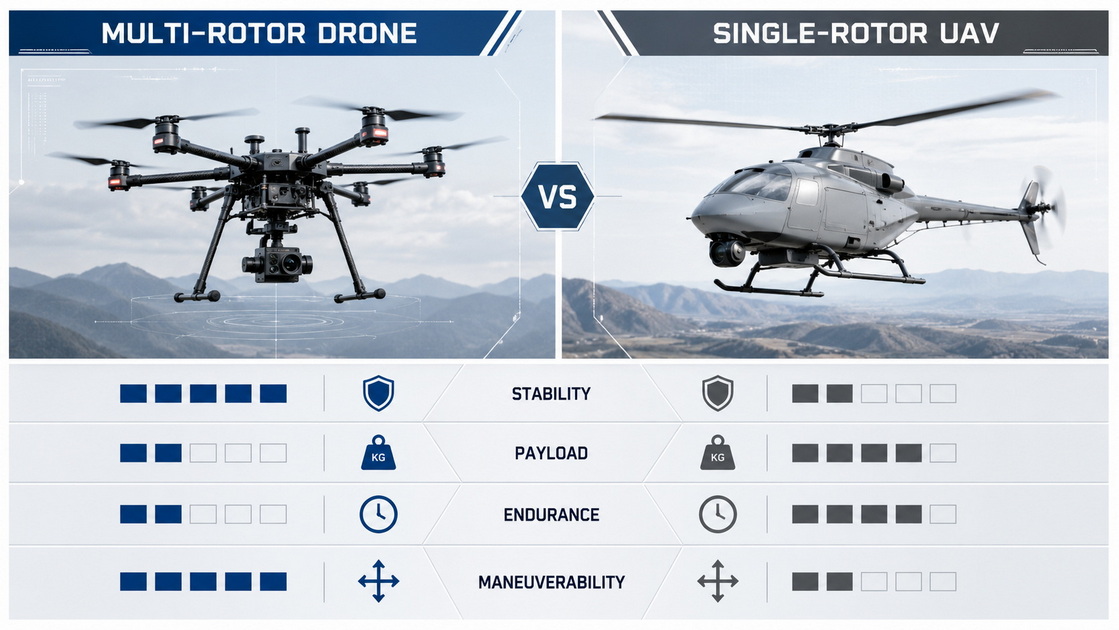
| Factor | Multi-Rotor Drone | Single-Rotor UAV |
|---|---|---|
| Lift method | Multiple smaller rotors share the load | One main rotor generates lift, with tail rotor or equivalent control system |
| Stability | Excellent for hovering and precise framing | Stable when tuned well, but mechanically more complex |
| Payload efficiency | Good for light to medium payloads | Better for heavier payloads and longer endurance |
| Flight time | Usually shorter because multiple motors consume more power | Often longer due to aerodynamic efficiency |
| Maintenance | Simpler and easier for most users | More demanding because of rotor, tail, and vibration components |
| Safety profile | Smaller rotors reduce some mechanical risk | Large blades increase safety concerns |
| Best use cases | FPV, filming, inspections, mapping, short-duration missions | Heavy lift, long hover, industrial missions, specialized operations |
This comparison shows the core tradeoff clearly: multi-rotor drones prioritize control and simplicity, while single-rotor UAVs prioritize endurance and lifting efficiency.
Multi-rotor drones are the dominant choice for FPV flying, aerial filming, and close-range inspection because they are easier to fly, easier to stabilize, and easier to integrate into compact systems. They can hover accurately and make small position corrections quickly, which is ideal for camera work and precise maneuvering.
Their biggest advantage is control. Because multiple rotors share lift and attitude control, the pilot or flight controller can achieve smooth movement, tight turns, and consistent framing. This is one reason multi-rotors remain the preferred architecture for content creation and many commercial applications.
From a manufacturing perspective, multi-rotor platforms also support a broad range of motor sizes, KV options, and lightweight propulsion configurations. That makes them highly adaptable for custom product development.
Single-rotor UAVs are built for efficiency, heavier payloads, and longer endurance. A larger main rotor can generate lift more efficiently than several small rotors, which is why this configuration is often favored in missions that require extended hover time or heavier onboard equipment.
The tradeoff is complexity. Single-rotor systems generally create more vibration and require more careful maintenance, tuning, and operator discipline. They also introduce higher safety risk because of the large moving blades and the mechanical components needed for torque control.
For industrial buyers, the benefit is not just flight time. It is the ability to carry more capable sensors, tools, or payloads without sacrificing operational efficiency. That makes single-rotor UAVs attractive in specialized professional environments.
For FPV racing and freestyle, multi-rotor drones remain the clear standard because they provide rapid response, tight maneuvering, and the high-agility flight behavior pilots want. FPV growth is being driven by racing, filmmaking, agriculture, inspection, and teleoperated systems, all of which favor responsive and compact propulsion architectures.
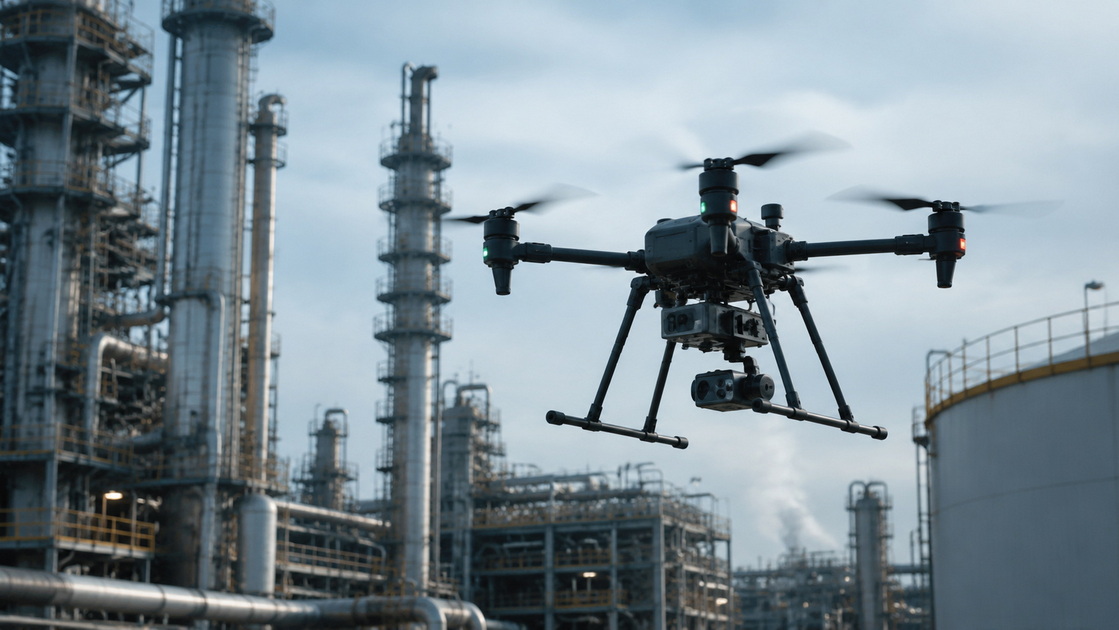
For industrial inspections, multi-rotors are often chosen when the aircraft must hover near structures, hold position in confined spaces, or capture detailed visual data. Inspections of towers, facades, rooftops, and machinery usually benefit from stable low-speed control.
Single-rotor UAVs are stronger candidates when the mission requires long-duration hover, heavy payload support, or special-purpose equipment. This may include large cameras, custom sensors, or mission payloads in engineering and research workflows.
Motor choice should match the aircraft architecture, not the other way around. In multi-rotor systems, the goal is usually fast throttle response, efficient mid-throttle operation, low vibration, and consistent control under rapid changes in direction or altitude.
In single-rotor systems, the priority shifts toward torque, endurance, vibration resistance, and thermal stability over longer operating cycles. The propulsion system must handle larger mechanical loads and still maintain predictable output.
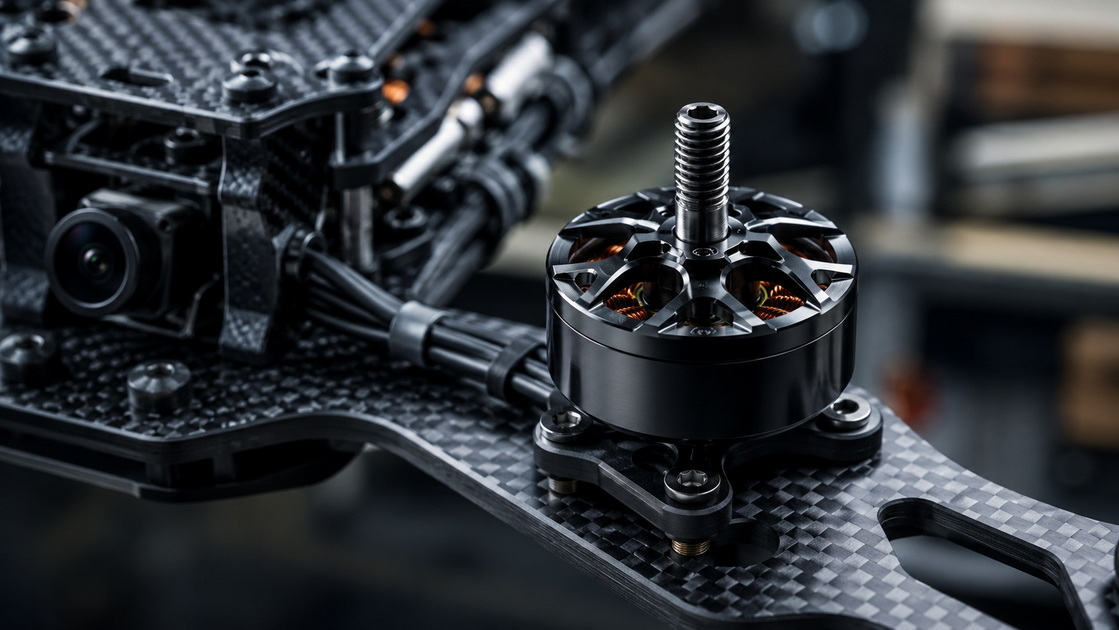
For manufacturers, this is where brushless motor design becomes critical. The motor is not just a component; it is the core of the energy conversion chain that determines how efficiently electrical power becomes thrust.
If you are building a product or choosing a platform for a customer, use this simple framework:
1. Define the mission. Is the aircraft for FPV, inspection, mapping, heavy lift, or specialty robotics?
2. Set the payload target. Camera weight, sensor weight, battery size, and accessory load matter.
3. Choose the endurance requirement. Short flights favor multi-rotors; long hover missions may favor single-rotor systems.
4. Assess vibration tolerance. Sensitive imaging and telemetry systems need stable, low-vibration operation.
5. Check maintenance and safety constraints. Single-rotor aircraft demand more technical discipline and stricter safety procedures.
This approach helps avoid the common mistake of selecting a platform based on appearance rather than system requirements.
For commercial operations in the United States, drone use must follow applicable federal rules, including pilot certification, aircraft registration, line-of-sight requirements, and operating limitations. FPV flights can still be compliant, but they generally require a visual observer to keep the aircraft within unaided sight.
This matters because platform choice can affect operational compliance. Single-rotor aircraft may be suitable for professional missions, but they usually demand stronger operational controls due to size, vibration, and blade safety.
For buyers planning international deployment, local airspace regulations and certification rules should be reviewed before finalizing the propulsion platform or system architecture.
At Zhongshan Yuhang Power Technology Co., Ltd., the most important question is not whether a rotor system is better, but which propulsion solution is best for the application. FPV drones, RC cars, brutal fans, gimbal systems, aircraft, sweep robots, underwater robots, and other specialty equipment all place different demands on torque, speed, efficiency, and reliability.
That is why custom OEM and ODM support is often the real competitive advantage. A well-matched motor platform can improve flight responsiveness, extend service life, reduce vibration, and make system integration easier for the customer.
For engineering-led buyers, this is the most valuable takeaway: the best drone platform is the one whose propulsion system matches the mission profile with the least compromise.
| Buyer Need | Better Choice | Why |
|---|---|---|
| FPV racing | Multi-rotor | Fast response, agility, compact build |
| Aerial filming | Multi-rotor | Stable hover and precise framing |
| Tight-space inspection | Multi-rotor | Better station-keeping and maneuverability |
| Heavy payload hover | Single-rotor | Stronger lift efficiency |
| Long endurance hover | Single-rotor | Better aerodynamic efficiency |
| Simple maintenance | Multi-rotor | Fewer mechanical parts |
| High-safety beginner use | Multi-rotor | Smaller rotor risk and easier control |
This table can help product teams, distributors, and OEM buyers quickly align use case with platform choice.

Multi-rotor drones are the best fit for FPV, precision hovering, and most camera-focused or inspection-focused applications. Single-rotor UAVs become more attractive when payload capacity, endurance, and efficiency matter more than simplicity.
For manufacturers and OEM buyers, the real opportunity is not choosing one architecture universally, but matching the correct motor and propulsion system to the exact mission. That is how you get better performance, lower failure rates, and stronger customer satisfaction.
Multi-rotor drones use several smaller rotors for lift and control, while single-rotor UAVs rely on one main rotor and a tail rotor or similar stabilizing system.
Multi-rotor drones are generally better for FPV because they are more agile, easier to control, and better suited for racing and freestyle flight.
Single-rotor UAVs usually handle heavier payloads more efficiently because the main rotor can generate more lift with better aerodynamic efficiency.
Yes, they can be. Their larger blades and higher mechanical complexity increase safety risk compared with most multi-rotor systems.
Multi-rotor drones are typically easier to maintain because they have fewer complex mechanical parts than single-rotor systems.
1. KDE Direct. "Multi-Rotor vs. Single-Rotor | Which to Use for Your Next Flight Project."
https://www.kdedirect.com/blogs/news/multi-rotor-vs-single-rotor
2. AICorespot. "Single- vs. Multi-Rotor Drones: Which Should You Use?"
https://aicorespot.io/single-vs-multi-rotor-drones-which-should-you-use/
3. Stellar Market Research. "FPV Drone Market Global Industry Analysis and Forecast (2026-2032)."
https://www.stellarmr.com/report/fpv-drone-market/2350
4. FAA. "Small Unmanned Aircraft Systems (Part 107)."
https://www.faa.gov/uas/commercial_operators/part_107
5. FAA. "Certificated Remote Pilots including Commercial Operators."
https://www.faa.gov/uas/commercial_operators/become_a_drone_pilot
6. FAA. "Federal Drone Laws in the United States."
https://www.faa.gov/uas/resources
7. Yuhang Power. Company information and product positioning.
https://www.kdedirect.com/blogs/news/multi-rotor-vs-single-rotor


