Language


Views: 213 Author: Yuhang Power Publish Time: 2026-08-26 Origin: Site
Content Menu
● What Do 4S and 6S Mean in an FPV Motor Setup?
● 4S FPV Motor vs 6S FPV Motor: Core Differences
● Why 6S Uses Lower-KV FPV Motors
● Power, Current, and Battery Sag: The 6S Advantage
● Thrust, Torque, and Flight Feel
>> 4S FPV motor flight characteristics
>> 6S FPV motor flight characteristics
● Motor KV Selection by Drone Size
● Important Compatibility Checks Before Switching to 6S
● Expert Test Method: Select a Motor Using Measured Data
>> Step 1: Define the real operating target
>> Step 2: Test matched motor-and-propeller combinations
>> Step 3: Measure efficiency, not only peak thrust
>> Step 4: Validate thermal margin
● 4S vs 6S: Which FPV Setup Is Worth It?
● Custom FPV Motor Solutions From Yuhang Power
● FAQ
>> 1. Can I use a 4S FPV motor on a 6S battery?
>> 2. What KV motor should I use for a 5-inch 6S FPV drone?
>> 3. Is a 6S FPV drone faster than a 4S FPV drone?
>> 4. Does 6S provide longer FPV flight time?
>> 5. Do I need a 6S-rated ESC for a 6S FPV motor setup?
Choosing between a 4S FPV motor and a 6S FPV motor is really about selecting a complete propulsion system—not simply choosing a different motor label. Battery voltage, motor KV, propeller size and pitch, ESC current rating, frame weight, and flight style must work together.
For most modern 5-inch freestyle and racing builds, a properly matched 6S FPV motor setup offers stronger voltage stability, lower current for the same power target, and more headroom as the battery discharges. A 4S FPV motor setup can still be an excellent choice for pilots who want lower entry cost, already own 4S batteries, or prefer a practical and accessible build.
At Zhongshan Yuhang Power Technology Co., Ltd., we develop and manufacture brushless motor solutions for FPV drones, RC vehicles, high-speed blowers, gimbals, aircraft, robotic vacuum cleaners, and underwater robots. From an engineering perspective, the right choice is not "6S is always better." It is the voltage-and-KV combination that gives your propeller the required thrust, response, efficiency, and temperature margin.
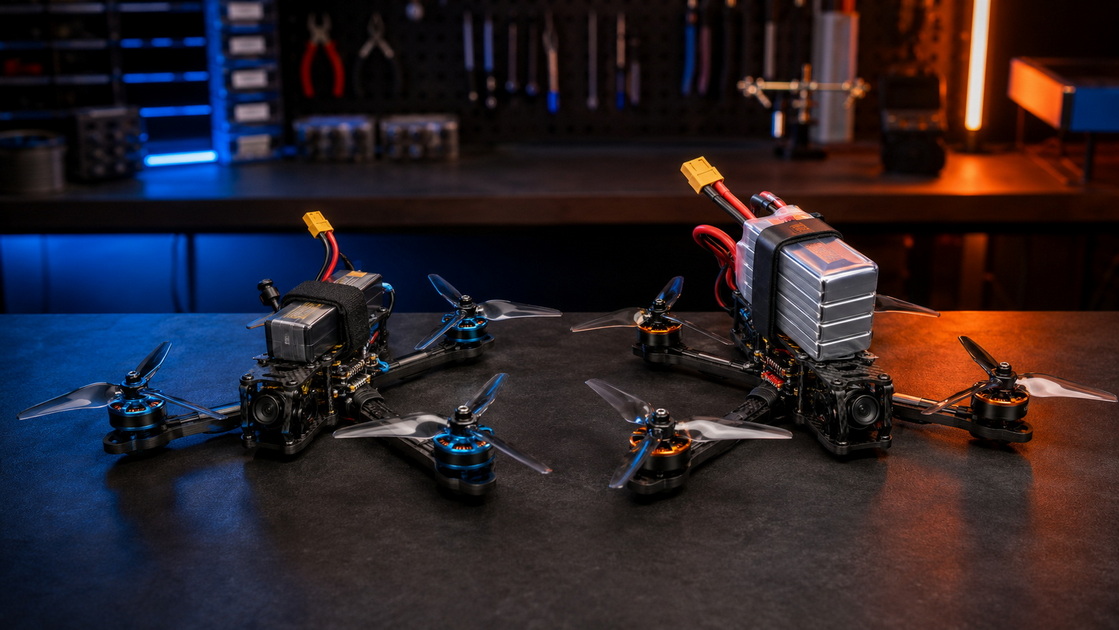
The "S" refers to the number of lithium-polymer battery cells connected in series.
- A 4S LiPo battery has four cells in series.
- A 6S LiPo battery has six cells in series.
- A single LiPo cell has a nominal voltage of 3.7 V and a fully charged voltage of 4.2 V.
- A 4S battery is nominally 14.8 V and reaches 16.8 V when fully charged.
- A 6S battery is nominally 22.2 V and reaches 25.2 V when fully charged.
Therefore, 6S provides 50% higher nominal voltage than 4S. This is why a 6S FPV drone motor must normally use a lower KV rating than a comparable 4S motor.
The basic no-load motor-speed relationship is:
Theoretical RPM=Battery Voltage×Motor KV
KV is not a direct measure of motor quality, torque, or maximum power. It indicates the approximate no-load revolutions per minute per volt. A 2300KV motor running at 16.8 V has a theoretical no-load speed of 38,640 RPM; a 1700KV motor at 25.2 V has a theoretical no-load speed of 42,840 RPM. Real propeller-loaded RPM will be lower because of aerodynamic load, motor resistance, battery sag, ESC timing, and temperature.
Factor | 4S FPV Motor Setup | 6S FPV Motor Setup |
Nominal battery voltage | 14.8 V | 22.2 V |
Fully charged voltage | 16.8 V | 25.2 V |
Typical 5-inch motor KV range | 2300KV–2800KV | 1600KV–2100KV |
Typical motor pairing example | 2207 2500KV | 2207 1750KV |
Current needed for equal power | Higher | Lower |
Battery-voltage sag | Usually more noticeable | Often less noticeable |
Power delivery | Strong, especially with high KV | Smooth, powerful, and sustained |
Best use cases | Budget builds, existing 4S fleets, general freestyle | Modern 5-inch freestyle, racing, demanding payloads |
Component compatibility | Requires 4S-rated ESC and electronics | Requires verified 6S-rated ESC, FC, VTX, and accessories |
Upgrade path | Cost-effective starting point | Better long-term performance headroom |
As a commonly used guideline for 5-inch FPV drones, 4S motors are often selected around 2300KV to 2800KV, while 6S motors are commonly selected around 1600KV to 2100KV. The correct range changes with motor stator size, propeller selection, total drone weight, and intended flight style.
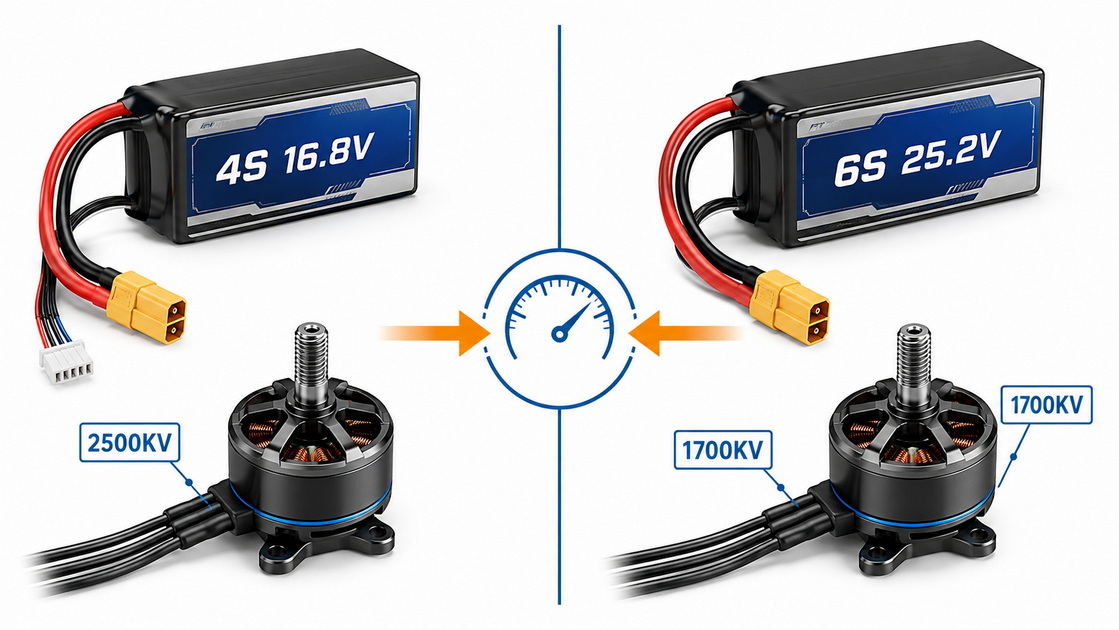
The central technical principle is voltage matching.
Because 6S battery voltage is higher, using the same high-KV motor from a 4S build on 6S can cause excessive RPM, high current draw, overheating, ESC overload, and possible motor failure.
For example:
Setup | Full-Charge Voltage | Motor KV | Theoretical No-Load RPM |
4S FPV setup | 16.8 V | 2500KV | 42,000 RPM |
6S FPV setup | 25.2 V | 1700KV | 42,840 RPM |
6S FPV setup | 25.2 V | 2500KV | 63,000 RPM |
The first two configurations are reasonably comparable because their theoretical motor-speed range is similar. The third configuration is potentially unsafe without a carefully validated motor, propeller, ESC, throttle limit, and cooling strategy.
For a typical 5-inch propeller, a 6S motor around 1700KV to 1900KV is widely used, while 4S commonly uses higher KV values such as 2400KV to 2700KV. An independent FPV motor-selection guide gives examples such as 2207 motors at 1855KV for 6S and 2755KV for 4S.
Electrical power can be described as:
P=V×I
Where P is power, V is voltage, and I is current.
For the same power requirement, a higher-voltage system can supply that power at lower current. If a drone needs 1,000 W:
- At 16.8 V, the system needs almost 60 A.
- At 25.2 V, the system needs less than 40 A.
This does not mean that every 6S drone automatically flies longer. Flight time depends on battery energy in watt-hours, battery mass, propeller efficiency, throttle habits, and aircraft weight. But lower current can reduce stress on battery leads, connectors, ESCs, and internal battery resistance.
A 6S battery can also maintain a more consistent feel later in the flight. As voltage falls, a 4S build often experiences a more obvious reduction in motor response. This is why many experienced pilots prefer 6S for aggressive freestyle and racing.
A 6S battery has 50% higher nominal voltage than 4S, and FPV testing guidance highlights the lower-current advantage for equivalent power output.
Pilots often describe 6S as "more powerful," but the real difference is more precise: a well-matched 6S propulsion system can deliver the required propeller RPM with lower current and greater voltage reserve.
A tuned 4S setup can feel fast, direct, and highly enjoyable. It remains a capable option for:
- Beginner and intermediate FPV pilots
- Budget-conscious 5-inch builds
- Pilots who already own several 4S batteries and chargers
- Lightweight freestyle quads
- 4-inch and smaller builds with correctly matched motor KV
A 4S 5-inch quad with 2207 2500KV motors can provide strong punch-out performance. The trade-off is that it may draw more current during aggressive throttle inputs, which can cause more voltage sag and warmer electronics.
A 6S system is especially effective for pilots who want:
- More stable power delivery through the flight
- Strong recovery after dives and sharp turns
- Higher thrust margin for heavy digital FPV systems
- Better consistency during fast racing laps
- Greater tuning headroom for modern freestyle builds
The best 6S experience does not come from maximum KV. It comes from balancing stator size, winding KV, magnet strength, bearing quality, cooling, propeller load, and ESC capability.
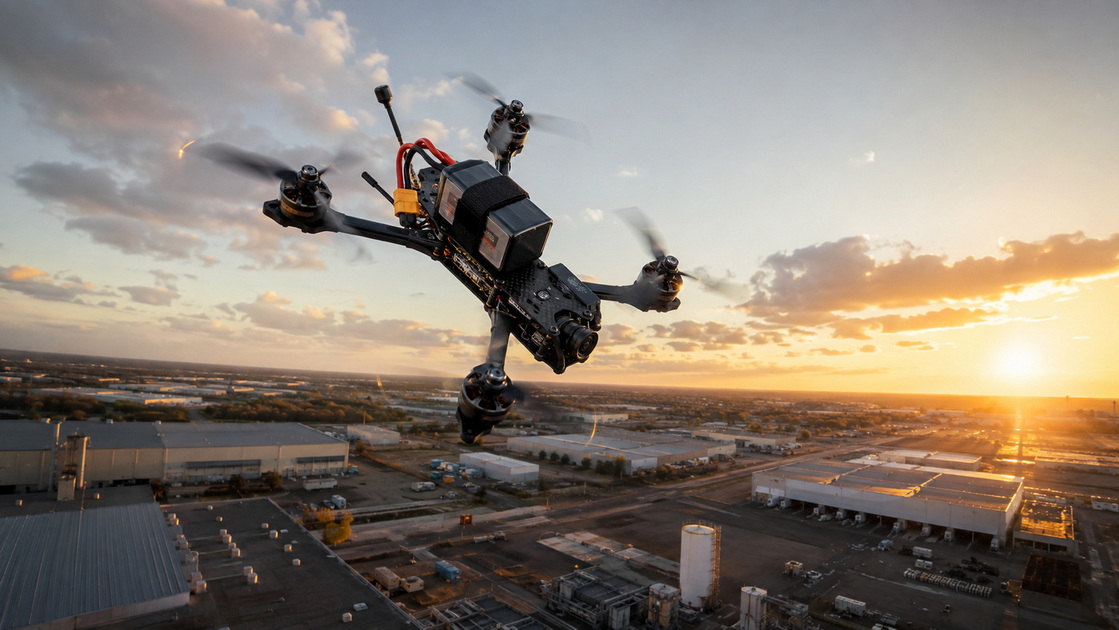
Motor KV should never be selected by battery voltage alone. Larger propellers impose more load and generally require lower KV, while smaller propellers can operate efficiently at higher KV.
Drone Class | Typical Propeller Size | Common 4S KV Direction | Common 6S KV Direction |
Micro FPV / whoop | 1–2.5 inch | High KV, application-specific | Less common; application-specific |
Lightweight freestyle | 3–4 inch | Approximately 2600KV–4000KV | Approximately 1800KV–3000KV |
Standard freestyle / racing | 5 inch | Approximately 2300KV–2800KV | Approximately 1600KV–2100KV |
Long-range FPV | 6–7 inch | Lower KV, carefully matched | Approximately 1200KV–1700KV, carefully matched |
These ranges are starting points, not universal specifications. A heavier frame, high-pitch propeller, duct system, camera payload, or high-altitude operation can change the ideal motor selection.
For example, an FPV motor-selection guide suggests 2000KV for a 4-inch 6S build, 2300KV–2600KV for a 5-inch 4S build, and 1200KV–1600KV for 7-inch configurations.
Switching from 4S to 6S is not as simple as changing the battery and motors. Every power-path component must be rated for the higher voltage.
Before installing a 6S LiPo battery, confirm:
1. ESC voltage rating: The ESC must be explicitly rated for 6S operation.
2. Flight controller input rating: Verify direct battery input, BEC limits, and voltage regulator specifications.
3. FPV camera and video transmitter rating: Some systems require regulated power rather than direct battery voltage.
4. Capacitor voltage rating: Use an appropriately rated low-ESR capacitor; inadequate voltage ratings can cause failure.
5. Motor KV and propeller pairing: Lower-KV motors are normally required for full-power 6S operation.
6. Connector and wiring condition: Ensure XT60 or other connectors, solder joints, and battery leads are in good condition.
7. Firmware throttle settings: A motor-output limit can help testing, but it is not a replacement for properly matched hardware.
Software can limit motor output and make certain cross-voltage setups possible. However, compatibility should never be assumed. A 4S-rated high-KV motor running directly on a 6S battery may overheat or fail if the system is not properly configured.
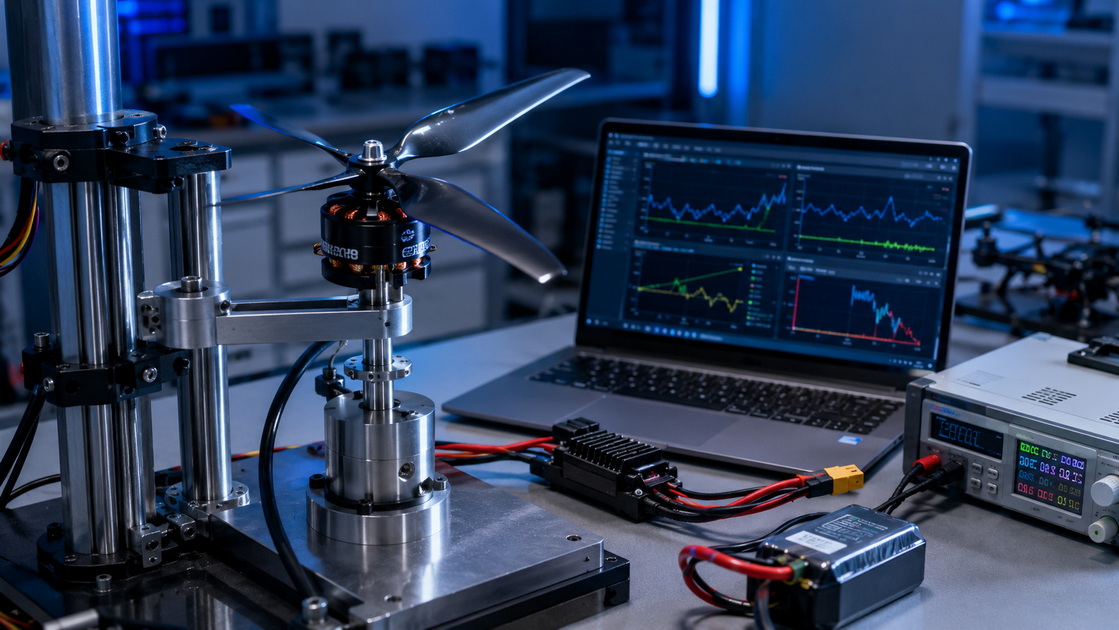
Marketing thrust figures are useful, but they do not replace a controlled test. For OEM, ODM, and professional drone projects, we recommend a structured validation process.
Document:
- Aircraft takeoff weight
- Desired thrust-to-weight ratio
- Battery configuration and capacity
- Propeller diameter, blade count, and pitch
- Required flight time
- Payload weight
- Ambient temperature and intended operating altitude
Test multiple combinations using the same ESC, battery condition, and propeller family. Record:
- Static thrust
- Current draw
- Input power
- Motor temperature
- ESC temperature
- Vibration level
- Noise
- Battery voltage under load
Use the following practical metric:
Efficiency=Thrust/Electrical Power
A motor that produces the highest maximum thrust may not be the most efficient choice for a long-range drone, cinematic platform, robotic application, or battery-sensitive design.
A motor that performs well for a 10-second bench test may become unreliable after repeated throttle changes in flight. Assess windings, magnets, bearings, ESC temperature, and propeller loading over realistic flight cycles.
This test-led approach is especially important for OEM and ODM projects, where consistent performance, service life, supply continuity, and production tolerances matter as much as peak flight performance.
Choose a 4S FPV motor setup if you are building on a controlled budget, own a 4S battery fleet, are learning FPV maintenance, or want a reliable configuration with readily available components.
Choose a 6S FPV motor setup if you want modern 5-inch performance, more consistent power under load, lower current for a given power target, and better headroom for aggressive freestyle, racing, or heavier equipment.
For most new performance-oriented 5-inch builds, 6S with appropriately lower-KV motors is usually the stronger long-term choice. For commercial product development, the correct answer must be validated through thrust, efficiency, heat, vibration, and flight testing.
Zhongshan Yuhang Power Technology Co., Ltd. develops and manufactures brushless motors and complete power-system solutions for FPV drones, RC vehicles, high-speed fans, gimbal cameras, aircraft, robotic vacuum cleaners, underwater robots, and specialized equipment.
We support OEM and ODM brushless motor projects, including customization of:
- Stator dimensions and motor KV
- Winding configuration and wire specification
- Magnet grade and rotor design
- Shaft length and mounting pattern
- Bearing configuration
- Wire length and connector options
- Propeller-load and voltage optimization
- Branding, packaging, and quality-control requirements
Send us your drone size, battery voltage, propeller specification, takeoff weight, target thrust, and target market. Our engineering team can help develop a customized 4S or 6S FPV motor solution for your application.
Not at full output unless the motor KV, propeller load, ESC rating, and throttle limit have been carefully validated. A typical 4S high-KV motor can overspeed, overheat, or damage the ESC when directly powered by 6S.
For many 5-inch FPV drones, 1600KV–2100KV is a practical starting range. Freestyle builds often use approximately 1700KV–1900KV, while the correct final selection depends on motor size, propellers, total weight, and desired flight feel.
Not automatically. A properly matched 4S system can be very fast. A properly matched 6S setup can provide lower-current power delivery and more consistent performance, but speed ultimately depends on motor KV, propellers, drone weight, drag, tuning, and pilot control.
Not by voltage alone. Compare battery energy in watt-hours, aircraft weight, motor efficiency, propeller efficiency, and flight style. A heavier 6S battery may offset some efficiency benefits in a lightweight build.
Yes. The ESC, flight controller power path, capacitor, and every directly connected component must be rated for the maximum fully charged 6S voltage of 25.2 V.
1. Oscar Liang. "[6S vs 4S LiPo for FPV Drones: Which Battery Voltage Is Better?]" Updated January 11, 2025.
2. Oscar Liang. "[How to Choose FPV Drone Motors]" Updated March 31, 2026.
3. Oscar Liang. "[Using LiPo Batteries for FPV Drones: Beginner's Guide]" Updated August 4, 2026.
4. Oscar Liang. "[You Can Use Both 4S and 6S LiPo on the Same Motors]" Updated May 31, 2023.
5. Oscar Liang. "[Testing 6S Mini Quad With High-KV Motors]" Updated May 26, 2019.
6. BETAFPV. "[Pavo20 Pro II Brushless Whoop Quadcopter]." Accessed August 2026.


