Language


Views: 202 Author: Yuhang Power Publish Time: 2026-08-27 Origin: Site
Content Menu
● How a Quadcopter Drone Works
● The Four Forces That Affect Drone Flight
● Differential Thrust: How Drones Move
>> Hover: balanced lift and torque
>> Pitch: forward and backward movement
>> Roll: left and right movement
>> Yaw: rotation around the vertical axis
● Essential Drone Components and Their Functions
>> Frame: the structural foundation
>> Brushless drone motors: the propulsion source
>> Propellers: where motor power becomes thrust
>> ESC: the electronic motor controller
>> Flight controller and sensors
● Battery Design, Power Delivery, and Safety
● Expert Validation Method for Drone Propulsion Systems
>> Step 1: Define the operating requirement
>> Step 2: Test the motor, propeller, ESC, and battery together
>> Step 3: Confirm thermal and vibration margin
● Drone Types and Propulsion Requirements
● Compliance and Operational Readiness
● Build a Better Drone Power System With Yuhang Power
● FAQ
>> 1. How does a quadcopter hover?
>> 2. Why do drone propellers rotate in opposite directions?
>> 3. What is the difference between a brushless motor and an ESC?
>> 4. What does KV mean on an FPV drone motor?
>> 5. How do drones move forward without wings?
A drone is not simply a flying camera or a remote-controlled aircraft. It is a tightly integrated unmanned aerial system in which motors, propellers, ESCs, batteries, sensors, and flight-control software make continuous corrections to generate stable flight.
For FPV drones, industrial multirotors, RC aircraft, robotics platforms, and OEM equipment, the propulsion system is particularly important. The quality of the brushless drone motor, propeller match, ESC response, battery capability, and frame stiffness directly affects thrust, efficiency, vibration, handling, safety, and service life.
At Zhongshan Yuhang Power Technology Co., Ltd., we develop and manufacture brushless motors and complete power-system solutions for FPV drones, racing quadcopters, RC cars, high-speed fans, gimbal cameras, aircraft, robotic vacuum cleaners, underwater robots, and customized equipment. In real product development, good drone performance does not come from one "powerful" component. It comes from a correctly matched system.

Most FPV and consumer camera drones use a multirotor design, commonly with four motors. Instead of relying on wings to create lift like a fixed-wing airplane, a quadcopter generates lift by accelerating air downward through its propellers.
The basic relationship is straightforward:
- Each propeller creates upward thrust.
- The combined thrust of all motors must equal the drone's weight to hover.
- Combined thrust greater than weight causes ascent.
- Combined thrust lower than weight causes descent.
- Uneven thrust between motors tilts or rotates the drone.
The propulsion system converts electrical energy from the battery into mechanical rotation. The propeller converts rotational power into airflow and thrust. The flight controller constantly measures motion and sends commands to each ESC, which adjusts motor speed.
A drone does not remain stable because its motors rotate at one fixed speed. It remains stable because the control system makes very small, rapid speed changes across all motors.
Drone flight is governed by the same physical forces that affect other aircraft. However, a multirotor manages them differently because it uses thrust vectoring rather than aerodynamic control surfaces.
| Force | What It Does | How a Drone Manages It |
|---|---|---|
| Lift | Upward force opposing gravity | Propellers accelerate air downward |
| Weight | Downward gravitational force | Lower total thrust keeps the aircraft descending |
| Thrust | Propeller-generated force | Motor speed changes control altitude and movement |
| Drag | Air resistance opposing motion | Frame, propellers, payload, and speed affect drag |
For hovering, the drone must maintain a balance:
Total Thrust=Aircraft Weight
For ascent:
Total ThrustAircraft Weight
For controlled forward movement, the drone tilts forward. Its thrust vector then has both an upward component that supports weight and a horizontal component that moves the aircraft forward.
This is why a quadcopter must usually increase total thrust when pitching or rolling aggressively. Without extra thrust, tilting the aircraft would reduce the upward force and cause altitude loss.

A multicopter moves by changing the speed of individual motors. This is called differential thrust.
Most quadcopters use two clockwise-rotating and two counterclockwise-rotating propellers. Opposing motor rotation helps cancel the reaction torque that would otherwise spin the aircraft body.
To hover, all four motors create enough combined thrust to equal the drone's total weight. Clockwise and counterclockwise propellers are balanced so that their rotational torque cancels out.
The flight controller still makes constant small corrections during hover because wind, changing battery voltage, vibration, and pilot inputs continuously disturb the aircraft.
To fly forward, a quadcopter increases thrust at the rear motors and decreases thrust at the front motors. The aircraft pitches forward, and its angled thrust vector produces forward movement.
To move backward, the process reverses.
To move left, the drone increases thrust on its right-side motors and decreases thrust on its left-side motors. This creates a left roll angle and a sideways thrust component.
To move right, it increases left-side thrust and reduces right-side thrust.
Yaw rotates the drone left or right without requiring a major change in tilt.
To yaw, the flight controller changes the balance between clockwise and counterclockwise motor groups. It increases speed in one rotation direction while reducing speed in the opposite direction. Total lift is kept as stable as possible, but the torque imbalance rotates the aircraft.
The standard definitions are:
- Roll: Rotation around the front-to-back axis
- Pitch: Rotation around the side-to-side axis
- Yaw: Rotation around the vertical axis
A drone is a connected system. A high-performance motor cannot compensate for an undersized ESC, a weak battery, a vibrating frame, or poor flight-controller tuning.
| Component | Primary Function | Selection Considerations |
|---|---|---|
| Frame | Holds all components and supports loads | Weight, stiffness, arm design, vibration resistance |
| Brushless motors | Convert electrical power into rotation | Stator size, KV, torque, bearings, cooling, voltage |
| Propellers | Convert motor rotation into thrust | Diameter, pitch, blade count, material, balance |
| ESC | Controls motor speed from FC commands | Current rating, voltage rating, firmware, cooling |
| Flight controller | Stabilizes and controls the drone | Gyroscope quality, processor, firmware, I/O |
| LiPo or Li-ion battery | Stores and supplies electrical energy | Voltage, capacity, discharge capability, weight |
| Receiver | Receives pilot commands | Protocol, range, latency, failsafe behavior |
| GPS module | Provides position and navigation data | Satellite reception, accuracy, antenna placement |
| Camera and VTX | Provide FPV video transmission | Resolution, latency, power requirement, heat |
| Payload | Performs mission work | Weight, power draw, mounting, vibration isolation |
The frame is the drone's skeleton. Carbon fiber is widely used in FPV and professional multirotors because it offers high stiffness relative to weight.
A flexible frame can transmit vibration into the flight controller. That vibration can degrade gyro data, complicate tuning, generate oscillations, reduce video quality, and increase component fatigue.
A practical design rule is simple: keep the center of gravity close to the geometric center of the airframe. An unbalanced battery, camera, or payload makes stabilization work harder and can reduce handling consistency.
Modern FPV and professional multirotors normally use three-phase brushless DC outrunner motors. The stationary stator contains copper windings, while the outer bell rotates with permanent magnets and drives the propeller.
The ESC energizes stator phases in sequence, generating a rotating magnetic field that turns the rotor.
When choosing an FPV drone motor, consider:
- Stator size: Influences torque potential, weight, and propeller compatibility
- KV rating: Approximate no-load RPM per volt; it must match battery voltage and propeller load
- Magnet design: Affects torque response and efficiency
- Winding quality: Affects electrical resistance, heat, and consistency
- Shaft and bearing design: Influences durability and smoothness
- Mounting pattern: Must match the frame and propeller system
- Cooling path: Important for high-current racing, heavy payloads, and hot environments
For example, a 5-inch 6S FPV drone often uses lower-KV motors than an equivalent 4S drone because the 6S battery has higher voltage. The correct choice should be based on measured thrust, current, temperature, and real flight behavior—not only a published KV number.
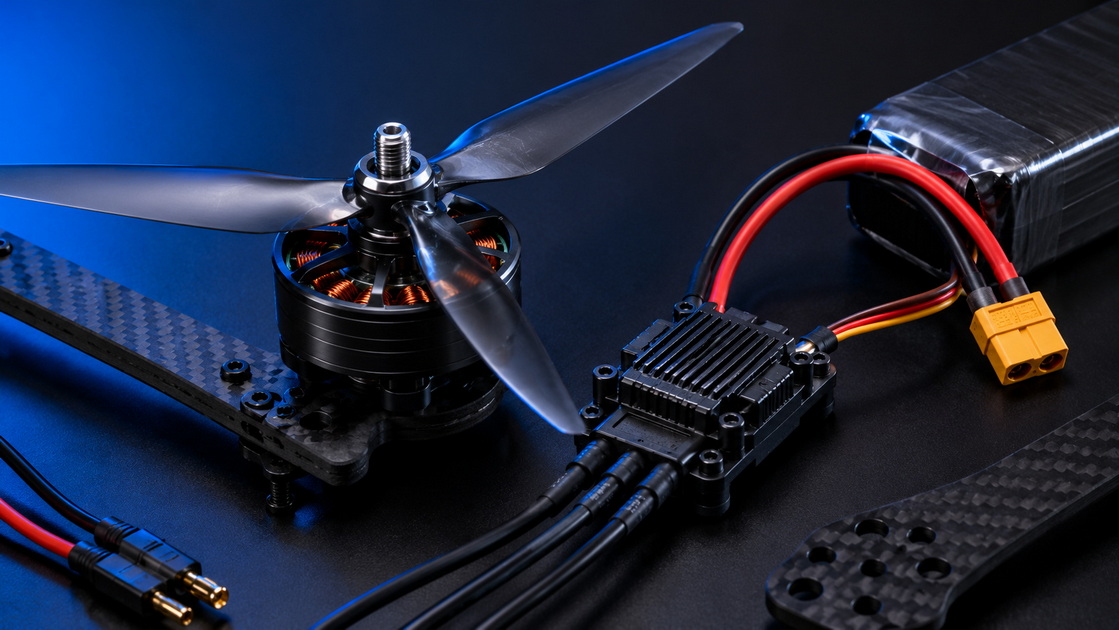
Propellers are not accessories. They are aerodynamic components that determine how the motor load is translated into thrust and efficiency.
Key variables include:
- Diameter: Larger diameter generally moves more air and can create more lift at lower RPM
- Pitch: Higher pitch can increase speed potential but raises motor load and current draw
- Blade count: More blades can improve grip and response but often reduce efficiency
- Material: Stiffness, durability, balance, and impact resistance affect flight behavior
- Balance: Poor balance can cause vibration, heat, and unstable flight-control performance
A steep, aggressive three-blade propeller may be suitable for a racing quad. A lower-pitch propeller may be better for longer flight time, reduced motor temperature, or smoother cinematic operation.
The electronic speed controller, or ESC, is the power-management link between the battery, flight controller, and motor.
The flight controller sends a digital speed request. The ESC converts battery energy into precisely timed three-phase electrical pulses that rotate the brushless motor. ESC performance affects throttle smoothness, motor timing, heat generation, current handling, and response speed.
For reliable system design, the ESC must have:
- A current rating appropriate for peak load
- A voltage rating appropriate for the battery
- Adequate heat dissipation
- Compatible firmware and signal protocol
- Quality capacitors and wiring
- A safety margin for aggressive throttle changes
Selecting an ESC only by the highest printed amp rating is risky. Real current capability changes with airflow, ambient temperature, PCB design, MOSFET quality, wire length, propeller load, and battery condition.
The flight controller is the drone's decision-making center. It receives pilot commands and sensor data, then adjusts the motors to maintain the intended attitude.
Its inertial measurement unit typically includes:
- Gyroscope: Measures angular velocity
- Accelerometer: Measures linear acceleration
- Barometer: Supports altitude estimation in some systems
- Magnetometer: Supports heading information where fitted
- GPS: Supports position hold, return-to-home, navigation, and mission functions
The controller compares intended motion with actual motion. It then uses control logic—commonly PID control—to calculate motor corrections.
In practical terms, the flight controller performs a feedback loop: sense the drone's movement, calculate the error, command a correction, and repeat at high speed.
NASA describes UAS flight-control architectures that compare aircraft position, heading, and orientation with programmed data to determine control inputs needed to maintain the intended course.
FPV drones commonly use LiPo batteries because they can deliver high current in a lightweight package. Long-range and endurance platforms may use Li-ion battery packs where energy density is more important than maximum burst current.
Battery selection should consider:
- Cell count and operating voltage
- Capacity in mAh
- Energy in watt-hours
- Maximum continuous and burst discharge capability
- Battery mass
- Connector and wire capacity
- Expected current draw
- Charging and storage requirements
For a LiPo pack:
For example, a 6S 1300mAh LiPo battery has approximate nominal energy of:
22.2×1300/1000=28.86 Wh
Higher voltage does not automatically mean longer flight time. Flight time depends on total energy, aircraft mass, propulsion efficiency, flight speed, weather, payload, and pilot behavior.
Lithium batteries require disciplined handling. The FAA warns that lithium batteries can catch fire if damaged or if terminals are short-circuited, and spare lithium batteries are prohibited in checked luggage. For air travel, battery size limits and airline approval rules may also apply; the FAA states that batteries up to 100 Wh are allowed in passenger baggage, while 101–160 Wh batteries require air-carrier approval.
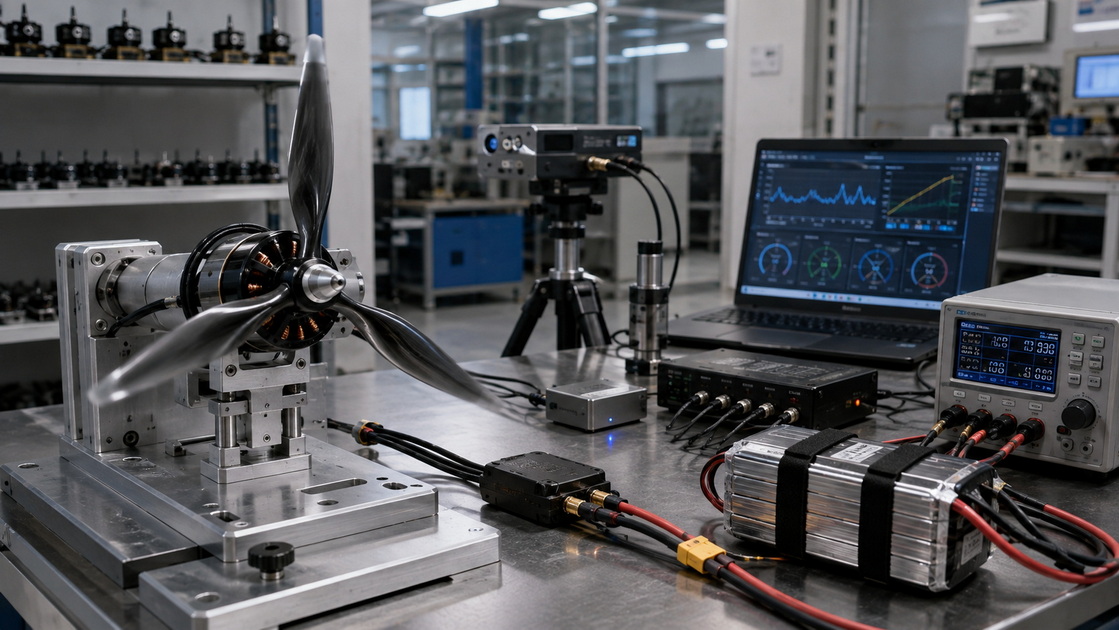
A reliable drone propulsion system should be validated with data before entering mass production. This is particularly important for OEM and ODM projects, where manufacturing consistency and product reliability affect warranty costs and brand reputation.
Specify:
1. Takeoff weight and payload weight
2. Drone type and mission profile
3. Battery voltage and capacity
4. Propeller diameter, pitch, and blade count
5. Target flight time
6. Required thrust-to-weight ratio
7. Ambient temperature and altitude
8. Noise, vibration, and reliability targets
Bench testing should record:
- Static thrust
- Current draw
- Input power
- Motor temperature
- ESC temperature
- Voltage sag
- Vibration
- Noise
- Throttle response
The relevant measure is not just maximum thrust. A high-thrust motor can still be a poor selection if it creates excessive heat, battery sag, vibration, or poor endurance.
A useful engineering metric is:
Propulsion Efficiency=Thrust/Electrical Power
A short thrust-bench test is not enough. Run repeated load cycles that represent actual use, such as punch-outs, climbs, braking, and rapid throttle changes.
Evaluate windings, magnets, bearings, solder joints, ESC MOSFETs, and frame fasteners. In professional applications, temperature margin and vibration resistance are often more important than peak thrust.
Different airframes need different power-system priorities.
| Drone Type | Primary Strength | Propulsion Priority |
|---|---|---|
| FPV racing drone | Speed and rapid response | High power-to-weight ratio and fast throttle response |
| Freestyle quadcopter | Control authority and durability | Torque, smoothness, crash resistance, thermal margin |
| Camera drone | Stable imaging | Low vibration, efficiency, stable hovering |
| Agricultural drone | Payload and operational coverage | High thrust, reliability, large propellers, redundancy |
| Inspection drone | Precision and stable flight | Endurance, low vibration, safety features |
| Fixed-wing UAV | Long-range efficiency | Efficient propeller and motor combination |
| Underwater robot | Controlled underwater movement | Sealed motor or thruster design, corrosion resistance |
The original article correctly identifies structure, propulsion, control, and power as the main drone subsystems. Its main information gap is that it does not show how to select and validate these subsystems as one engineering package. For product developers, system matching and test data are what convert a working drone into a reliable commercial platform.
Hardware performance is only one part of a successful drone project. Operators must also understand local aviation, registration, insurance, privacy, radio-frequency, and battery-transport rules.
In the United States, the FAA states that drones must generally be registered unless they weigh 0.55 lb / 250 g or less and are flown under the limited recreational exception. Drones required to be registered must comply with Remote ID requirements. Rules vary by jurisdiction, intended use, aircraft weight, payload, and operating environment, so operators should confirm current local requirements before flight.
Zhongshan Yuhang Power Technology Co., Ltd. provides brushless motor manufacturing, R&D support, and customized power-system solutions for FPV drones, racing drones, RC vehicles, gimbal equipment, aircraft, fans, robotic cleaning equipment, and underwater robots.
We support OEM and ODM development for:
- Custom stator dimensions and KV ratings
- Winding specification and wire length
- Magnet and rotor configuration
- Shaft, bearing, and mounting customization
- Propeller-load matching
- Voltage and ESC compatibility
- Branding, packaging, and quality-control requirements
Send us your drone drawing, payload, battery voltage, propeller specification, target thrust, expected flight time, and application environment. Our engineering team can help develop a tested brushless motor and propulsion-system solution for your project.
A quadcopter hovers when the total upward thrust produced by its propellers equals its total weight. The flight controller makes constant small motor-speed corrections to counter wind, vibration, and attitude changes.
Opposite rotation cancels the reaction torque generated by spinning propellers. Without this balance, the drone body would rotate uncontrollably in the opposite direction.
A brushless motor creates mechanical rotation. The ESC receives commands from the flight controller and supplies timed three-phase power to control the motor's speed.
KV is the approximate no-load RPM a motor produces per volt. It must be matched with battery voltage, propeller size, load, and desired performance. Higher KV is not automatically better.
The flight controller speeds up rear motors and slows front motors, tilting the drone forward. The angled thrust vector then creates a forward force while maintaining enough upward lift to stay airborne.
1. YR Drone. "[Working Principle and Components of Drone]." Accessed August 2026.
2. NASA Glenn Research Center. "[Aircraft Rotations]." Updated July 21, 2022.
3. Smithsonian National Air and Space Museum. "[Roll, Pitch, and Yaw]." Accessed August 2026.
4. NASA Technology Transfer Program. "[Low Weight Flight Controller Design]." Accessed August 2026.
5. Federal Aviation Administration. "[How to Register Your Drone]." Updated March 18, 2024.
6. Federal Aviation Administration. "[Lithium Battery Resources]." Accessed August 2026.
7. Federal Aviation Administration. "[Lithium Batteries in Baggage]." Accessed August 2026.


