Language


Views: 210 Author: Yuhang Power Publish Time: 2026-08-29 Origin: Site


Content Menu
● Top 10 FPV Motor Manufacturers
>> 1. Zhongshan Yuhang Power Technology Co., Ltd. / LN-MOTOR
>> 2. T-MOTOR
>> 4. EMAX
>> 5. iFlight
>> 6. GEPRC
>> 7. RCINPOWER
>> 9. MEPSKING
>> 10. HGLRC
● Capacity, MOQ, and Certification Comparison
● FPV Motor Technical Checklist
>> Key specifications to confirm
>> The overlooked internal pitfall: the "approved sample is not production sample" gap
● FAQ
>> 2. Is a CE certificate enough to prove that an FPV motor meets EU requirements?
>> 3. What factory data should I request before approving an FPV motor sample?
>> 5. What MOQ should I expect for customized FPV motors in China?
China remains the world's most important supply base for FPV drone motors and related propulsion components. The strongest ecosystem is concentrated in Guangdong's Greater Bay Area—especially Shenzhen, Dongguan, Huizhou, Zhongshan, and nearby cities—where motor factories can access CNC machining, magnets, bearings, winding materials, ESC suppliers, FPV assemblers, and export logistics within a short supply radius. Shenzhen alone has more than 1,700 enterprises connected to the low-altitude economy supply chain.
For procurement managers, choosing a Chinese FPV motor manufacturer should not mean choosing the lowest unit price. A suitable long-term supplier must demonstrate repeatable performance, batch consistency, traceable material sourcing, responsive engineering support, stable delivery, and clear OEM/ODM boundaries.
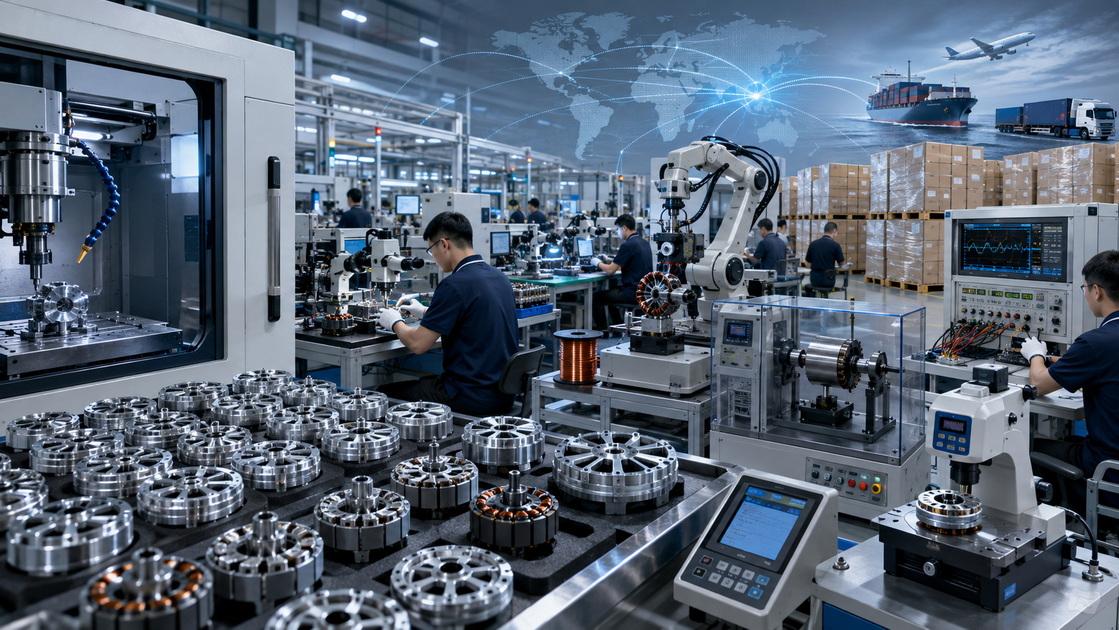
This is not a ranking based solely on brand popularity. The manufacturers and brands below were selected based on their relevance to FPV propulsion, demonstrated market presence, product specialization, and suitability for different buyer profiles.
Key evaluation dimensions include:
- Manufacturing specialization: Whether the supplier genuinely develops and produces brushless motors rather than only reselling finished FPV products.
- R&D and engineering support: Ability to customize stator size, KV rating, winding configuration, shaft, bearings, wires, mounting pattern, color, packaging, and performance targets.
- Quality-control process: Incoming inspection for magnets, bearings, stator laminations, shafts, and copper wire; plus dynamic balancing, no-load current testing, vibration checks, and final appearance inspection.
- Production stability: Capacity planning, component inventory, order tracking, batch traceability, and realistic delivery commitments.
- Market validation: Presence in FPV racing, freestyle, cinematic, long-range, industrial UAV, RC, or gimbal applications.
- Compliance readiness: Ability to provide relevant materials declarations and, where applicable, support documentation for RoHS, CE-related product integration, REACH, or customer-specific testing.
- OEM/ODM suitability: Whether the company can support private-label orders, differentiated technical specifications, custom packaging, and smaller brand development.
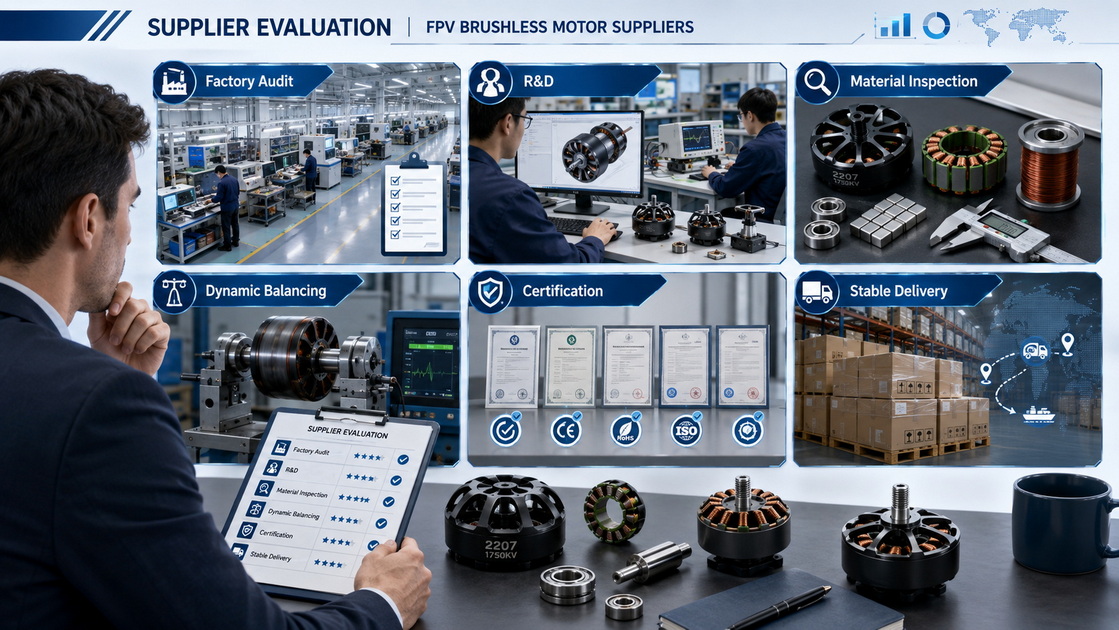
China's advantage is not only lower labor cost. The real purchasing advantage comes from its dense, interconnected manufacturing network.
A motor project may require aluminum bell machining, stator laminations, N-series magnets, copper winding, bearings, epoxy, silicone wire, anodizing, laser marking, packaging, ESC matching, and propeller testing. In South China, many of these upstream and downstream capabilities are available locally, reducing communication loops and supporting faster engineering changes.
The broader drone market continues to expand. One 2025 market estimate valued the global commercial drone market at USD 17.34 billion and projected growth to USD 65.25 billion by 2032, although market-size figures vary according to definitions and coverage. The FPV racing drone segment has also been projected to grow rapidly, driven by hobby, cinematic, long-range, and specialist-use demand.
For buyers, this means supplier choice should be based on the intended application—not simply on whether a motor is marketed as an "FPV motor."
| Manufacturer / Brand | Location | Core Strength | Suitable Buyer Type | OEM/ODM Orientation |
|---|---|---|---|---|
| Zhongshan Yuhang Power Technology Co., Ltd. / LN-MOTOR | Zhongshan, Guangdong | Flexible brushless-motor customization and multi-application power solutions | Growing FPV brands, distributors, specialized equipment makers | High |
| T-MOTOR | Nanchang, Jiangxi | Professional UAV propulsion systems and established global market presence | Premium UAV, VTOL, industrial, and branded FPV buyers | High |
| BrotherHobby | Shenzhen, Guangdong | FPV racing/freestyle motors and precision brushless motor manufacturing | FPV brands, racing and freestyle distributors | Medium to high |
| EMAX | Dongguan, Guangdong | Integrated FPV hardware portfolio, motors, drones, ESCs, and electronics | Mass-market FPV and retail-oriented brands | Medium |
| iFlight | Huizhou, Guangdong | Integrated FPV drone systems and XING motor ecosystem | Cinewhoop, long-range, and ready-to-fly FPV buyers | Medium |
| GEPRC | Shenzhen, Guangdong | FPV drones, motors, components, and cinewhoop platforms | FPV retailers and cinematic-drone buyers | Medium |
| RCINPOWER | China | High-performance outer-rotor and gimbal motor specialization | Premium FPV, racing, and precision-motion buyers | Medium |
| Flash Hobby | China | Cost-focused RC, drone, and FPV motor supply | Value-oriented distributors and replacement-part buyers | Medium to high |
| MEPSKING | China | FPV components and motor-related product portfolio | Online sellers, component distributors, FPV retailers | Medium |
| HGLRC | Shenzhen, Guangdong | FPV drone racing ecosystem and related components | FPV kit, component, and entry-to-mid-market buyers | Medium |
Established in 2021, Zhongshan Yuhang Power Technology Co., Ltd. focuses on the R&D, production, and sales of brushless motors. Its LN-MOTOR brand serves applications including drones, RC vehicles, gimbal shooting systems, aircraft, underwater robots, and other professional equipment. The company positions itself around end-to-end power-system solutions as well as customized OEM and ODM projects.
For buyers building an FPV motor brand or adapting motors for a specialized platform, Yuhang Power is particularly relevant because of its flexibility. Rather than requiring customers to select only from fixed catalog models, it can support engineering discussions around application-specific needs, such as:
- Motor stator dimensions and target torque profile
- KV selection for specific battery voltage and propeller combinations
- Customized winding turns and wire diameter
- Bearing grade and shaft configuration
- Bell structure, anodized color, logo laser marking, and packaging
- Silicone cable length, connector requirements, and mounting pattern
- Matching recommendations for ESCs, propellers, and complete power systems
Its technical team reports more than 10 years of brushless-motor manufacturing and design experience. This makes the company a practical option for small and medium-sized FPV brands that may need more communication efficiency, lower development friction, and deeper customization support than a large consumer brand can provide.
Best fit: Private-label FPV motor programs, emerging distributors, niche drone applications, custom RC/robotics propulsion projects, and buyers seeking a China-based engineering partner with flexible communication.
Buyer question to ask: Can the factory provide a documented sample-validation plan covering no-load current, thrust, efficiency, motor temperature, vibration, bearing noise, and batch-to-batch tolerances?
T-MOTOR was founded in 2009 and specializes in R&D, production, and sales of UAV propulsion systems, including motors, ESCs, and propellers. Its offerings cover multirotor, fixed-wing, and VTOL applications, and the company states that it also supports OEM/ODM requirements.
T-MOTOR is generally associated with higher-performance propulsion products and broader UAV-system capability. Its product coverage extends beyond FPV racing into professional aerial photography, agricultural, commercial, and industrial UAV segments.
For procurement teams, its main strengths are product breadth, established international visibility, and the ability to source coordinated propulsion components from one ecosystem.
Best fit: Professional UAV integrators, established FPV brands, VTOL projects, high-performance multirotor programs, and buyers prioritizing proven product platforms.
Buyer question to ask: Is the requested OEM project a true custom motor development program, or a private-label adaptation of an existing platform?
BrotherHobby was established in 2010 and is headquartered in Shenzhen. The company identifies itself as a manufacturer focused on the design, development, production, and marketing of brushless motors.
The brand is widely recognized in FPV racing and freestyle circles, where low rotating mass, responsiveness, crash resistance, and power-to-weight ratio are major decision factors. Its product portfolio includes the Avenger line and OEM Tornado Series motors.
BrotherHobby's Shenzhen location is strategically useful because it operates close to the dense FPV hardware supply chain, including frame, flight-controller, ESC, camera, VTX, and battery-related suppliers.
Best fit: Racing and freestyle FPV brands, performance-oriented distributors, and buyers seeking recognizable motor platforms.
Buyer question to ask: Which parts are controlled in-house, and which are outsourced—especially bells, shafts, bearings, stator laminations, and final balancing?
EMAX is an FPV-focused manufacturer with products across brushless motors, FPV drones, servos, flight controllers, ESCs, cameras, and other drone hardware. Its portfolio includes the Tinyhawk drone line and the ECO motor range.
Its advantage is integration. Buyers who need a broader FPV product assortment—not merely a standalone motor supplier—may find the EMAX ecosystem commercially useful. The company highlights large-scale ECO II motor production and application history, though purchasers should still validate the exact model and batch performance required for their project.
Best fit: Retail-ready FPV product lines, beginner-to-intermediate drone programs, mass-market distributors, and buyers seeking product-category consolidation.
Buyer question to ask: Can motor changes be coordinated with ESC firmware, flight-controller parameters, and complete drone tuning?
Founded in 2014, iFlight grew from a small office into a global FPV business and is headquartered in Huizhou, China. It develops FPV drones, flight systems, motors, ESCs, and related parts, with products that target cinematic, freestyle, long-range, and professional-use cases.
The brand's XING motors are associated with its broader FPV airframe and ready-to-fly product ecosystem. For example, iFlight's long-range product messaging references optimized XING motors in 10-inch platforms designed for extended flight time.
Best fit: Buyers sourcing complete or semi-complete FPV systems, cinewhoop and long-range brands, and retailers prioritizing an established FPV product family.
Buyer question to ask: If replacing motors in a drone platform, are tuning data, recommended ESC settings, and propeller-match data available?
GEPRC is an FPV product provider offering drones, frames, motors, ESCs, flight controllers, propellers, and video-transmission products. Its brand was established in 2012, according to its company profile.
GEPRC is especially relevant to buyers involved in cinematic FPV, cinewhoop, long-range, and integrated FPV systems. Its market position is based more on a full FPV product ecosystem than on being a motor-only manufacturer.
That distinction matters: a buyer sourcing motors for an independent private-label brand should verify whether the supplier offers genuine motor engineering control, not just branded replacement components.
Best fit: FPV drone retailers, cinewhoop distributors, complete-system buyers, and brands seeking compatible components.
Buyer question to ask: Is custom motor development available independently from the company's own drone-platform specifications?
RCINPOWER specializes in the design, production, and sales of model outer-rotor brushless motors, precision gimbal motors, RC electronics, and CNC products. Its product positioning is relevant to FPV pilots who value detailed motor performance, lightweight configurations, and premium finishing.
The company's gimbal and CNC experience can also be attractive for buyers whose project crosses over into stabilized payloads, robotics, precision mechanisms, or customized mechanical assemblies.
Best fit: Premium FPV motor programs, lightweight freestyle platforms, micro/ultralight builds, gimbal-related designs, and technically demanding niche projects.
Buyer question to ask: Can the supplier provide test data under the buyer's actual propeller, voltage, ESC protocol, and target duty cycle?
Flash Hobby markets drone motors, BLDC motors, RC motors, and FPV motors from China, emphasizing cost efficiency and global cooperation.
This makes it a relevant option for buyers seeking relatively broad motor selection and value-oriented sourcing. However, price-sensitive procurement must be managed carefully: lower quoted prices can result from differences in bearing specification, magnet grade, copper fill, balancing time, bell-wall thickness, or inspection intensity.
Best fit: Cost-sensitive distributors, replacement-parts sellers, entry-level FPV programs, and broad RC product catalogs.
Buyer question to ask: What exact material and QC specifications distinguish the quoted motor from the supplier's lower-cost alternative?
MEPSKING is active in FPV components and appears in FPV market overviews alongside major hardware brands. Its relevance is strongest for buyers sourcing broader FPV component assortments rather than commissioning a highly specialized motor-only engineering project.
For purchasing teams, MEPSKING may be useful where assortment breadth, online channel readiness, and accessory bundling matter. As with other component-led brands, buyers should confirm the actual manufacturer, quality-control process, and private-label rights for every target SKU.
Best fit: FPV retailers, e-commerce sellers, component bundle programs, and buyers seeking multi-category sourcing.
Buyer question to ask: Is the motor manufactured by the brand's own facility, an exclusive partner factory, or a commonly available OEM platform?
HGLRC was founded in Shenzhen in June 2016 and is part of China's FPV racing-drone ecosystem. Its relevance is primarily in FPV drones and components rather than in standalone motor specialization.
For distributors and product managers, HGLRC can be suitable when the objective is to build an FPV category assortment with compatible electronics and airframe components. But if motor performance is the product's central differentiator, a direct motor specialist may be the better sourcing route.
Best fit: FPV component distributors, hobby retail channels, starter kits, and integrated racing-drone projects.
Buyer question to ask: Does the proposed motor have independent thrust and efficiency data, or is it primarily designed as a compatible part within a branded drone platform?
Publicly verified factory capacity and MOQ figures are not consistently disclosed by all manufacturers. Procurement managers should therefore treat any online capacity claim as preliminary until confirmed through an RFQ, factory audit, video inspection, and trial order.
| Manufacturer / Brand | Capacity Positioning | Typical MOQ Approach | Compliance / Documentation to Request |
|---|---|---|---|
| Zhongshan Yuhang Power / LN-MOTOR | Flexible small-to-mid-volume and custom-project oriented | Usually negotiable by model, customization level, and packaging | RoHS material declaration, inspection reports, custom specification sheet, traceability records |
| T-MOTOR | Established professional UAV propulsion supplier | Product- and project-dependent | OEM/ODM agreement, quality documentation, applicable material and product records |
| BrotherHobby | Established FPV motor manufacturer | Model and customization dependent | Material specifications, balancing/QC records, RoHS confirmation where required |
| EMAX | Large integrated FPV product ecosystem | Often SKU and distribution-program dependent | Product compliance documents, warranty and batch records |
| iFlight | Integrated FPV platform supplier | Product and distribution dependent | Product specifications, compatibility data, applicable compliance documentation |
| GEPRC | Integrated FPV component supplier | Product and dealer-program dependent | Product records and model-specific compliance documents |
| RCINPOWER | Specialized performance component supplier | Project dependent | Motor performance test data, material declarations, QC records |
| Flash Hobby | Broad value-oriented product supply | Often relatively flexible for standard models | Material grade confirmation, test samples, inspection criteria |
| MEPSKING | Component portfolio supplier | SKU and channel dependent | Model traceability, source-factory documentation, compliance support |
| HGLRC | FPV ecosystem supplier | SKU and project dependent | Product specifications, compatibility and inspection records |
MOQ varies substantially based on whether the buyer orders an existing model, custom color, laser logo, custom winding, private packaging, dedicated molds, or exclusive specifications. Always request MOQ in writing for each configuration.
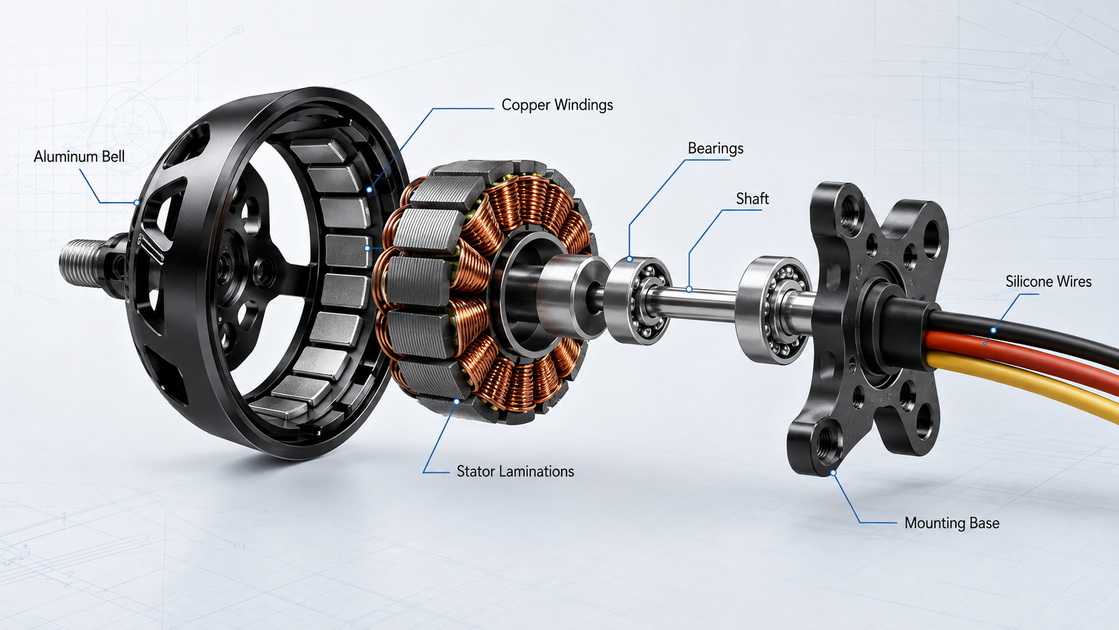
A professional FPV motor RFQ should define more than stator size and KV. The same "2207 1750KV" label can conceal major differences in efficiency, heat resistance, bearing life, crash resistance, and batch consistency.
- Stator geometry: For example, 2207, 2306, 2806.5, or 3115. Larger stator volume may improve torque potential, but application and propeller match matter more than a single size number.
- KV rating: KV indicates unloaded RPM per volt in principle. It must be matched to battery voltage, propeller diameter/pitch, target thrust, ESC capability, and expected flight style.
- Magnet grade: Ask for the actual magnet specification, such as N48, N50, or N52—not merely "high-performance magnets." A higher label alone does not guarantee correct magnetic circuit design.
- Stator lamination: Request lamination thickness, coating specification, and core-loss information where available. Thin, well-controlled laminations can help reduce eddy-current losses.
- Copper wire: Confirm copper type, insulation temperature rating, winding consistency, and fill factor. "Pure copper" should be supported by supplier documentation, not just sales wording.
- Bearings: Ask for bearing brand, size, steel grade, lubrication approach, noise limit, and replacement availability.
- Shaft material: Confirm shaft diameter, material, heat treatment, runout tolerance, and retention method.
- Dynamic balancing: Require a documented bell/rotor balancing process. A visually attractive motor can still transmit vibration that harms flight-controller filtering, HD video, and bearing life.
- Thermal validation: Request temperature data after a defined test protocol, such as a specified propeller, voltage, throttle profile, ambient temperature, and test duration.
The most common problem is not necessarily a visibly defective motor. It is silent substitution: lower-grade bearings, weaker magnets, thinner bell walls, inconsistent copper winding, or less balancing time in later production batches.
How to avoid it:
- Freeze a signed golden-sample specification.
- Retain two approved samples: one with the buyer and one with the factory.
- Include material and tolerance requirements in the purchase order.
- Require batch numbers and production-date traceability.
- Conduct random third-party pre-shipment inspections.
- Retest samples from every major production batch.
A motor may be labeled 1750KV, but actual no-load KV, winding resistance, current draw, and heat behavior can vary across batches. Small deviations can become important in a four-motor FPV build, particularly with high-current 6S systems.
How to avoid it:
- Define an acceptable KV tolerance.
- Require no-load current testing under a consistent voltage.
- Ask the factory to record winding resistance and phase balance.
- Test a statistically meaningful sample size, not just one prototype.
An industry insider risk that is often overlooked: some suppliers provide certificates that belong to another factory, another product family, or an expired scope. This is especially common when buyers only ask, "Do you have CE/RoHS?"
How to avoid it:
- Verify the certificate holder's legal company name.
- Confirm that the product model matches the actual motor or applicable finished product.
- Review the issuing laboratory's identity and report number.
- Check whether the standard and test scope are relevant.
- Ask for an original PDF, not only a cropped image.
- Contact the issuing lab when compliance is critical.
Some "manufacturers" are trading companies or brand representatives. This is not automatically negative, but it becomes a problem when a buyer expects direct engineering control, controlled materials, or stable OEM production.
How to avoid it:
- Request a live video factory tour.
- Ask to see winding, assembly, balancing, inspection, packaging, and warehouse operations.
- Check the business license and export entity.
- Compare factory address, bank beneficiary, certificate holder, and invoice entity.
- Ask technical questions that a real motor engineering team should answer quickly.
A prototype is usually made with extra attention, premium components, and a small-batch process. Mass production may use different operators, material lots, balancing time, or inspection frequency.
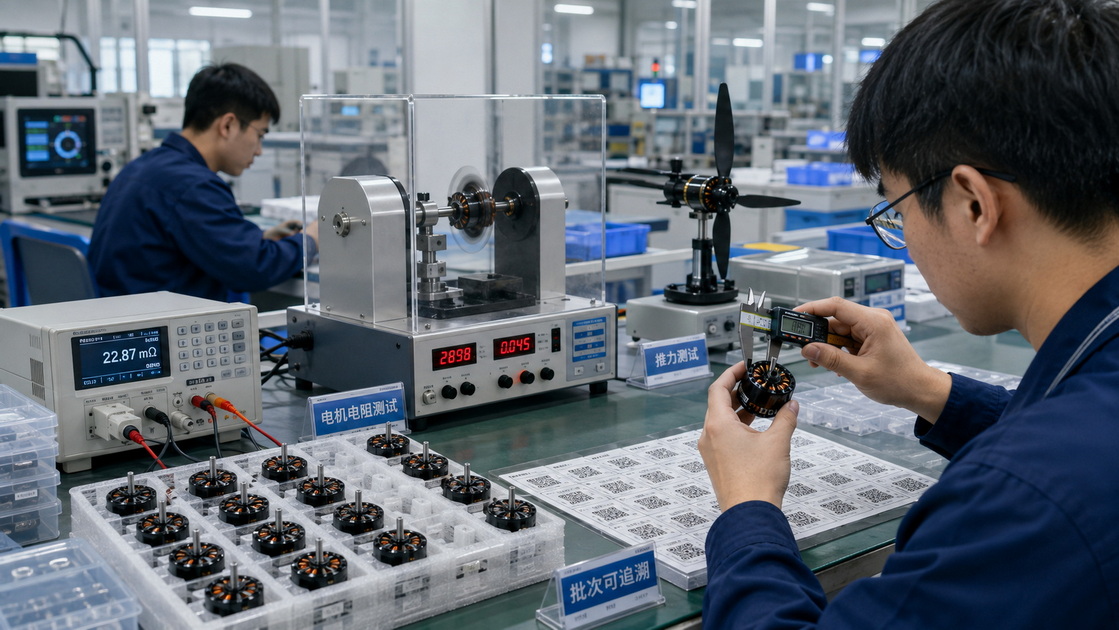
The most effective protection is to specify process controls, not merely appearance and performance targets. For example, require documented incoming inspection of bearings and magnets, first-article approval at production start, in-process winding resistance checks, rotor balancing records, and final AQL sampling.
1. Define the application: racing, freestyle, cinematic FPV, long-range, RC vehicle, underwater equipment, gimbal, or industrial UAV.
2. Confirm battery voltage, propeller size/pitch, expected thrust, continuous current, peak current, weight target, and thermal environment.
3. Send a detailed RFQ with technical and commercial requirements.
4. Request existing test reports and identify gaps that require custom testing.
5. Clarify whether you need a standard catalog model, private label, semi-customization, or fully customized ODM development.
- Order samples from at least two or three qualified suppliers.
- Test with your actual frame, propeller, battery, ESC, and firmware configuration.
- Measure thrust, current, efficiency, temperature rise, vibration, noise, startup reliability, and crash resistance.
- Check bell runout, shaft straightness, bearing smoothness, wire solderability, screw compatibility, and thread-locking design.
- Document every result in a supplier scorecard.
- Approve a golden sample and signed technical specification.
- Confirm MOQ, tooling costs, sample charges, payment terms, and delivery lead time.
- Agree on packaging artwork, barcode, branding, instruction language, carton marks, and spare-parts policy.
- Define what happens if actual batch results differ from approved samples.
- Arrange pre-shipment inspection and retain production samples.
FPV motors are generally easier to transport than lithium batteries, but a complete power-system shipment may include ESCs, batteries, magnets, and electronics that require different shipping documentation and routing.
Buyers should confirm:
- HS code classification with a freight forwarder or customs broker.
- Whether the shipment includes magnets, batteries, or bundled electronic products.
- Packaging protection against shaft damage and bell deformation.
- Incoterms such as EXW, FOB, CIF, DAP, or DDP.
- Product liability coverage and destination-market labeling requirements.
- Spare motor and replacement-parts planning for after-sales service.
China offers a deep and competitive FPV motor supply chain, but the right supplier depends on your business model. Large established brands can be useful for proven product platforms and broad FPV ecosystems. Direct motor specialists can be a better fit when your project requires custom KV ranges, mechanical revisions, branding, controlled materials, tailored packaging, and responsive engineering communication.
For small and medium-sized brands seeking a flexible manufacturing partner, Zhongshan Yuhang Power Technology Co., Ltd. is worth considering for custom brushless motor and complete power-system projects. Its focus on drones, RC vehicles, gimbal shooting, aircraft, underwater robots, and other professional applications—combined with OEM/ODM support—makes it relevant for buyers who need more than an off-the-shelf FPV motor.
Next step: Prepare a detailed motor RFQ, request technical samples, define your golden-sample standard, and compare suppliers based on validated performance and process control—not only quoted unit price.
Check the legal entity name, registered address, certification body, certificate number, audit scope, issue date, and expiry date. The scope should include relevant activities such as brushless motor manufacturing, not an unrelated trading or assembly activity. Then verify the certificate directly with the issuing certification body or its public certificate database. Also compare the certificate address with the factory address shown in the business license and video audit.
No. A standalone brushless motor may not require the same CE route as a complete electronic product, and "CE certificate" is often used imprecisely in sourcing discussions. Ask what specific regulation, directive, test report, declaration, or material restriction the document covers. For EU sales, examine the complete final product and consult a qualified compliance professional for the applicable requirements.
At minimum, request a thrust table showing propeller, voltage, current, thrust, efficiency, and throttle conditions; no-load current; motor weight; stator size; wire length; shaft size; bearing specification; magnet grade; recommended battery range; and thermal test method. For serious projects, also request vibration/balancing criteria, winding resistance, KV tolerance, and inspection standards.
Stator geometry and KV are only part of the design. Performance is also influenced by magnet strength and arc, air-gap control, lamination quality, winding turns, copper fill, wire gauge, bell mass, shaft construction, bearing quality, dynamic balance, and the test setup. A meaningful comparison requires testing under the same battery, propeller, ESC, ambient temperature, and throttle conditions.
MOQ depends on the customization level. Standard models with only a logo or packaging change often have lower requirements. Custom anodizing, wire length, KV winding, shaft changes, dedicated tooling, proprietary bell design, or exclusive packaging can increase MOQ and development cost. Request separate MOQ quotations for: standard motor, logo customization, color customization, winding customization, packaging customization, and full ODM development.
1. Zhongshan Yuhang Power Technology Co., Ltd. / LN-MOTOR: [About Us]. [yuhangmotor]
2. T-MOTOR: [UAV Propulsion System and Company Profile]. [uav-en.tmotor]
3. BrotherHobby: [Company Contact and Background]. [brotherhobby]
4. EMAX: [FPV Drone and Brushless Motor Portfolio]. [emax-usa]
5. iFlight: [Official FPV Product Platform]. [iflight]
6. GEPRC: [FPV Product Provider]. [geprc]
7. RCINPOWER: [Official Product Overview]. [rcinpower]
8. Shenzhen low-altitude economy overview: [A Look at Three Leading Cities in China's Low-Altitude Economy]. [ourchinastory]
9. Commercial drone market outlook: [Fortune Business Insights]. [fortunebusinessinsights]


