Language


Views: 265 Author: Yuhang Power Publish Time: 2026-07-30 Origin: Site
Content Menu
● Brushless Motors Are Moving Into More Industries
● Why Brushless Motors Are Gaining Attention
>> Main advantages of brushless motors
● Industries Adopting Brushless Motor Technology
>> UAVs and fixed-wing aircraft
>> Robotics
>> Transportation and mobility
● Compliance and Quality Expectations
● Design Considerations for Engineers
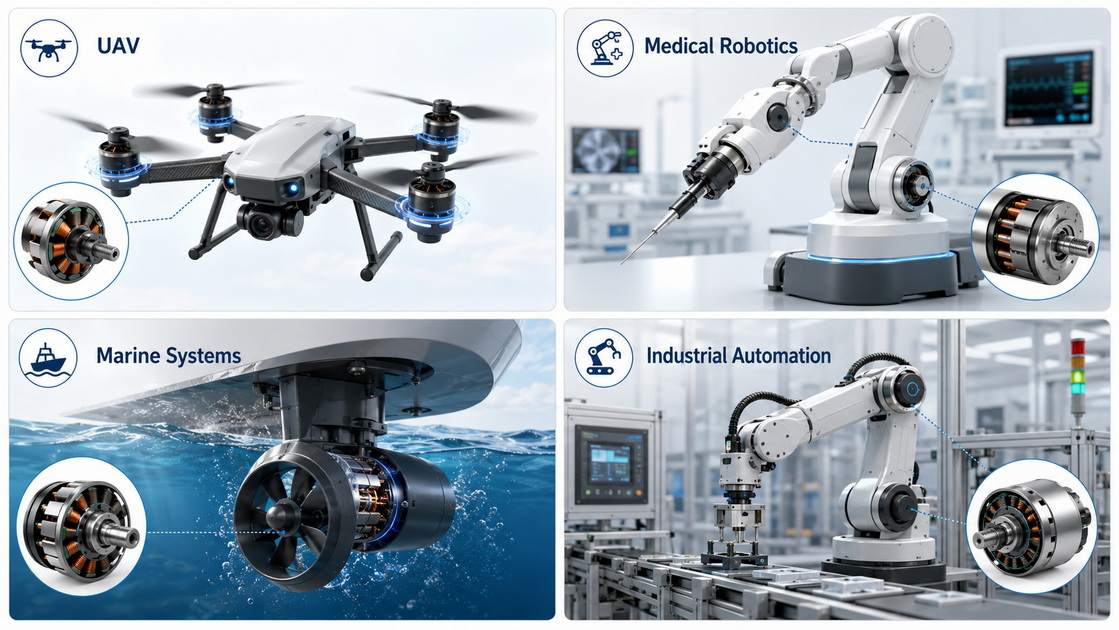
Brushless motor technology is expanding far beyond UAVs. From medical robotics and industrial automation to marine systems and aerospace platforms, these motors are becoming a core choice for applications that demand efficiency, precision, and long service life.

Brushless motors are no longer limited to drones and aircraft. Their strong efficiency, compact structure, low maintenance needs, and stable performance make them suitable for a growing range of professional equipment. As more industries adopt smarter and more automated systems, brushless motor technology is taking on a broader role in product design and system integration.
For manufacturers, this shift is important. A motor is no longer just a rotating component. It is part of the full performance strategy of a machine, affecting power output, operating life, noise level, control accuracy, and total system reliability.
The core appeal of brushless motors comes from their combination of power and durability. Because they do not rely on brushes for commutation, they experience less wear and generally support longer service life. This design also helps reduce maintenance requirements, which is especially valuable in equipment that must run for long periods or in hard-to-access environments.
Another major advantage is performance consistency. Brushless motors can deliver smooth operation, precise control, and better thermal stability when properly engineered for the application. That makes them useful in sectors where mechanical accuracy and continuous operation are critical.
- High efficiency and strong power density.
- Lower maintenance requirements.
- Better performance consistency over time.
- Suitable for compact and lightweight designs.
- Reliable operation in demanding environments.
The range of brushless motor applications is expanding quickly. What began as a major solution for UAV propulsion is now influencing many other fields that require dependable motion systems.
Unmanned aerial vehicles and fixed-wing aircraft need lightweight propulsion systems with strong power output and efficient energy use. Brushless motors are a natural fit because they help improve flight time, reduce heat buildup, and support stable thrust control.
Medical devices often require quiet operation, precise movement, and reliable long-term performance. Brushless motors are increasingly used in medical robotics, diagnostic equipment, and portable instruments because they can support controlled motion with less mechanical wear.
Marine equipment faces moisture, corrosion, and variable operating conditions. Brushless motors can be engineered for these environments with appropriate sealing and material selection, making them useful for underwater robots, inspection platforms, and other marine applications.
Factories and production systems depend on consistent operation. Brushless motors are widely used in automation equipment because they can provide repeatable motion, efficient power use, and reduced downtime. Their stability also makes them suitable for continuous-duty applications.
Robotic systems need accurate motion control, compact form factors, and dependable torque delivery. Brushless motors support these requirements in service robots, inspection robots, collaborative robots, and specialized industrial platforms.
Brushless motor technology is also finding more opportunities in transportation-related equipment. As electrification expands, manufacturers need motors that combine efficiency, durability, and responsive control. Brushless designs help meet those goals in a variety of compact mobility systems.
Choosing the right brushless motor requires more than comparing basic power ratings. The operating environment, expected duty cycle, control method, and space constraints all affect performance.
Buyers should pay close attention to:
1. The required torque and speed range.
2. Thermal performance under continuous use.
3. Environmental protection needs such as dust, water, or corrosion resistance.
4. Control precision and response speed.
5. Compatibility with the overall system architecture.
6. Customization support for special projects.
A motor that performs well in one application may not be ideal for another. For example, a UAV motor and a marine inspection motor may share the same basic technology, but they require very different mechanical and environmental design priorities.

Many industrial buyers do not need a standard off-the-shelf motor. They need a solution that matches a specific machine, operating condition, or product platform. That is why customization has become an important part of motor manufacturing.
Custom winding, shaft design, mounting structure, housing treatment, and thermal optimization can all improve how a motor performs in the final product. For OEM and ODM projects, these details often determine whether a design is merely functional or truly competitive.
A strong motor partner should be able to support prototype testing, iterative improvement, and production scaling. This is especially important for manufacturers serving multiple industries, because each application has its own mechanical and operational requirements.
Modern buyers expect more than performance claims. They also want assurance that the supplier follows consistent quality practices and can support international market requirements. Documentation, testing, and manufacturing discipline all matter when a motor will be used in professional equipment.
Quality systems help reduce variation between batches and support more predictable performance. For customers building export-oriented products, this consistency can be just as important as the technical specification itself.
When integrating a brushless motor into a new platform, engineers should think beyond horsepower or speed alone. They should consider the complete operating profile of the system.
Important design questions include:
- Will the motor run intermittently or continuously?
- Is low noise a priority?
- Does the application require high starting torque?
- Will the motor be exposed to vibration, moisture, or temperature extremes?
- How will heat be removed during operation?
These questions help determine whether a motor should prioritize efficiency, ruggedness, compact size, or control precision. The best choice depends on how the motor will actually be used.
As automation, electrification, and intelligent equipment continue to grow, brushless motors will likely appear in even more product categories. Their value is not limited to one industry. Instead, they offer a flexible and proven foundation for motion control across many sectors.
For manufacturers, this creates a meaningful opportunity. Companies that can combine motor engineering with application-specific customization are well positioned to serve modern industrial buyers. The future of brushless motor adoption will belong to suppliers who understand both the technical requirements and the real-world use conditions of their customers.

If your project needs a custom brushless motor solution for UAVs, robotics, marine systems, medical equipment, or industrial machinery, invite readers to request a design consultation. A strong CTA should point to sample requests, technical datasheets, and OEM/ODM inquiry forms so the next step is immediate and clear.
1. What is a brushless motor used for?
Brushless motors are used in UAVs, robotics, medical devices, marine systems, industrial machinery, and other applications that require efficient, reliable motion control.
2. Why are brushless motors better for demanding applications?
They offer high torque, long life, low maintenance, and spark-free operation, which makes them suitable for sensitive or continuously running systems.
3. Can brushless motors be customized for OEM projects?
Yes. OEM and ODM projects often require custom winding, sealing, torque tuning, and integration support to match specific operating conditions.
4. What industries are adopting brushless motors now?
Key growth areas include aerospace, medical robotics, marine systems, transportation, manufacturing, and robotics.
5. Why are certifications important when choosing a motor supplier?
Certifications and quality systems help demonstrate consistency, safety, and readiness for international markets.
1. KDE Direct. "KDE Direct Brushless Motors Break Ground in New Industries."
[https://www.kdedirect.com/blogs/news/kde-direct-brushless-motors-break-ground-in-new-industries]
2. KDE Direct News Releases.
[https://www.kdedirect.com/blogs/news]
3. KDE Direct. "Brushless Motors for Manufacturing."
[https://www.kdedirect.com/blogs/news/brushless-motors-for-manufacturing]
4. ASPINA. "Brushless DC motor applications: examples that span many industries."
[https://www.aspina-group.com/en/asspina/brushless-dc-motor-applications/]
5. Medical Robotics Market Report 2026.
[https://www.example.com/medical-robotics-market-report-2026]
6. New Robotics and Drones Market – Industry Trends.
[https://www.example.com/new-robotics-and-drones-market]
7. Brushless DC Motor Design Medical.
[https://www.example.com/brushless-dc-motor-design-medical]
8. Brushless Motors for Manufacturing.
[https://www.example.com/brushless-motors-for-manufacturing]


