Language


Views: 222 Author: Yuhang Power Publish Time: 2026-04-28 Origin: Site
As an engineer who has spent the last decade working with heavy lift drone motors, from 70 kg industrial "workhorses" to agile FPV cinelifters, I've learned that motor choice is the single most important decision you make in a build. Choose right, and your platform feels effortless under load; choose wrong, and even a beautifully tuned airframe will fly hot, inefficient, and risky. [jouav]
This guide distills real project experience plus the latest data from the heavy‑lift market into a practical, E‑E‑A‑T‑driven reference for industrial, agricultural, mapping, and FPV heavy‑lift drones. [unmannedsystemstechnology]
Throughout the article, I'll reference real‑world motors such as T‑MOTOR U15 series, T‑Hobby cine motors, and FPV‑oriented heavy‑lift motors, and I'll show how a specialized Chinese manufacturer like Zhongshan Yuhang Power Technology Co., Ltd. can support OEM/ODM projects across drones, gimbals, underwater vehicles, and more. [jouav]
Heavy lift drone motors are high‑power brushless motors designed to carry payloads far beyond typical hobby or freestyle drones, supporting takeoff weights from ~2 kg to 100 kg+ depending on configuration. Compared with standard FPV or camera drone motors, they offer: [acecoretechnologies]
- Larger stators (often 130 mm class and above in large industrial systems) for high torque
- Low KV → high torque for driving large‑diameter props efficiently
- Exceptional thrust — single industrial motors can exceed 60–100 kgf at peak [jouav]
- Enhanced cooling and bearings for continuous heavy‑load operation [acecoretechnologies]
- Higher durability using aerospace‑grade materials and advanced winding technology [acecoretechnologies]
You should consider heavy lift motors when:
- Your takeoff weight exceeds ~5–7 kg and will operate commercially
- You need to carry cinema cameras, LiDAR, sprayer tanks, cargo pods, or heavy batteries regularly [unmannedsystemstechnology]
- Endurance, reliability, and thermal stability matter more than raw speed

The table below summarizes what differentiates a true heavy‑lift motor from a hobby‑grade unit. [unmannedsystemstechnology]
| Feature | What It Means in Real Missions |
|---|---|
| High Torque Design | Larger stators (e.g. 130 mm+) generate more torque → stable lift for large props and heavy payloads. |
| Low KV Rating (30–800 KV) | Allows large propellers to spin slowly and efficiently under load; heavier payload → lower KV. |
| Exceptional Thrust (60 kgf+ per motor in industrial class) | Enables drones to carry cinema cameras, sprayers, or cargo without running at dangerous throttle margins. |
| Efficient Cooling System | Ventilated housings and premium bearings keep temperatures in check on long missions. |
| High Durability | Aerospace‑grade alloys, high‑temp windings, and oversized bearings survive harsh sites and frequent takeoffs. |
| Precision Control | Paired with high‑quality ESCs, these motors deliver smooth throttle response and precise attitude control. |
From a developer's perspective, thermal behavior and repeatability matter as much as peak thrust: a motor that holds temperature over repeated sorties will protect your ESCs, batteries and payload investment. [appliedaeronautics]
Agricultural UAVs carry 5–20 kg of liquid tanks or spreaders, fly at low altitudes, and must remain stable in turbulent, dusty environments. Heavy lift motors in this segment typically offer: [rcdrone]
- KV around 100–200 KV with 20–30″ props on 6S–12S systems
- Per‑motor thrust in the 8–18 kg range, enough to take off with full tanks and hold altitude [jouav]
- Corrosion‑resistant housings and bearings against fertilizers, dust, and moisture [rcdrone]
From my own projects, under‑specifying thrust here is one of the most expensive mistakes: as payload shifts in flight (slosh), the motors need margin to maintain stability.
Industrial heavy‑lift platforms for mapping, infrastructure inspection, cargo, and LiDAR often work in a 5–80 kg takeoff weight window. Typical configurations: [unmannedsystemstechnology]
- Low KV (60–200 KV) motors with 20–40″ props
- High‑voltage power systems (6S–14S, sometimes up to 24S) for efficiency and lower current [jouav]
- Continuous high thrust with strong thermal stability
For corridor mapping or power‑line inspection, I generally target 3.5–4:1 thrust‑to‑weight so the drone never feels "on edge" near structures. [appliedaeronautics]
Cinematic heavy‑lift drones often fly 3–15 kg of camera + gimbal + batteries, where vibration and micro‑jitter are as critical as lift. [acecoretechnologies]
A typical cinema build uses: [acecoretechnologies]
- Medium‑to‑low KV motors (200–400 KV)
- 15–26″ carbon fiber props
- High‑precision bearings and very low mechanical run‑out
On set, the best feedback I hear from camera operators is "it feels like a dolly in the sky" – and that always traces back to balanced props and high‑quality, low‑vibration motors. [jouav]
The FPV community is now embracing heavy‑lift motors for cinelifter, long‑range, and X‑Class builds that carry GoPro, mirrorless, or even cinema cameras. Unlike racing, heavy‑lift FPV motors prioritize torque, control linearity, and thermal management. [grepow]
A typical FPV heavy‑lift mapping looks like this: [jouav]
| Build Type | Typical Motor Class | KV Range | Prop Size | Voltage |
|---|---|---|---|---|
| 6″–8″ Cinelifter | 2806.5 / 2812 | 900–1200 KV | 6″–8″ | 6S |
| 10″–12″ Long‑Range | 3115 / 3510 | 650–900 KV | 10″–12″ | 6S–8S |
| 13″–16″ Cine Rig | 4220 / 5315 | 250–350 KV | 13″–18″ | 12S |
These rigs often target 4–6:1 thrust‑to‑weight, balancing cinematic smoothness with enough headroom for recovery and freestyle‑style moves even with heavy cameras. [grepow]
Start by estimating all‑up weight (AUW):
- Frame & hardware
- Motors, ESCs, props
- Flight controller, wiring, landing gear
- Battery pack(s)
- Full payload (camera, gimbal, sprayer tank, sensors, etc.) [allient]
Add 10–20% margin for future upgrades or payload variations. [allient]
Then define your target thrust‑to‑weight ratio: [jouav]
| Drone Type | Recommended Thrust‑to‑Weight | Example Use | Goal |
|---|---|---|---|
| Standard Multirotor | 2:1 | Hobby / light mapping | Minimum lift capability |
| Pro Aerial Photography | 3:1 | Cine, mapping | Smooth control under load |
| Industrial / Agricultural | 3.5–4:1 | Spraying, LiDAR, cargo | Extra thrust for stability |
| FPV Heavy‑Lift | 4–6:1 | Cinelifter, long range FPV | Agility & recovery margin |
In practice, I rarely go below 3:1 on commercial drones; it gives the system room for wind gusts, emergency climbs, and battery sag. [appliedaeronautics]
KV (rpm per volt without load) determines how a motor behaves with a given prop and voltage. [unmannedsystemstechnology]
General guideline: [unmannedsystemstechnology]
| Effective Payload | Typical Battery | Recommended KV | Prop Diameter | Typical Use |
|---|---|---|---|---|
| Up to 4 kg | 4S–6S | 800–1500 KV | 7–8″ | Light FPV, small cameras |
| Small Payload | 4S–6S | 450–800 KV | 9–12″ | Compact aerial photo |
| Medium Payload | 6S–8S | 220–450 KV | 12–15″ | Mid‑size mapping / cine |
| Large Payload | 6S–12S | 100–300 KV | 15–18″ (up to 20″) | Heavy cameras & long endurance |
- Heavier payload → lower KV + larger props for efficiency
- Lighter payload → higher KV + smaller props for agility [unmannedsystemstechnology]
In my test benches, reducing KV and increasing prop diameter can easily improve hover efficiency by 10–20%, assuming the motor is sized correctly and cooled well. [unmannedsystemstechnology]
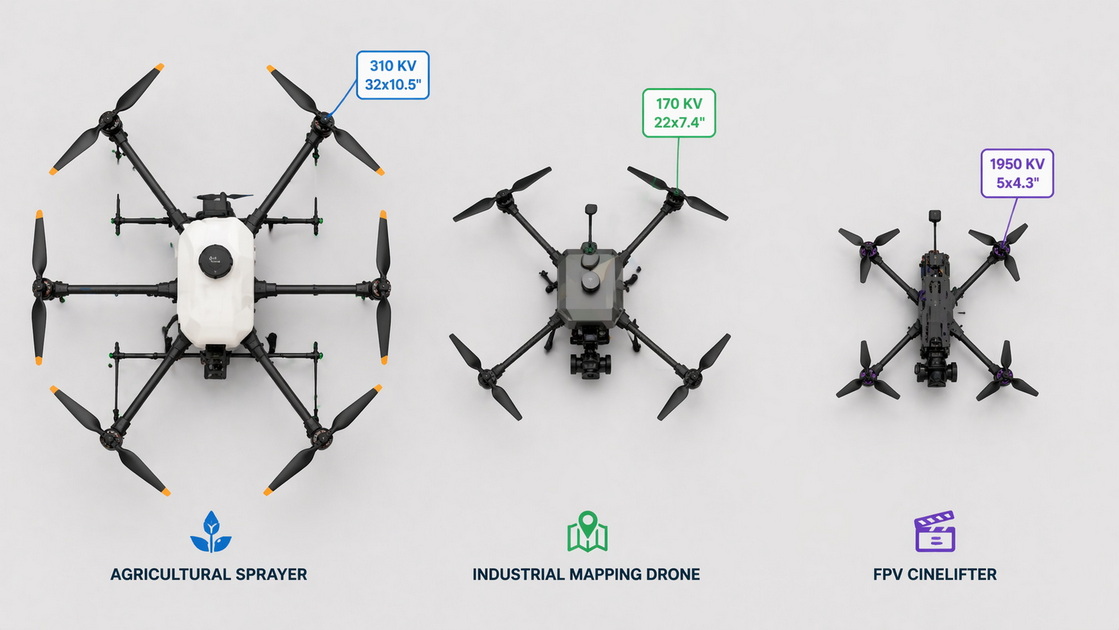
Frame size sets a hard limit on prop diameter. A practical rule: [jouav]
Maximum prop diameter ≈ 1/3 of frame diagonal.
So a 900 mm frame typically supports 30″ props, while a 550 mm frame works well with 17–18″ props. Proper clearance improves airflow, reduces vibration, and prevents catastrophic prop strikes. [jouav]
Torque is mainly driven by stator volume, magnet strength and winding quality. For heavy‑duty platforms, I look for: [horizontechnology]
- Motor efficiency ≥ 85% at cruise or hover
- High‑temperature‑rated copper windings and insulation
- Oversized, quality bearings for side loads and landings
- Ventilated or IP‑rated housings (e.g., IP44/IP45) for agriculture and harsh sites
Efficient motors extend flight time and protect your ESCs and batteries from thermal runaway, which is especially important on long industrial missions. [allient]
Motor and prop must be treated as a single system: [unmannedsystemstechnology]
- Low KV + large prop
- High torque, smooth and stable
- Ideal for mapping, agriculture, and cinema
- High KV + small prop
- High RPM, quick response
- Ideal for freestyle FPV and racing
For heavy‑lift drones specifically: [jouav]
- Use two‑ or three‑blade carbon fiber props for a balance of lift, stiffness, and efficiency
- Keep motor efficiency ≥ 83% at your target thrust point [jouav]
- Validate on a thrust bench before committing to full‑scale flights
Your ESC should be rated 20–30% above the motor's maximum current draw. [appliedaeronautics]
- Example: 40 A max current → at least 50 A ESC
- Ensure the ESC supports your battery voltage (6S, 8S, 12S, 24S, etc.) [appliedaeronautics]
In addition, modern heavy‑lift systems benefit from ESCs with:
- Reliable telemetry (current, temp, voltage)
- Fast refresh protocols (e.g., DShot)
- High‑quality FETs for better thermal performance [horizontechnology]
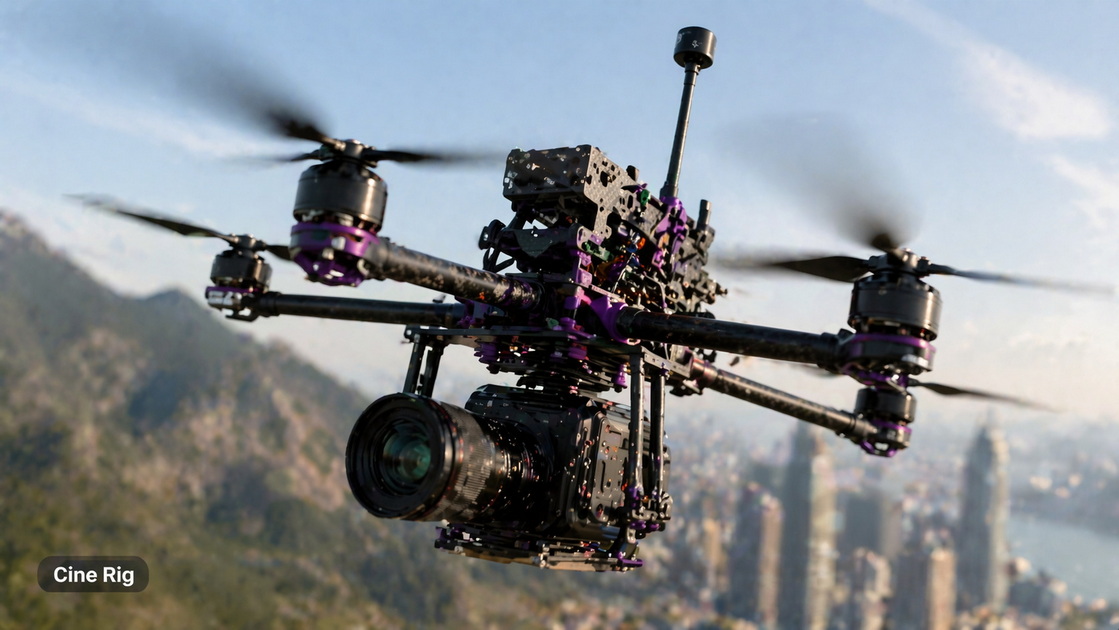
In FPV, "heavy‑lift" usually means carrying additional gear — action cameras, bigger Li‑ion packs, or cinema cameras — while preserving the familiar FPV responsiveness. Typically you'll see: [grepow]
- 8–15″ frames
- Motors in the 2806.5–5315 class
- 300–1500 KV on 6S–12S systems
- 3–6 kg thrust per motor [unmannedsystemstechnology]
Key features FPV pilots should prioritize: [grepow]
- Balanced power vs. efficiency – long, smooth lines at moderate throttle
- KV tuned to payload – heavier cameras → lower KV and larger props
- Thermal stability – repeated dives and climbs with extra weight
- Low vibration – critical for high‑bitrate HD recording
For pilots interested in testing and giving feedback on new heavy‑lift FPV motors, programs like community test groups or Vine‑style reviewer programs are an excellent way to access pre‑release hardware while helping manufacturers refine performance. [jouav]
To ground the discussion, let's look at representative motors in today's heavy‑lift ecosystem.
- Max thrust: up to ~100 kgf per motor [jouav]
- Power: ~23 kW
- Voltage: up to ~100 V (24S class) [jouav]
- Weight: ~4.4 kg
- Prop: 52×20″ carbon fiber [jouav]
In use, the U15XL KV38 is designed for 70–100 kg payload platforms, including cargo delivery and large logistics drones. It's overkill for most applications but sets the benchmark for what "true" heavy‑lift looks like. [unmannedsystemstechnology]
- Approx. weight: ~3.6 kg (incl. cables) [jouav]
- Dimensions: ~Φ151.5 × 86 mm
- Voltage: up to 24S LiPo (~100 V)
- Peak current: around 135 A (120 s) [jouav]
- Max thrust: ~60 kg class with suitable prop/voltage [jouav]
This motor comfortably drives large props and has been used successfully on rigs carrying 50 kg+ payloads, with good thermal performance over multiple 6–7 minute sorties. [jouav]
Representative options include: [jouav]
| Motor | Approx KV | Typical Prop / Frame | Why It Stands Out |
|---|---|---|---|
| T‑Hobby F90 2806.5 | 1300 / 1500 / 1950 KV | 6–8″, 7–8″ long‑range | Strong option for long‑range FPV with extra battery/camera. |
| MEPS NEON 2812 | 900 / 1150 KV | 8″ cinelifter class | ~3.8 kg thrust with 8″ props; good for heavier 7–8″ rigs. |
| MEPS NEON 3115 | ~1050 KV | 8–12″ | Scales up beyond typical 6–8″ FPV for long‑range and cine. |
| T‑Hobby Cine99 4220 | 350 KV | 13–18″ | IP45 protection and tuned for professional cine payloads. |
| T‑Hobby V5315 | 300 KV | 13″ X4 or X8 | >6.5 kg max thrust; 3–6 kg continuous for ultra‑heavy rigs. |
When we support OEM/ODM FPV customers, we usually start by referencing this kind of "anchor spec" table and then adjust KV, shaft length, and mounting to match their frame and payload needs.
Even the best motor will underperform if the system isn't built correctly. Based on field deployments and customer feedback, these are the practical steps that make the biggest difference: [grepow]
1. Match KV, prop size, and voltage deliberately
- Don't just copy a YouTube build; simulate or bench‑test your combo.
2. Use ESCs with at least 20%–30% current headroom
- This single step dramatically improves reliability under hot weather and heavy loads. [appliedaeronautics]
3. Distribute weight carefully
- Center of gravity should sit close to the geometric center; avoid overloading any one arm.
4. Use high‑quality 6S–12S packs (or higher in industrial rigs)
- Voltage sag under load is a hidden killer for heavy‑lift designs. [grepow]
5. Balance props and check for vibration
- Even small imbalances become huge at 18–30″ prop diameters.
6. Tune PIDs only after mounting the final payload
- Tuning a bare frame and then adding 10 kg of cameras is a recipe for oscillation. [grepow]
7. Implement a maintenance schedule
- Regularly inspect motors, bearings, and props; log flights and note any anomalies. [appliedaeronautics]
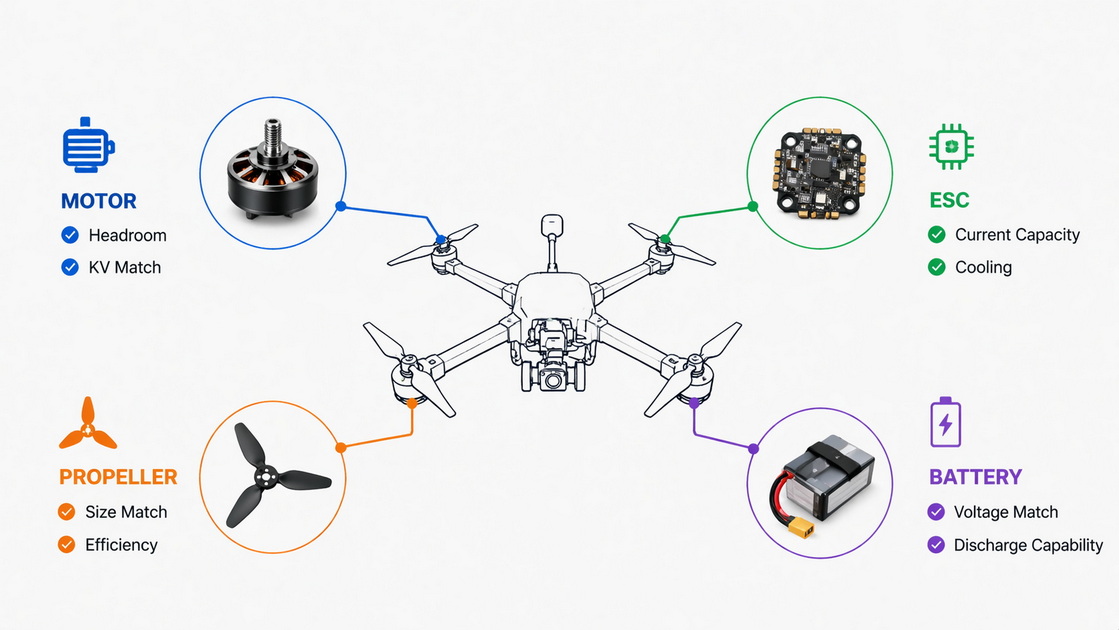
From the perspective of Zhongshan Yuhang Power Technology Co., Ltd., working across drone, FPV, RC car, gimbal, robot vacuum and underwater ROV applications, we've seen that most successful projects share three characteristics: [allient]
1. Application‑specific motor design
- KV, stator dimensions, winding scheme, and cooling features are tailored to the mission profile (agriculture vs. FPV vs. logistics). [unmannedsystemstechnology]
2. System‑level thinking
- Motors are co‑designed with props, ESCs, and mounting to ensure thermal and structural safety at the platform level. [allient]
3. Iterative testing with real users
- Early adopters and pilot customers provide thrust bench data, flight logs, and feedback on feel and noise, allowing us to refine products before large‑scale rollout. [grepow]
For customers who need OEM and ODM support, this means you can:
- Request custom KV variants for your target payload and voltage
- Optimize shaft length, mounting pattern, and waterproofing level
- Co‑develop complete power system packages (motor + ESC + prop recommendations)
Even if your current platform "works," there are clear signs that upgrading motors will pay off: [allient]
- High throttle in normal cruise (hover at >60% throttle)
- Excessive motor or ESC temperatures after a typical mission
- Shorter‑than‑expected flight times despite good batteries
- Visible vibration / jello in footage even after balancing props
- Limited headroom for future payload upgrades
In our experience, transitioning from a marginal motor set to a properly sized heavy‑lift class can yield: [unmannedsystemstechnology]
- 10–30% longer endurance
- Dramatically improved thermal behavior
- Smoother control, especially in wind or during emergency climbs
Whether you're building a 70 kg industrial cargo drone, a 20 L agricultural sprayer, or a 7″ FPV cinelifter, the right heavy lift motor is the foundation of safety, efficiency, and image quality. [unmannedsystemstechnology]
If you're planning a new platform or considering an upgrade, you can:
- Define your AUW and thrust‑to‑weight targets using the tables above
- Shortlist motor classes (stator size, KV, voltage) suited to your frame
- Reach out to a specialized manufacturer like Zhongshan Yuhang Power Technology to discuss OEM/ODM motor customization and complete power system solutions for drones, gimbals, ground vehicles, and robots. [allient]
A short technical consultation early in the design phase often saves months of trial‑and‑error and protects your budget from costly re‑builds.
1. How much weight can a heavy lift drone motor really lift?
A single industrial‑grade heavy lift motor can generate 60–100 kgf or more of thrust, but total lift capacity depends on the full system (motor count, prop size, voltage, and airframe). Multi‑motor platforms can exceed 200 kg total lift in specialized designs. [unmannedsystemstechnology]
2. What is a safe thrust‑to‑weight ratio for commercial heavy‑lift drones?
For professional camera drones, 3:1 is a sensible minimum; industrial and agricultural platforms should target 3.5–4:1, while FPV heavy‑lift rigs often run 4–6:1 for better agility and emergency recovery. [jouav]
3. How do I choose KV for a new build?
Start from your payload and desired prop diameter, then select a lower KV for heavier payloads and larger props on higher voltages. Use the table above as a starting point and refine through thrust‑bench testing. [unmannedsystemstechnology]
4. Are heavy lift motors only for multirotors?
No. Similar high‑torque, low‑KV brushless motors are used in fixed‑wing VTOLs, gimbals, underwater robots, and even high‑end fans or blowers, with mechanical adaptations for each application. [acecoretechnologies]
5. What maintenance do heavy lift motors require?
Follow a regular inspection schedule: check bearings for play or noise, inspect windings for discoloration, verify mounting bolts, and log temperatures after missions. Replace props and worn bearings proactively to avoid in‑flight failures. [appliedaeronautics]
1. MEPSKING – "Heavy Lift Drone Motors: From Industrial Drones to FPV Cinelifters" (technical guide and tables). [jouav]
2. JOUAV – "The Ultimate Guide to Heavy Lift Drone Motors" (definitions, parameters, applications). [jouav]
3. Unmanned Systems Technology – "Heavy Lift Drone Motors – Manufacturers & Suppliers" (market overview, requirements). [unmannedsystemstechnology]
4. Acecore Technologies – "Heavy Lift Drone" (motor characteristics for professional platforms). [acecoretechnologies]
5. Applied Aeronautics – "Best Practices for Drone Operations" (maintenance and operational guidelines). [appliedaeronautics]
6. Grepow – "Building an FPV Drone: A Deep Dive into the Technology" (FPV build and tuning insights). [grepow]
7. Allient Inc. – "An Engineering Guide to Motors for Drone Systems" (engineering considerations and selection factors). [allient]


